“For if you keep silent at this time, relief and deliverance will rise for the Jews from another place, but you and your father’s family will perish. Who knows? Perhaps you have come to royal dignity for just such a time as this.”
—Esther 4:14
The book of Esther in the Bible is a story about calling, or ”vocation,” we like to say, at Lutheran colleges and universities. It’s a story about a calling that Esther discovers by understanding herself, understanding the moment, and seizing an opportunity.
In case you’re new to the book of Esther, or need a refresher, here’s a quick synopsis of the story:
Esther, a Jew, has been appointed queen by the King of Persia.
The king’s advisor, Hamaan, is plotting to have every Jew in the empire killed because Esther’s cousin, Mordecai, refuses to bow down and worship Hamaan, and that has left a bad taste in Hamaan’s mouth for all Jews.
Mordecai, knowing that his cousin, now Queen Esther, holds a unique (perhaps even providential) place in the kingdom, convinces Esther that she is the one called to use her influence to save her people from destruction.
Mordecai speaks that famous line to Esther: “Perhaps you have come to royal dignity for just such a time as this.”
The story has a predictably happy ending. Esther reveals her Jewish identity, and Hamaan’s heinous plot to the King, and Esther and her people are saved.
The title of our conference is “Vocation of Lutheran Higher Education,” which suggests that it is not just individuals, like Esther or you or me who have a vocation; but that institutions, and even whole enterprises; this broad thing called “Lutheran Higher Education,” has a calling.
And perhaps the vocation of Lutheran Higher Education, perhaps the calling of my beloved institution, and yours, is for just such a time as this.
We like to say that no other kind of institution is better positioned for such a time as this. We want to believe that we are the special ones. In the midst of challenges facing enrollment and finances, in the midst of changes in young adults, staffing, technology, educational models, values, the list goes on…perhaps our colleges and universities have been called to and for this very moment.
But what is it in particular that sets our institutions apart, and sets us up for this time and this calling?
We could quote Rooted and Open here, and list all the buzz words: liberal arts, freedom from and for, intellectual humility, service of neighbor, hospitality.
But there’s another idea that we don’t talk about all that much. And it may just be the thing that positions our colleges and universities best for this moment. It is the very Christian, very Lutheran notion of death and resurrection.
And just like “rooted and open,” the hardest word in the phrase “death and resurrection” is the word “and.”
Death and resurrection. It’s both.
We are so often tempted into either/or thinking. Especially about death and resurrection. Either we live or we die. We flourish or we fail. It’s one or the other.
But Jesus always says it’s both. We don’t have life without death. We don’t have success without failure. And every end is met with a beginning. Everything old is met with something new that God is doing.
Death and Resurrection. Finding life and losing it. The “and” is the hardest part.
But ask any person, at any of our NECU institutions, and they are doing it. They’ll tell you a story about how their institution is dying and how it is finding new ways to live. How their students are thriving and they are floundering.
I don’t know of other kinds of institutions that can say this with the same honesty or the same hope. We live and we die. There is truth and promise in both.
Esther discovered her calling by understanding herself, understanding the moment, and seizing an opportunity.
Those last two we’re pretty good at. We understand the moment, the stakes, and we’re ready to seize every opportunity.
The reminder we need now is to understand ourselves; what it is that is distinctive about us as leaders, and about our institutions, that calls us into this very moment.
For Esther it was understanding her identity as a Jew.
For us it is understanding our colleges and universities as places founded on and fueled by faith. It is not lost on me that the book of Esther never once mentions God, which maybe gives us license not to talk about God too much at our institutions either. To be sure, at many of our schools it is becoming rarer and rarer to hear God’s name uttered…and when we do talk about our church-relatedness, we prefer to emphasize “Lutheran” over “Christian,” which I think is helpful to some of us because “Lutheran” feels, oddly, more specific and less specific at the same time.
But Esther needed reminders of her identity, and we do too. And I am of the (sometimes unpopular) opinion that naming God, out loud, as an active subject at our institutions is a good way to remind ourselves and others of who we are.
Friends, we are spiritual people. We are God’s people. Our institutions are Christian places, even if the majority of the people who live and work and learn there aren’t Christians. Our colleges and universities are not churches, but they are places where God is at work; where God is doing death and resurrection work. And the callings we have, they don’t come to us out of thin air. Someone is doing the calling. We believe that it is God who calls us. We can, and should, give God credit for that.
For just such a time as this. We are called. By God. To live, to die, and to live again.
-
 Editorial
From the Publisher
Lamont Anthony Wells
5 min audio
Wells frames the issue as a record of the 2025 VLHE Conference at Augsburg under the theme “Ethical Leadership in a Changing World,” arguing that vocation is never solitary but a collective, public witness of ethical formation, theology and care, flourishing and belonging, and leadership rooted in God’s grace.
-
Editorial
From the Editor
Colleen Windham-Hughes
5 min audio
Windham-Hughes plays on the shared Latin root of “education” and “seduction” (ducere, to lead) to warn against the No-saying seductions of giving up or condemnation, and to call educators to the riskier Yes of showing up to build third-space communities of truth-telling and hope.
-
Article
Wake Up Running! A Call to Ethical Leaders in Quest of Democratic Space
Walter Earl Fluker
44 min audio
Abridged from his VLHE keynote, Fluker draws on Habakkuk and Octavia Butler’s Parable of the Sower to call a new generation of ethical leaders to “wake up running” toward democratic futures, packing their runaway bags with love-filled-justice, grace-filled-empathy, and hope-filled-resiliency for the soul-filled work the moment requires.
-
Article
Building a Third Space in the Age of AI: A Conversation with Dr. Walter Earl Fluker
Elizabeth Kubek
11 min audio
Prompted by AI chatbots being marketed to students as a safer alternative to messy human relationships, Kubek interviews Fluker on how Howard Thurman’s vision of common consciousness, somaesthetics, and nature-rooted learning offers educators a “third space” alternative to AI’s hall of mirrors.
-
Article
Ethical Leadership: Rooted, Open, Generative, and Mindful
John Arthur Nunes
25 min audio
As he prepares to teach an Ethical Leadership First Year Seminar at California Lutheran, Nunes organizes his pedagogy around three mutually-reinforcing “turns” — inward, outward, and intellectual — grounded in Luther’s mandatum dei and larvae dei, Bonhoeffer’s estates, and Howard Thurman’s call to hear “the sound of the genuine” in oneself.
-
Article
Ethical Leadership for a Changing World: A Shared Calling from Cradle to Career
Cory Newman, Janelle Rozek Hooper
5 min audio
Hooper and Newman recount how an ELCA Barna survey on early childhood education sparked the realization at VLHE 2025 that ELCA colleges and the 1,200 Lutheran schools and early learning centers share identical challenges — and an untapped potential to form ethical leaders across the full educational continuum from cradle to career.
-
Article
What is Required of You?: Higher Education Leadership in a Moral Key
Paul C. Pribbenow
15 min audio
Drawing on Micah 6:8 and Stephen Carter’s “etiquette of democracy,” Pribbenow describes the three things Augsburg requires of every incoming student — show up, pay attention, and do the work — as a democratic social ethic that prepares students for engaged citizenship in a fractured public life.
-
Article
What Does Ethical Leadership in a Changing World Require?
Kristina Frugé
5 min audio
Frugé argues that ethical leadership in a changing — perhaps ending — world means cultivating trustworthy communities through patient, co-created relationship work, drawing on her experience stewarding the writing community behind Hungry for Hope: Letters to the Church from Young Adults.
-
Article
Fostering Moral Imagination and Inclusivity: The Role of Ethical Leadership in ELCA Colleges and Universities Amid Societal Challenges
Lamont Anthony Wells
12 min audio
Wells argues that “moral imagination” — the capacity to envision ethical alternatives, empathize across difference, and respond creatively to injustice — is the heart of ethical leadership in NECU institutions, and that anchoring leadership in this principle positions Lutheran higher education to cultivate socially responsible citizens.
-
 Editorial
From the Editor
Tom Christenson
No. 8 · Winter 2000
Christenson marks the eighth edition of Intersections, expresses gratitude to the ELCA Division for Higher Education and Schools and especially to the soon-retiring Bob Sorenson for backing the journal, the Vocation of a Lutheran College Conferences, and the Lutheran Academy of Scholars, and introduces an issue that gathers analyses and arguments from both insiders to Lutheran theology and outsiders, from veterans of the institutions and recent arrivals—voices that together remind us that what is and what ought to be need to inform each other.
-
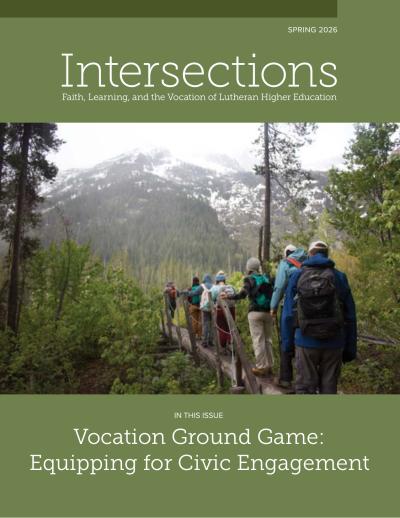 Article
Bringing Core Values to Life through Civic Engagement
Austin Trantham
No. 63 · Spring 2026
5 min audio
Trantham shows how Saint Leo University’s Benedictine Core Values shape his civic engagement work — from advising a “Why Vote?” campaign and Constitution Day panels to engaging students in the Unify Challenge for respectful cross-institutional discourse.
-
 Article
Lutheran Identity and Diversity in Education
Bruce Reichenbach
No. 17 · Summer 2003
Reichenbach applies the theological taxonomy of exclusivism, inclusivism, and pluralism to Lutheran colleges and argues that institutions self-consciously committed to inclusivism must hold a non-negotiable theological core in paradoxical tension with intentional diversity. Drawing on Richard Hughes, Darrell Jodock, Gilbert Meilaender, Robert Benne, and Mark Schwehn, he surveys the theological themes Lutheran writers identify as identity-forming—the four solas, law and Gospel, two kingdoms, vocation, simultaneously saint and sinner, the theology of the cross—and proposes that diversity at an inclusivist Lutheran college is to be employed in service of educating “head, hands, and heart,” maintained through a critical mass of faculty and staff who carry the “DNA of the school.”
-
 Article
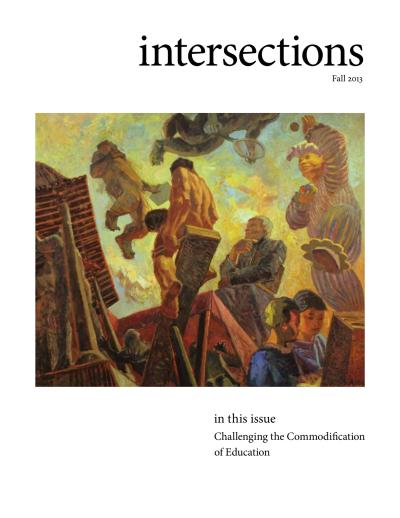
Welfare of the City and Why Lutherans Care about Education
L. DeAne Lagerquist
No. 38 · Fall 2013
Lagerquist takes readers on a historical tour from sixteenth-century Saxony through the founding decades of Lutheran higher education in the United States to the present day, recovering Luther’s “gift economy” alongside Lewis Hyde and Oswald Bayer as a counter to the market logic that increasingly governs American higher education. She offers four propositions on vocation and commodification and proposes that Lutheran institutional vocation is to accept and pass along the gifts that come to our schools for the well-being of students, neighbors, and the world.
-
 Editorial
From the Editor
Tom Christenson
No. 4 · Winter 1998
Christenson thanks the departing Jim Unglaube, recommends Ronald A. Wells’s Keeping Faith: Embracing the Tensions in Christian Higher Education (Eerdmans) as both an interesting collection of essays and a model worth imitating at ELCA institutions, previews the issue’s pieces by Richard Hughes, Carl Skrade and Spencer Porter, Gregory Clark, and Karla Bohmbach, and introduces three new features of the journal: “What I Have Learned” (an essay by a senior or emeritus faculty member, inaugurated by Richard Ylvisaker), “Reviews” (initiated by Karla Bohmbach), and a “Bulletin Board” for cross-campus announcements.
-
 Editorial
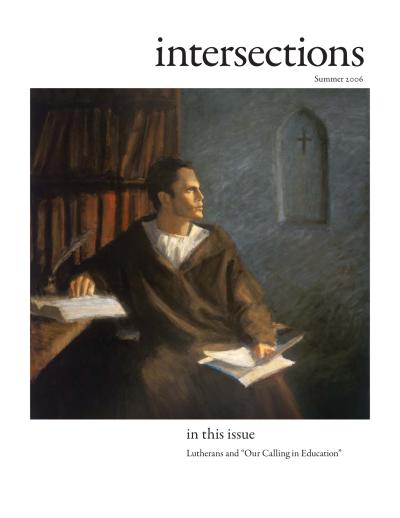
From the Editor
Robert D. Haak
No. 23 · Summer 2006
Haak previews the issue’s four essays by Marcia Bunge, Paul Dovre, Samuel Torvend, and Cheryl Budlong — each engaging the ELCA Task Force on Education’s study document and first draft of the social statement on Lutheran education — and invites readers to bring their distinctive voices as professional educators at Lutheran institutions into the conversation before the October 15 deadline. He also invites submissions to Intersections and directs readers to LauraOMelia@augustana.edu to be added to the direct mailing list.