Through the years, I have donned many roles and titles: son, husband, student, employee, father, pastor, and others. My new role and title as Director for Colleges and Universities for the churchwide organization of the ELCA brings with it a new role and title I never expected to carry: publisher. Nonetheless, I am delighted that the Vocation and Education unit sponsors and publishes this journal of conversation about the “intersection” of faith, learning and teaching in Lutheran higher education. With this issue of Intersections, I am pleased to assume the duties of publisher and to continue Vocation and Education’s sponsorship of the journal.
Let me introduce myself. I became Director for Colleges and Universities as of August 1, 2008, although I have been with the churchwide organization since December 2000. I will continue serving as Associate Executive Director of the Vocation and Education unit, with responsibility for leading the unit’s working group for Educational Partnerships and Institutions. This group is a team of fifteen persons who staff churchwide ministries in theological education and seminaries, lifelong learning/continuing education, schools (primary and secondary) and early childhood education, “first call” theological education, Lutheran Partners, theology and daily life ministry, the Book of Faith Initiative, and of course, colleges and universities, which is the portfolio I directly carry along with my colleague, Marilyn Olson. I serve in these capacities under Call as a pastor of this church. My academic field is American Church History. Before coming to the churchwide offices, I served for ten years at Auburn Theological Seminary, as Associate Director of its Center for the Study of Theological Education.
It is with thanks for the good work of Dr. Arne Selbyg that I begin my relationship to Intersections. This journal prospered during Arne’s tenure as Director for Colleges and Universities. He developed Intersections into the important voice it has become for Lutheran higher education.
This issue looks at a theme dear to Arne: the aims and purposes of Lutheran higher education. The Rev. Mark Hanson, presiding bishop of the ELCA, offers reflections on the core mission of higher education related to the ELCA. Two pieces included in this issue are from Wartburg College’s fall 2008 campus conversation about the college’s mission as a college that takes faith seriously. First, my essay attempts to discuss the implications for being a church-related college of several key shifts in the relationship between religion and culture in America in recent decades. This essay was first presented as a lecture at Wartburg in September 2008. Later that fall, the college convened a dialogue between Dr. Robert Benne of Roanoke College and Dr. Thomas Christenson of Capital University about what it means to be a college of the church (see p. 12). A sermon by Luke Lambert III of Wartburg College, preached in the Castle Church in Wittenberg, Germany, in 2006 on Jesus’ desire to “save our minds,” rounds out our conversation in this issue of Intersections.
-
 Editorial
From the Editor
Robert D. Haak
Haak frames the issue around “Lutheran conversations,” centered on the exchange between Robert Benne and Tom Christenson at Wartburg College’s ongoing campus conversation about what it means to be a “college of the church,” alongside Mark Wilhelm’s historical and social context, Lake Lambert’s sermon, and Bishop Mark Hanson’s short piece reprinted from The Lutheran—and points readers to the Lutheran Academy of Scholars seminar at Harvard as a place to continue the conversation.
-
Reflection
Colleges Lead Way: Curiosity, Faith, Discernment, Mission are Key
Mark S. Hanson
Reprinted from The Lutheran (November 2007), Hanson names four marks of the colleges of this church—nurturing unquenchable curiosity, nourishing faith formation and exploration, modeling public moral deliberation, and preparing students for engagement in the world—and gives thanks for the colleges’ vocation to call us to stand outside ourselves and reach out in mission for the sake of the world.
-
Article
Even Lutheranism Can Be Cool Now: Changes in Religion and American Culture
Mark Wilhelm
Wilhelm names two major changes in the role of religion in American culture—the rise of a rhetoric of religious individualism, exemplified by “Sheilaism” in Robert Bellah’s Habits of the Heart, and a proliferation of religious options driven by the democratization of authority, the end and beginning of ethnicity, the success of ecumenism, and the information revolution—and draws implications for Lutheran-related higher education, including support for Stephen Prothero’s call for core religious literacy and a confident reclaiming of each college’s religious heritage as a platform for engaging the religious diversity of America.
-
Article
Point / Counterpoint: What It Means to be a "College of the Church"
Robert Benne, Tom Christenson
Moderated by Wartburg College pastor Larry Trachte and introduced by Kathryn Kleinhans, this Wartburg campus conversation between Robert Benne (Roanoke College) and Thomas Christenson (Capital University) probes what it means to be a college of the church—Benne emphasizing ethos, vocation, and the Christian intellectual tradition over against secularization and generic education, and Christenson lifting up persistent vocational questions, the gift of difference, and induction into a community of discourse—and finds large common ground around hiring for mission, pedagogy that asks deep questions, and the courage to claim a living religious tradition while inviting everyone to the banquet.
-
Reflection
Saving Minds
Lake Lambert
In a sermon preached in the Castle Church in Wittenberg during Wartburg College’s 2006 faculty and staff development seminar, Lambert names two sins of the mind—coveting and mental sloth (in both its rigid refusal to think and its mindless relativism)—and, drawing on Luther’s Large Catechism and Martin Luther King, Jr.’s “A Tough Mind and a Tender Heart,” calls Christians to receive the wisdom that comes when faith puts knowledge into action, sustained by the hope of the resurrection.
-
 Article
Why All This Talk About Understanding the Mission of NECU Member Institutions as a Vocation?
Mark Wilhelm
No. 56 · Fall 2022
In his valedictory keynote, retiring NECU Executive Director Mark Wilhelm argues that Lutheran higher education is, properly understood, vocation-based education — outlining four core practices recovered over the past fifty years and naming the constructive and corrective work still to be done, including a fuller embrace of DEIJ and of the diverse vocations of NECU’s 27 institutions.
-
 Editorial
From the Publisher
Mark Wilhelm
No. 55 · Spring 2022
Wilhelm announces his planned retirement on January 31, 2023, after serving as the founding executive director of the Network of ELCA Colleges and Universities, and gives thanks for the privilege of helping NECU articulate a shared vision for Lutheran higher education in twenty-first-century North America.
-
 Editorial
From the Publisher
Mark Wilhelm
No. 53 · Spring 2021
Wilhelm reflects on an NPR report of teenagers’ pandemic diaries and the fraught Christian history of struggling to live out Jesus’s ethic of love, framing the issue as a record of NECU institutions working out how to act for the common good through the pandemic of 2020–2021.
-
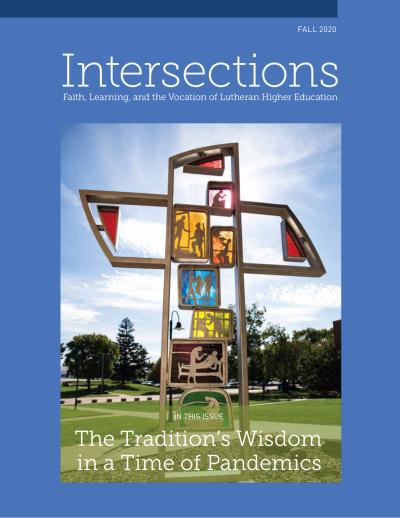 Editorial
From the Publisher
Mark Wilhelm
No. 52 · Fall 2020
Wilhelm argues that the “hackneyed” expressions of higher education — “you are not just a number,” “the college experience,” “risen to the challenge” — tell the simple truth about NECU institutions even as the Covid-19 pandemic has pushed budgets, employees, and campus life to the breaking point.
-
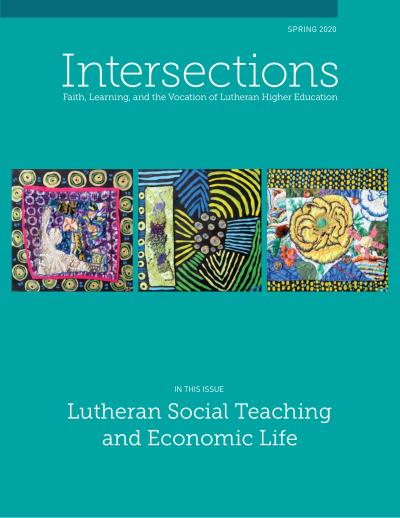 Editorial
From the Publisher
Mark Wilhelm
No. 51 · Spring 2020
Wilhelm frames the issue by tracing how Lutheran educational ideals — once a primary source of contemporary higher education — were masked in the United States, and introduces a NECU initiative that uses the case of business ethics to explore Lutheran social teaching as an academic resource.
-
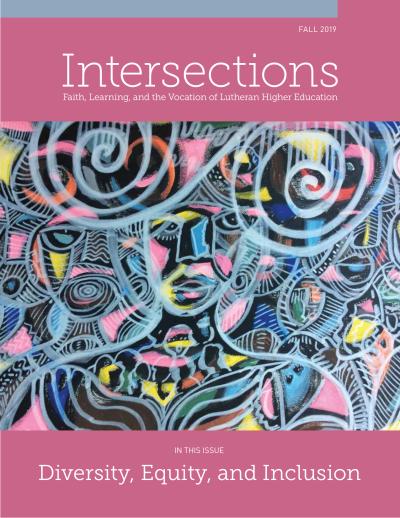 Editorial
From the Publisher
Mark Wilhelm
No. 50 · Fall 2019
Wilhelm frames the issue by noting that a federal court’s vindication of Harvard’s race-conscious admissions process is a win for higher education’s commitments to diversity, equity, and inclusion — and argues that for Lutheran higher education, the commitment to diversity is an old and foundational claim, rooted in Christianity’s openness to all and reflected in the four diverse gospels of the New Testament.
-
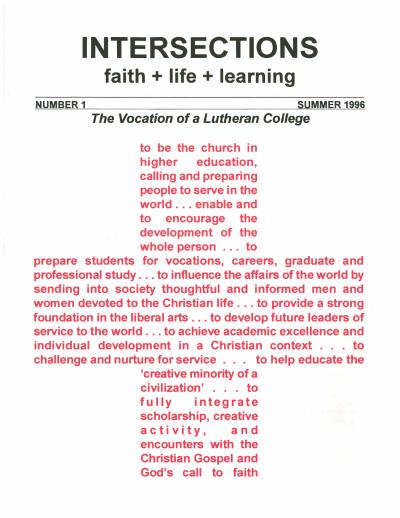 Response
Knowing and a Tradition to be Known
Kurt Keljo
No. 1 · Summer 1996
Keljo, University Pastor at Capital, embraces Schwehn’s vocational call but challenges his epistemological framing. We are called to bear witness to the Truth more than to pursue it; truth and power need not be dissociated when power is understood cruciform-ly as love and service; alongside objectivity, a case can be made from the tradition for connected knowing (image of God, idolatry, repentance, Incarnation). Christians offer not a particular epistemology but a foundation for epistemology—a tradition to be known. He closes with James Fowler’s four marks of the “public church”: particularly Christian, prepared for pluralism, balancing intimacy with public engagement, and unafraid of ideological pluralism in confident, nondefensive civility.
-
 Article
Dual Citizenship: Reflections on Educating Citizens at Augsburg College
Paul C. Pribbenow
No. 29 · Spring 2009
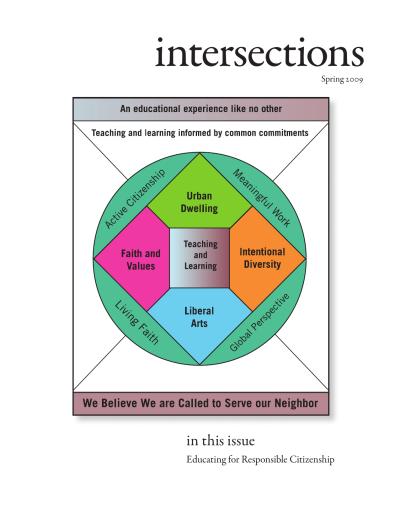
Pribbenow argues that the vocation of Augsburg College is to educate “dual citizens”—those able to live within the messiness of common work rather than resolve every tension once and for all. Drawing on John Courtney Murray on democracy as “the intersection of conspiracies,” Bill Moyers, Jean Bethke Elshtain, Stephen Carter, and the Augsburg vision statement “We believe we are called to serve our neighbor,” he names four common commitments and five principles of civic education that ground Augsburg’s incarnational mission in its city neighborhood.
-
 Editorial
From the Publisher
Arne Selbyg
No. 22 · Spring 2006
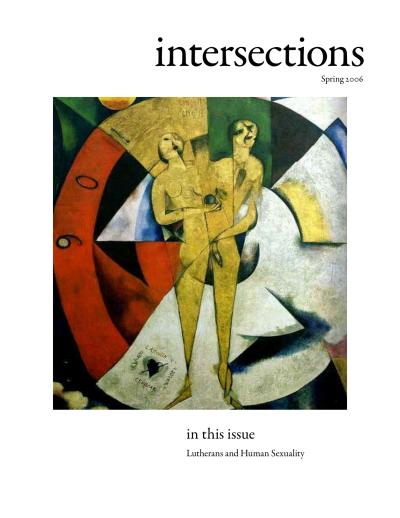
Selbyg notes that both the ELCA and Intersections have undergone major changes this year—the Division for Higher Education and Schools is gone, replaced by the Educational Partnerships and Institutions group within the Vocation and Education unit, and the journal has a new editor (Robert Haak), a new home at Augustana College, a new printer, and a new design. He commends the issue’s focus on human sexuality and points readers to the first draft of Our Calling in Education.
-
 Article
Deep Roots, Big Questions, Bold Goals
Colleen Windham-Hughes
No. 49 · Spring 2019
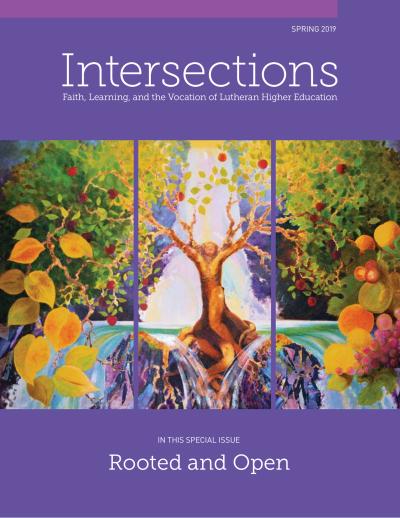
Adapted from a presentation to the California Lutheran University Board of Regents, Windham-Hughes reads the title Rooted and Open as both reaching back into the Lutheran tradition and opening forward into a shared future, then unpacks the document’s “called and empowered — to serve the neighbor — so that all may flourish” through the lenses of freedom of inquiry as a third path, vocation-centered education, radical hospitality, and civil discourse oriented toward the common good.
-
 Article
Sense of Vocation
Ruth R. Kath
No. 31 · Winter 2010
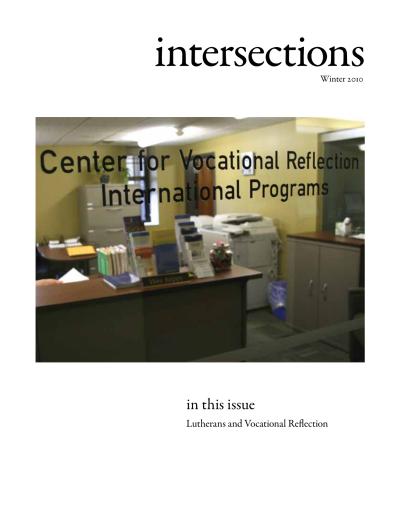
Kath describes Luther College’s Sense of Vocation program, organized into three components: General Program Initiatives (Vocation Visitors such as Parker Palmer, the Faith and Learning Workshop, self-directed reading grants, publications, and travel funds), the Church Ministry Program (Vocation Fellowships, the DIAKONOS discernment group, seminary visits, alumni discernment retreats, church leader workshops, clergy renewal, and the WIYLDE youth initiative), and the All-Student Vocation Program (Paideia I orientation, Peer Mentors, Capstone curriculum development grants, the Vocation Advising Workshop, and a Vocation Advising Handbook).
-
 Editorial
From the Publisher
James M. Unglaube
No. 3 · Summer 1997
Unglaube opens the journal’s second year by previewing the 1997 Vocation of a Lutheran College conference at Carthage, which will examine the Lutheran tradition from outside (Richard Hughes of Pepperdine on the Lilly Endowment’s Models for Christian Higher Education; David Johnson, President of the University of Minnesota at Morris and Luther College graduate, on the tradition from the public sector) and inside (Ann Pederson of Augustana in Sioux Falls; Timothy Lull of Pacific Lutheran Theological Seminary), and previews Eric Eliason’s emerging proposal for an Academy of Scholars in Lutheran Higher Education modeled on NEH/NSF-style summer seminars.