When Martin Luther wrote the Small Catechism, he taught parents to teach their children to ask questions. After quoting the content of our faith—the creed, the commandments and the Lord’s Prayer—he taught us to ask, “What does this mean?” As a result, Lutherans believe that faith seeks understanding and that reason—even when infected by sin—does not stand in opposition to it.
When I visit the colleges and universities of the ELCA, students ask questions. They engage my mind and renew my spirit. Along with inspired administrators and faculty, they lead the way as the colleges of this church reach out in mission for the sake of the world. The colleges of this church:
Nurture unquenchable curiosity: In this culture, lives are too busy and possessions too plentiful. Wouldn’t it be wonderful if Lutherans were known for our unquenchable curiosity? Luther’s unquenchable curiosity about the meaning of faith for our lives permeated his vocation and mission.
This curiosity has become a critical part of the vocation of our colleges: to plant deep within students a lifelong unquenchable curiosity about God and the centrality of faith, curiosity about themselves, about the vastness of the cosmos and the intricacies of DNA; curiosity about the richness of history, the beauty of the arts, and the complexities of science, math and economics. These colleges believe religion has a contribution to make as we engage life’s large questions. May our colleges encourage such curiosity throughout the denomination.
Nourish faith formation and exploration: Even in a time of fear, when we are distrustful of others and possessive of what we have, faith frees us to be engaged in the world. The colleges seek to nourish faith through campus ministry. In religion classes, faith is stretched and challenged as students explore the Bible and are exposed to the religious beliefs and practices of others. As communities of faith formation and exploration, our colleges are places where students not only explore and share their faith but also hear the faith stories of others. May they be communities of faith formation, exploration and lively conversations.
Model moral deliberation: Many are weary of this society’s contentious and polarized debates. Colleges can be beacons of hope as students return from experiences abroad or service projects in the U.S. As they do, they remind us that we must live globally, think critically, act locally, work collaboratively and live faithfully.
Colleges can be centers that teach us the art of public moral deliberation: creating safe spaces for people to gather; establishing rules for respectful engagement; and seeking solutions for difficult questions. In such contexts, colleges provide both the expertise of resource people and the capacity to bring people together to engage in moral deliberation. May our colleges lead us to become such communities of discernment for the sake of the world.
Prepare students for engagement in the world: One of the gifts Lutherans bring to the church, to higher education and to the world is the Lutheran understanding of vocation. ELCA colleges provide opportunities for students to explore the many contexts and relationships into which God calls us to be engaged for the sake of the world. Students report deep appreciation for the encouragement by our colleges to discern their gifts and passions. May our colleges be communities of preparation for our varied callings in families and neighborhoods, in congregations, as citizens of nations and the world, and as stewards of the environment.
The colleges and universities of this church have a vocation to call us to stand outside ourselves so we might be engaged together, reaching out in mission for the sake of the world. I am grateful to God for these schools and their unquenchable curiosity, faith, moral discernment and engagement in mission.
-
 Editorial
From the Publisher
Mark Wilhelm
Wilhelm introduces himself as the new Director for Colleges and Universities and publisher of Intersections, thanks his predecessor Arne Selbyg, and previews an issue devoted to the aims and purposes of Lutheran higher education—reflections from Presiding Bishop Mark Hanson, two pieces from Wartburg College’s fall 2008 campus conversation about being a college of the church (his own essay and the Benne/Christenson dialogue), and a sermon by Lake Lambert III preached in the Castle Church in Wittenberg.
-
Editorial
From the Editor
Robert D. Haak
Haak frames the issue around “Lutheran conversations,” centered on the exchange between Robert Benne and Tom Christenson at Wartburg College’s ongoing campus conversation about what it means to be a “college of the church,” alongside Mark Wilhelm’s historical and social context, Lake Lambert’s sermon, and Bishop Mark Hanson’s short piece reprinted from The Lutheran—and points readers to the Lutheran Academy of Scholars seminar at Harvard as a place to continue the conversation.
-
Article
Even Lutheranism Can Be Cool Now: Changes in Religion and American Culture
Mark Wilhelm
Wilhelm names two major changes in the role of religion in American culture—the rise of a rhetoric of religious individualism, exemplified by “Sheilaism” in Robert Bellah’s Habits of the Heart, and a proliferation of religious options driven by the democratization of authority, the end and beginning of ethnicity, the success of ecumenism, and the information revolution—and draws implications for Lutheran-related higher education, including support for Stephen Prothero’s call for core religious literacy and a confident reclaiming of each college’s religious heritage as a platform for engaging the religious diversity of America.
-
Article
Point / Counterpoint: What It Means to be a "College of the Church"
Robert Benne, Tom Christenson
Moderated by Wartburg College pastor Larry Trachte and introduced by Kathryn Kleinhans, this Wartburg campus conversation between Robert Benne (Roanoke College) and Thomas Christenson (Capital University) probes what it means to be a college of the church—Benne emphasizing ethos, vocation, and the Christian intellectual tradition over against secularization and generic education, and Christenson lifting up persistent vocational questions, the gift of difference, and induction into a community of discourse—and finds large common ground around hiring for mission, pedagogy that asks deep questions, and the courage to claim a living religious tradition while inviting everyone to the banquet.
-
Reflection
Saving Minds
Lake Lambert
In a sermon preached in the Castle Church in Wittenberg during Wartburg College’s 2006 faculty and staff development seminar, Lambert names two sins of the mind—coveting and mental sloth (in both its rigid refusal to think and its mindless relativism)—and, drawing on Luther’s Large Catechism and Martin Luther King, Jr.’s “A Tough Mind and a Tender Heart,” calls Christians to receive the wisdom that comes when faith puts knowledge into action, sustained by the hope of the resurrection.
-
 Article
Negotiating Legitimate and Conflicting Values
Eboo Patel, Katie Bringman Baxter, Mark S. Hanson
No. 44 · Fall 2016
In a closing-day conversation at the 2016 Vocation of a Lutheran College Conference, Mark Hanson and Eboo Patel — moderated by Katie Bringman Baxter of Interfaith Youth Core — share case studies in which legitimate religious values come into tension with one another, and make the case that Lutheran colleges should teach interfaith leadership through the hard cases rather than the easy ones.
-
 Article
Living at the Intersection of Fear and Hope
Mark S. Hanson
No. 32 · Spring 2010
Hanson draws on his January 2009 ELCA/ELCIC visit to Jordan, Israel, and Palestine—a Hebron Quran that did not burn, fifth graders dancing at the Hope School, a conversation with King Abdullah II—to frame the vocation of Lutheran higher education at the intersection of fear and hope. Engaging Brueggemann, Sittler, Buechner, Auden, Strandjord, Douglas John Hall, W. Robert Connor, Lewis Mudge, and Cynthia Moe-Lobeda, he argues that Lutheran colleges are called to critical inquiry that does not collapse into a hermeneutic of suspicion, to a “thinking faith” that resists religious fundamentalism, and to communities of discernment that work for the common good.
-
 Article
Reflections on Our Shared Commitments
Mark S. Hanson
No. 25 · Spring 2007
Originally delivered to the Lutheran Educational Conference of North America in March 2007, Hanson’s address describes the ELCA as “an ecology of interdependent ecosystems” and locates the church’s relationship to its twenty-eight colleges and universities in a shared mission rather than in older anxieties about church-relatedness. Drawing on Wittenberg’s Lutheran Identity Study, Augustana’s “Five Faith Commitments,” Pamela Jolicoeur’s Concordia address, W. Robert Connor on “big questions,” Joseph Sittler on grace, Walter Brueggemann on fear, Jonathan Strandjord on being “other-wise,” and Cynthia Moe-Lobeda’s Public Church for the Life of the World, he names four marks of shared mission: communities of free inquiry, encouragement of religious expression in a diverse society, education for the common good, and the formation of leaders for church and religious communities worldwide.
-
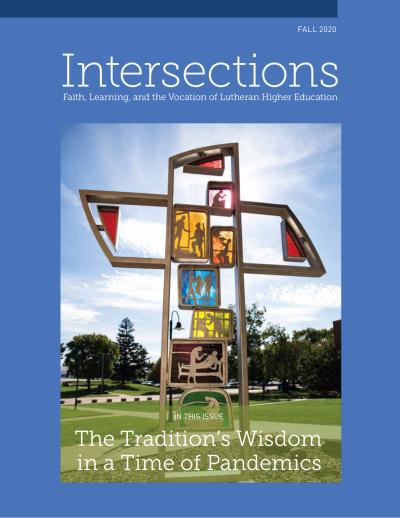 Article
Through Truth to Freedom—by Way of Reconciliation
Paul C. Pribbenow
No. 52 · Fall 2020
Reflecting on Augsburg’s 150th-anniversary motto “Through truth to freedom,” Pribbenow argues that in a season of three pandemics — pandemic illness, economic collapse, and the racial sin laid bare by the murder of George Floyd — higher education’s most authentic work is to educate for truth and freedom by way of confession and reconciliation.
-
 Article
'In, With, and Under:' The Tradition and the Teaching of Christian Ethics
Pamela K. Brubaker
No. 17 · Summer 2003
Brubaker describes how she teaches Introduction to Christian Ethics at California Lutheran University—a religiously diverse classroom where about 30% of students are Lutheran, 30% Roman Catholic, and many are “unchurched”—as a community of moral discourse rooted in the Lutheran dialectic of faith and reason. Drawing on Larry Rasmussen and Bruce Birch, Elizabeth Bettenhausen, Roger Crook, and Robert Benne’s typology of “Hot and Cool Connections” between church and politics, she walks through her course’s units on human sexuality, economic life, and war and peace—including the Bomb Shelter simulation, a mock Disney stockholders meeting on sweatshops, and a Congressional hearing on the School of the Americas—to show how ELCA social statements function as case studies in critical inquiry and education for citizenship.
-
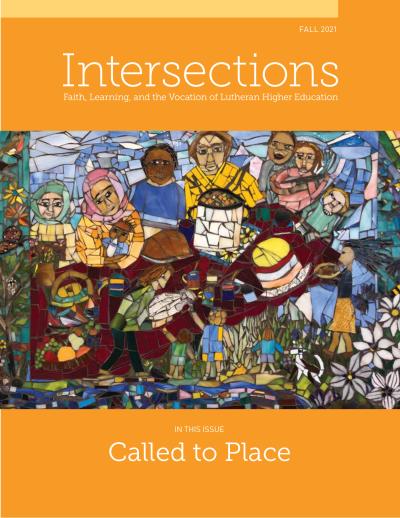 Reflection
Caught in a Place Between Caesar and God
Darrel D. Colson
No. 54 · Fall 2021
Colson reflects on his anguish, as Wartburg’s president, over an Iowa law that prevents him from requiring student COVID-19 vaccinations — reading Luther’s “Whether One May Flee From a Deadly Plague” alongside the conflict between obeying the law and serving neighbor.
-
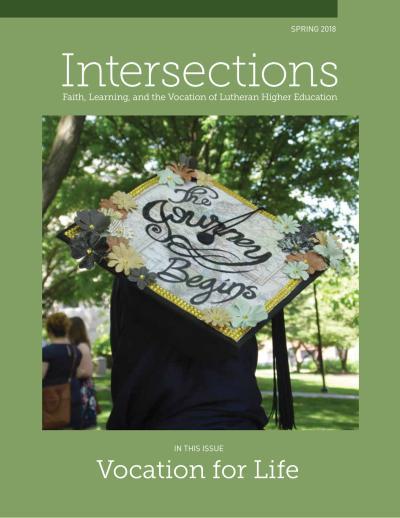 Editorial
From the Publisher
Mark Wilhelm
No. 47 · Spring 2018
Wilhelm celebrates that NECU schools continue to educate for vocation but warns that the culture of Lutheran higher education is at risk — sustained largely by informal cadres of individuals — and introduces NECU’s Rooted and Open statement as a first institutional step toward reclaiming the 500-year-old Lutheran intellectual and educational tradition.
-
 Editorial
From the Publisher
Mark Wilhelm
No. 55 · Spring 2022
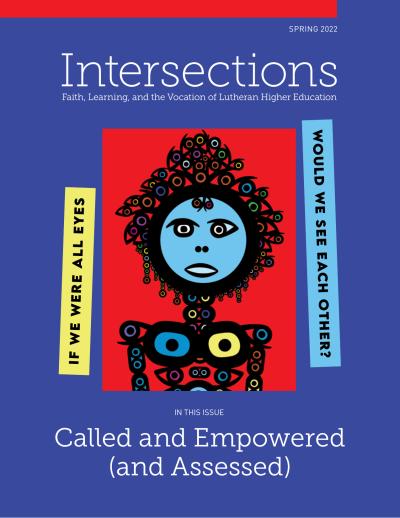
Wilhelm announces his planned retirement on January 31, 2023, after serving as the founding executive director of the Network of ELCA Colleges and Universities, and gives thanks for the privilege of helping NECU articulate a shared vision for Lutheran higher education in twenty-first-century North America.
-
 Article
The Vocation Movement in Lutheran Higher Education
Mark Wilhelm
No. 43 · Spring 2016
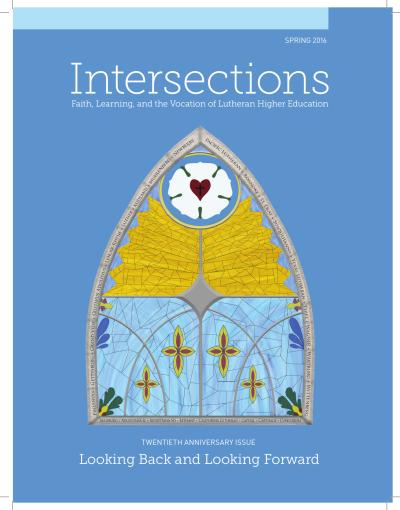
Wilhelm offers a brief history of the “vocation movement” in ELCA higher education, arguing that it arose as Lutheran leaders moved beyond institutional markers (percentages of Lutheran students, faculty, and board members) and the collapse of ethnic, separatist Lutheranism to re-ground their schools’ identity in a 500-year-old intellectual tradition that educates the whole person for vocation and the common good — an educational ideal open to persons of any religious or non-religious conviction.