With the publication of this issue of Intersections we have begun our second year of this valuable part of the Vocation of a Lutheran College Program. This entire effort has caught the attention of hundreds of people on our 28 college and university campuses and has been able to play an important role in nurturing the Lutheran tradition in higher education. Intersections has serves as an important bridge between the annual summer conference and the conversations which have been occurring on the campuses.
As I write this, the 1997 conference is just around the corner. This year we will be looking at the Lutheran tradition in higher education from two perspectives. The first is from the outside. Richard Hughes from Pepperdine University will share insights from the Lilly Endowment project which included publication of the book he co-edited: Models for Christian Higher Education. David Johnson, President of the University of Minnesota at Morris will look at the tradition from the perspective of someone in the public sector. David is a Luther College graduate and served for many years as the chief academic officer at Gustavus Adolphus College. The second perspective is from the inside. Ann Pederson from the Religion faculty at Augustana in Sioux Falls looks at the tradition from the campus setting. Timothy Lull, President of Pacific Lutheran Theological Seminary will give a broader view from the church. We will be gathering on the Carthage College campus in Kenosha, Wisconsin.
An exciting new development in this program will be shared in its initial stages at the conference at Carthage. Eric Eliason, Associate Professor of English at Gustavus Adolphus College, has been working on a model for the development of an Academy of Scholars in Lutheran Higher Education. He will share with us his thoughts on creating such an academy as a vehicle for summer seminars wherein faculty from our campuses will be able to do intensive scholarly research topics related to the sub-title of Intersections, namely the intersections of faith, life and learning, enabling participants to venture into this area and out of their more narrow academic discipline. We look forward to his report.
These are exciting days for Lutheran Higher education.
James M. Unglaube
Director, Colleges and Universities
ELCA Division for Higher Education and Schools
June, 1997
-
 Editorial
From the Editor
Tom Christenson
Christenson explains that this issue breaks from the first two issues’ single-focus pattern to feature three principal papers on the environment, the education of desire, and hiring and personnel policies, plus two poems and a piece of reflective bemusement. He then commends George Marsden’s The Outrageous Idea of Christian Scholarship (Oxford, 1997) and challenges Lutheran scholars to articulate how the particulars of their faith inform their scholarship—in conversation with Calvinist work like Nicholas Wolterstorff’s Reason Within the Bounds of Religion and Art in Action—rather than remaining silently complicit in the view that faith has no place in the academy.
-
Article
The Lutheran Liberal Arts College and Care for the Earth
H. Paul Santmire
Santmire, author of The Travail of Nature, proposes three mandates for the Lutheran liberal arts college: take responsibility for spiritual particularity by confronting the ambiguities of the classical Christian tradition (Lynn White’s charge against anthropocentric Christianity vs. the Franciscan ecological tradition from Irenaeus through Luther) and of classical Lutheran social ethics (the Two Kingdoms, Romans 13, the Third Reich, Bonhoeffer); promote responsible cultural criticism (against Thoreau’s sociopathic anti-urban suburbanism); and promote a holistic environmental ethos through an interdisciplinary core curriculum with ecology as the queen of the sciences, a community that liberates the social imagination (Mumford, Marcuse), a cosmic Liturgical praxis rooted in the Colossians 1:15–20 hymn to the cosmic Christ, and an academy that models ecological responsibility.
-
Article
An Aristotelian Twist to Faith and Learning
Gregg Muilenberg
Muilenburg, chair of Philosophy at Concordia, surveys the four traditional models for faith and reason—conflict, independence, dialogue, and integration—and argues that the Lutheran dialogical model is insufficient for wholeness. Drawing on the post-foundationalist epistemology of perspective and Aristotle’s account of knowing as desire-driven action, he proposes that faith is an ultimate value (an assessment belief of the form ‘x is better than y’), that learning is desire-directed action, and that the core of Christian education is the education of Christian desire—requiring both reflection and commitment, both integration and diversity.
-
Poem
Two Poems: The Dark Angels / Decorative Cooking
Gary Fincke
Two poems by Gary Fincke of Susquehanna University: “The Dark Angels,” a return to the sidewalk in front of the father’s razed bakery in Etna, the soot-pocked windows, the Saturday trash fire, the last eclair on the work room’s folding chair; and “Decorative Cooking,” the mother’s story of St. Julitta, Betty Crocker’s “New Design for Happiness,” the Sunday dinners of shaped Jellos and anise Magi cookies, the visit of the former pastor returned to Pittsburgh to declaim the death of God, and the father who lays evergreen crosses by the mother’s headstone in the Garden of Dreams.
-
Article
Mission and Hiring in the Christian College
Bruce Reichenbach
Reichenbach of Augsburg argues that the Christian or Church-related college’s mission to educate the whole person from a perspective of Christian faith and values can only succeed through intentional hiring of a “critical mass” of faculty, administrators, and staff committed to that mission (following George Marsden and the 1960s Danforth Commission), supplemented by on-going faculty development. He defends an inclusive community-with-diversity, a freedom-and-commitment tension grounded in Alasdair MacIntyre’s account of tradition, and the legality of preferential religious hiring under Title VII of the Civil Rights Act and the relevant case law (Tilton, Hunt, Roemer, Blanton, Grove City, Amos).
-
Response
A Call for Creative Education
Wendy McCredie
McCredie of Texas Lutheran responds to Reichenbach by reframing the four ideas embedded in his claim that “the entire college community should be knowledgeably committed to the college’s mission”—community, knowledge, commitment, mission—and argues that the Lutheran tradition’s unwillingness to be separate from the world should lead us to educate the public about the Lutheran tradition rather than interrogate prospective employees about their faith. She questions whether agreement on “Christian values” is possible (or even Lutheran), and reads Reichenbach’s “creative education” as the dialectical tension between gospel and law, God’s love and our human limits, that members of communities related to the Lutheran church are uniquely positioned to inhabit.
-
Response
Hitting a Moving Target
Harry Jebsen
Jebsen, former Provost of Capital University, responds to Reichenbach by arguing that the institutions, the ELCA, congregations and pastors, students, and curriculum are all moving targets. Drawing on Alvin Toffler’s Future Shock and his own fifteen years of hiring as Dean and Provost (a candidate who hoped the cross out front didn’t mean anything), he traces the drift from the “Mr. Chips” faculty who personified Dana and Midland Lutheran to a campus culture where “everybody is nice to each other” has replaced theological substance, and where MBA programs, conservatories, law schools, and adult-education programs further dilute the focus of the residential Lutheran college.
-
Reflection
Confessions of a Collaborator
Chuck Huff
Huff of St. Olaf offers a tongue-in-cheek public confession of his lifelong sin of collaboration—from elementary-school reports on dinosaurs and Cliff notes on Faulkner, through high-school algebra and college group projects, to borrowed syllabi, group work imposed on resentful students, tutorials, independent studies on every form of self-reliance, and circulated drafts. Even this confession was collaborated on, and (he confesses) he enjoyed it.
-
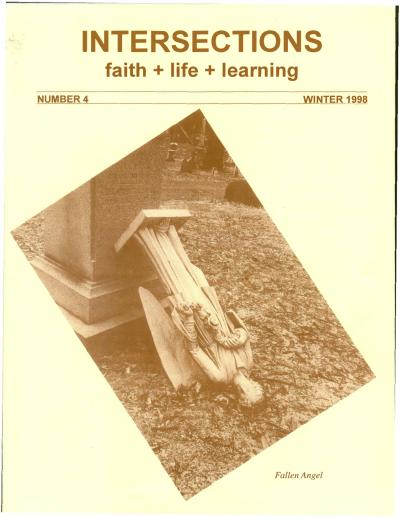 Editorial
The Vocation of a Lutheran College: Some Transitional Thoughts
James M. Unglaube
No. 4 · Winter 1998
Unglaube offers final reflections on thirty years in Lutheran higher education as he leaves the ELCA Division for Higher Education and Schools to join Carthage College, his alma mater. He recalls colleague Richard Solberg’s influence, the closing of Upsala College in 1995, the Higher Education and Namibia program shared with Naomi Linnell, the growth of endowments from $70 million to $1 billion in 25 years, and the Vocation of a Lutheran College project he credits Paul Dovre with inspiring. He likens the twenty-eight ELCA colleges to flowers on a rose bush—same Lutheran tradition, each blossom different—requiring constant nurture if the partnership between church and college is to thrive.
-
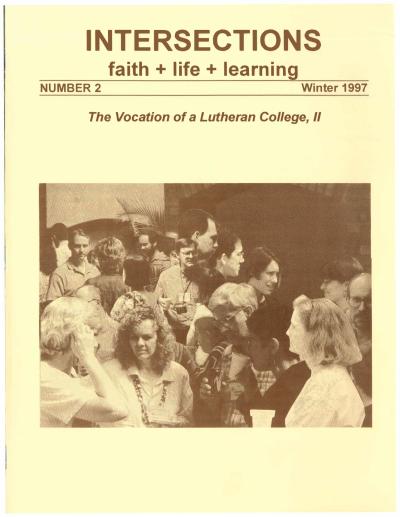 Editorial
From the Publisher
James M. Unglaube
No. 2 · Winter 1997
Unglaube reports on the second annual Vocation of a Lutheran College conference of August 1996, where Walter Bouman of Trinity Lutheran Seminary addressed “What is Lutheran; What is the Lutheran Tradition” (biblical, catholic, evangelical, sacramental, world-affirming—the world “received, enjoyed, served as God’s Gift”). He previews presentations by Wendy McCredie of Texas Lutheran and Baird Tipson of Wittenberg on how the Lutheran tradition is embodied in its colleges, and Bob Vogel’s challenge in “Coherence—And Now what?” that the tradition comes to life in how faculty give expression to their beliefs and values in the classroom and with colleagues.
-
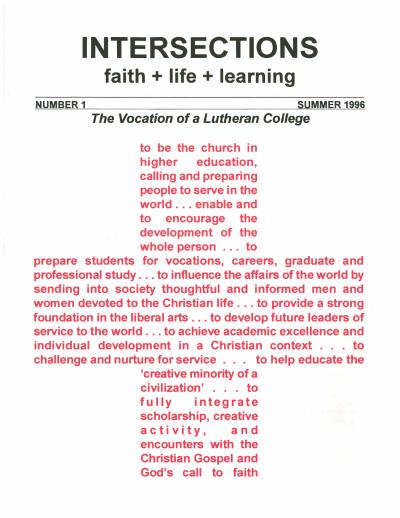 Editorial
From the Publisher
James M. Unglaube
No. 1 · Summer 1996
Unglaube welcomes readers to the inaugural issue of Intersections, crediting Editor Tom Christenson and Capital University, and announces the new annual Vocation of a Lutheran College Conference whose continuing dialogue the journal exists to enhance. He gives thanks to the Lilly Endowment for a sizable grant supporting the 1996 conference, campus dialogues, and the birth of the publication.
-
 Editorial
From the Publisher
Arne Selbyg
No. 17 · Summer 2003
Selbyg explains that the four essays in this issue grew out of the first Lutheran Academy of Scholars in Higher Education—a two-week seminar funded by the Lutheran Brotherhood Foundation and the Lilly Endowment, led for its first three years by Dr. Ronald Thiemann of Harvard Divinity School—whose official theme “Finding Our Voice—Christian Faith and Critical Vision” became informally “What’s Faith Got To Do With It?”
-
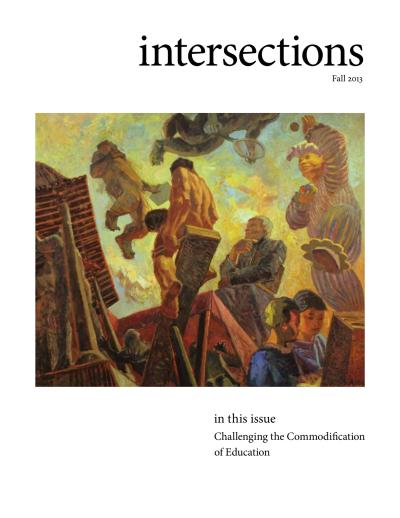 Article
Welfare of the City and Why Lutherans Care about Education
L. DeAne Lagerquist
No. 38 · Fall 2013
Lagerquist takes readers on a historical tour from sixteenth-century Saxony through the founding decades of Lutheran higher education in the United States to the present day, recovering Luther’s “gift economy” alongside Lewis Hyde and Oswald Bayer as a counter to the market logic that increasingly governs American higher education. She offers four propositions on vocation and commodification and proposes that Lutheran institutional vocation is to accept and pass along the gifts that come to our schools for the well-being of students, neighbors, and the world.
-
 Article
Of Fathers and Feminism: How One Lutheran Woman Came to a Vocation
Karla G. Bohmbach
No. 14 · Summer 2002
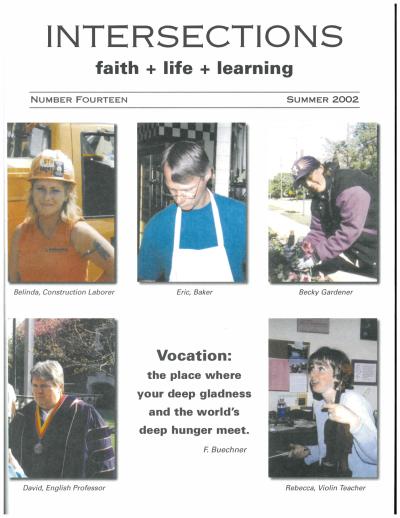
Bohmbach, a recently tenured Susquehanna University feminist biblical scholar one month shy of forty, traces her vocation back through a Vacation Bible School injury, an LCMS upbringing in which only men could preach or preside, her father’s contradictory message that she could do anything while modeling a church that limited women, St. Olaf’s revelation of a Lutheran female face, and a Duke graduate seminar on the History of Feminist Thought with Carol Meyers. Her published feminist work on biblical daughters and on the concubine of Judges 19 is read alongside Kathleen Norris’s account of word-bombardment in church, Michel Tournier on childhood as “ardent confusion,” and her own recent participation as both student and teacher in an Authorized Lay Worship Leaders Program.
-
 Institutional Focus
Pivoting to Imaginative Programming in the Midst of the Pandemic at Bethany College
Arminta Fox
No. 55 · Spring 2022
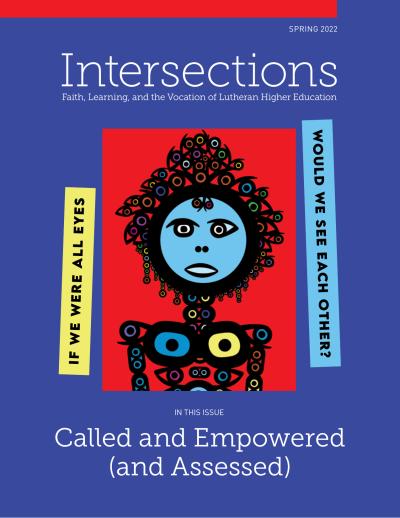
Fox recounts how Bethany College’s NetVUE Program Development Grant — originally designed around service-learning trips — was reimagined under COVID-19 into a guest-speaker model that tripled student participation and opened new vocational possibilities through the close, personal stories of alumni, alums-turned-volunteers, and community partners.
-
Article
Our Place in Church-Related Higher Education in the United States
Richard Hughes
No. 4 · Winter 1998
Adapting his 1997 Vocation of a Lutheran College Conference address, Hughes asks how the Lutheran heritage can sustain the life of the mind in church-related higher education. He compares Reformed, Mennonite, and Catholic traditions in turn—the Reformed integration of faith and learning around a Christian worldview, the Mennonite priority of discipleship over cognition, and the Catholic sacramental affirmation of the secular as bridge—before arguing that the Lutheran heritage’s particular gifts (justification by grace, theology of the cross, two kingdoms, paradoxical sensibility, vocation, and openness to ambiguity) uniquely support rigorous inquiry, genuine pluralistic conversation, and critical analysis. Drawing on Arthur Holmes, John Howard Yoder, Mark Schwehn, Alasdair MacIntyre, and Lutheran writers including Bob Benne and Tom Christenson, Hughes contends that Lutheran finitude grounds an unusually open and self-critical academic posture.
-
 Book Review
Paul Dovre, ed.: The Future of Religious Colleges
Baird Tipson
No. 15 · Winter 2002
Tipson, president of Wittenberg University, reviews Paul Dovre’s edited proceedings of the October 2000 Harvard Conference on the Future of Religious Colleges (Eerdmans, 2002), summarizing essays by Douglas Sloan on the failure of the “two-realm theory of truth,” George Marsden on faith-shaped scholarship, DeAne Lagerquist, Father David O’Connell, Mark Noll, Robert Benne, Mark Roche on Notre Dame, Joel Carpenter on neo-Calvinist Kuyperianism, and Mark Schwehn on a Lutheran “college-related church” and the centrality of vocation. Against Benne’s suggestion that only two or three robustly Lutheran colleges can be sustained, Tipson defends a less robust but still authentically Lutheran model embodied at places like Wittenberg, Gettysburg, and Roanoke, arguing for the enlightenment commitment to subjecting all truth claims to rigorous criticism and for hiring Marsden-style faith-shaped scholars rather than counting Lutheran heads.