The Division of Higher Education and Schools in the ELCA has made it one of its priorities to help the colleges and universities related to the ELCA bring into focus what makes Lutheran colleges and universities distinctive. We think our Lutheran identity is something to celebrate and be proud of, something that can help and has helped make colleges better educational institutions.
We have used many different means to sharpen the image of the Lutheran-ness of the colleges. We see the journal that you are reading now as a venue for thoughtful dialogue about how faith, life and learning intersect at these colleges and universities, and we hope the articles may inspire some of our readers to become better teachers and thereby better servants of God.
Much of the contents come out of the annual conference on “The Vocation of a Lutheran College”, and we are glad that the presentations made at the 1998 conference at Wittenberg University in Springfield, Ohio were so well received and that we were given so much positive feedback about that conference will be held at Susquehanna University in Selinsgrove, Pennsylvania, and the conference topic will be “Identity and Fragmentation: Can the Lutheran Center hold?”, a topic inspired by W. B. Yeats vision of the Second Coming.
Among the other means we have used to stimulate this discussion is sponsorship of the book “Lutheran Higher Education — An Introduction for Faculty” by professor Ernest Simmons of Concordia College in Moorhead, Minnesota, which was published in 1998 by Augsburg Fortress. The feedback that we have received on that book has also been very positive, and we are grateful to Dr. Simmons for his hard work and creative effort.
In 1999 we hope to launch a new initiative, which we expect will add new perspectives to the discussions. This will be a series of summer seminars which together will be called “The Lutheran Academy of Scholars in Higher Education”. The project is modeled after the NEH and NSF Summer Seminars, and we hope to bring together faculty from different institutions and different disciplines to work on related scholarly project while learning from each other and from a prominent academician. The funding and the details have not been nailed down yet as this is being written, by the time you receive this issue of Intersections you can call and or send an e-mail inquiry to us, and we will give you the latest information. We certainly are full of excitement over what that project can add to the discussion of the relationship between the church and higher education, faith and life.
Arne Selbyg
Director for Colleges and Universities
Division of Higher Education and Schools, ELCA
-
 Editorial
From the Editor
Tom Christenson
Christenson explains that three of the five papers from the 1998 Wittenberg Vocation of a Lutheran College conference appear here (with Robert Scholz and Cheryl Ney to follow in the next issue), passes on Andy Sheppard’s “Books for Belarus” appeal from Southwestern College, and reflects on Douglas John Hall’s The End of Christendom and the Future of Christianity—its claim that disengagement from cultural dominance is the prerequisite for faithful re-engagement, and its retrieval of Christ’s metaphors of “a little salt, a little yeast, a little light” as a possible session topic for a future VLC Conference.
-
Article
Learning and Teaching as an Exercise in Christian Freedom
Tom Christenson
Christenson, the 1998 Wittenberg keynote, argues that what makes our institutions Lutheran is not the percentage of Lutherans served or employed, ethnic celebration, or self-conscious difference, but a theologically informed vision of the educational task framed by the linked ideas of gift, freedom, and vocation. Drawing on Joe Sittler, Wendell Berry, David Orr, Harold Kushner, John Updike, Frederick Buechner, and Luther’s On the Freedom of a Christian, he reframes the liberal arts as four “liberating arts”—critical/deconstructive, embodying/connecting, melioristic/creative, and arts of enablement and change—and closes with his mother’s “end-of-the-month soup” as an image of vocation in a particular place.
-
Response
Of Imaginary Cows and a White Toy Sheep: The Freedom of a Christian College
Ryan La Hurd
La Hurd, president of Lenoir-Rhyne and a former Thiel English professor and Augsburg academic dean, responds to Christenson by insisting (with Robert Kegan’s story of Tommy’s imaginary cattle farm) that a college is composed of people but is not itself a person, and so cannot share in Luther’s freedom of the Christian. Drawing on Benedict Anderson’s Imagined Communities, Lewis Hyde’s The Gift, George Marsden, Mark Schwehn, Jacques Barzun, and the Pew Higher Education Roundtable, he distinguishes the “imagined college” (the gift-economy realm of teaching and the alma mater) from the “real college” (the commodity-economy realm of fund-raising, deferred maintenance, and federal aid reconciliation that does not have such freedom)—and ends with Pablo Neruda’s “Childhood and Poetry” and the marvelous white toy sheep offered through a hole in a fence.
-
Response
Finding the Words: The Trouble of Being California Lutheran University
Pamela M. Jolicouer
Jolicoeur, provost and vice president for academic affairs at California Lutheran, recounts the marketing problem of a university whose middle name is Lutheran in a Southern California religious landscape where the operative modifier is “Christian” (Pepperdine, Azusa Pacific) and tests Christenson’s three themes against her own “alumni magazine test”—the Jesuit standard set by Santa Clara. She concludes that freedom, gift, and vocation, though not uniquely Lutheran, are the words she can actually use: with prospective faculty, with the constituent church bodies who pressed for “Christian” in the new CLU mission statement (compromise: “rooted in the Lutheran tradition of Christian faith…”), and with the “C student” alumna headed for a Ph.D. in psychology whose consciousness of her own gifts had evaporated.
-
Reflection
Otherwise
David Wee
Wee’s September 3, 1997 St. Olaf Opening Convocation address takes its title from Jane Kenyon’s “Otherwise” and asks why we gather: to celebrate the gifts of life, place, companionship, and the work we love, and to become “otherwise”—wise about the others in our midst. He honors his own St. Olaf teachers (Ditmanson, Shaw, Stiehlow, Jordahl, Paulson, Meyer, Hove, Clausen, Larson, Jorstad) and the gruff Latvian stamp scholar Gus Eglas and Sherlock Holmes expert Randy Cox, draws Huck Finn’s “All right, then, I’ll go to hell” and Flannery O’Connor’s grandmother into a single argument, and closes on Tim Lull’s expectation that a Lutheran college campus should display contentment, courage, and cheerfulness as a family member faces day-six post-bone-marrow-transplant—“the first day of the rest of your life.”
-
Poem
Poetry: Rituals for an Uninvented Religion / On the Recently Discovered Mass Grave of Mice
Kevin Griffith
Two poems by Kevin Griffith of Capital University: “Rituals for an Uninvented Religion,” a seven-part liturgical bestiary of made-up customs (lead-filling cups in June, masks for the dying, two bottom-feeding August fish, wax grave markers with wicks, the leap-day child, and the carnival-free day of judgment), and “On the Recently Discovered Mass Grave of Mice,” prompted by New Zealand shepherds’ uncovering of 300,000 mouse skeletons, on the bones “each light as a child’s first question” and the “graveyard rush” we share with the good flock.
-
 Article
From Alien to Citizen
Arne Selbyg
No. 29 · Spring 2009
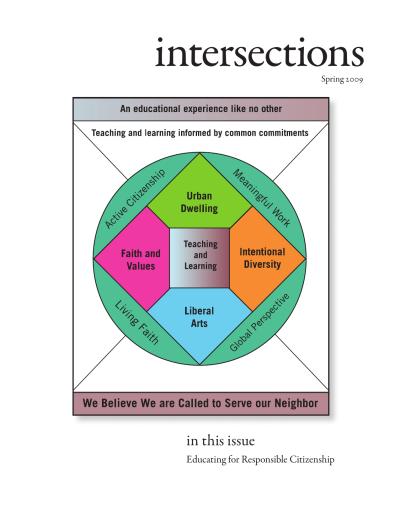
Selbyg reflects on three experiences of being educated for citizenship—growing up in Norway under the legacy of Lutheran pastors and public school teachers who resisted the Nazi occupation, arriving in America as a resident alien, and becoming a naturalized American citizen—and proposes the jazz ensemble as a better metaphor for American society than the melting pot, one in which different citizens learn skills, study other instruments, and dialog with one another in service to the common music.
-
 Editorial
From the Publisher
Arne Selbyg
No. 27 · Spring 2008
Selbyg, retiring this summer as Director for ELCA Colleges and Universities, reflects on his decade serving as spokesperson between the church and its twenty-eight colleges and universities, and argues that the link between the colleges and the church has grown stronger over the last ten years — sustained by supportive church leaders like Presiding Bishop Mark Hanson, the annual Vocation of a Lutheran College conference, and a Lutheran theology of higher education whose principles (questioning authority, returning to the sources, including the excluded, serving the neighbor) remain a strong basis for operating colleges and universities in the twenty-first century.
-
 Editorial
From the Publisher
Arne Selbyg
No. 26 · Fall 2007
Selbyg notes that, while a stated purpose of Intersections over its twelve years and twenty-six issues has been the intersection of faith, learning, and teaching, surprisingly few articles have addressed how Lutheran faculty teach and why — and credits the editor for assembling essays from authors whose teaching has benefited from the ELCA Wittenberg Center, on the eve of the City of Wittenberg’s “Luther Decade” leading up to the 2017 Reformation anniversary.
-
 Editorial
From the Publisher
Arne Selbyg
No. 25 · Spring 2007
Selbyg notes that most papers in this issue grew out of a pan-Lutheran conference organized by the Association of Lutheran College Faculties in fall 2006 rather than the annual Vocation of a Lutheran College conference, and argues that the ELCA’s ecumenical posture—truthful but open to learning from others—is a good foundation for institutions of higher education whose faculty likewise profess while remaining subject to change based on new research and insights.
-
 Editorial
From the Publisher
Arne Selbyg
No. 24 · Fall 2006
Selbyg situates this issue in the ongoing ELCA conversation about education that began with the 2005 conference and is feeding into the second draft of the ELCA Social Statement on Education, previews the 2007 conference (“The Vocation of a Lutheran College — Engaging the World”) at Augustana College, Rock Island, and lifts up Luther’s insistence that the church and its members contribute to their wider communities rather than retreat into self-centered enclaves.
-
 Editorial
From the Publisher
Arne Selbyg
No. 23 · Summer 2006
Selbyg features articles based on presentations at the 2005 Vocation of a Lutheran College conference focused on the upcoming ELCA Social Statement on Education, and urges members of the ELCA higher-education community to download the first draft (“Our Calling in Education”) from the ELCA website and submit feedback to the Task Force on Education before the October 15 deadline. He worries that the sexuality social statement on a 2009 timeline will draw more attention than the education statement, but reminds readers that, for Martin Luther and for those who work in Lutheran higher education, education is as important as sex.
-
 Article
Hope in the Face of Ecological Decline
Jason Peters
No. 32 · Spring 2010
Peters reads our ecological crisis—a campus “Birth Control Tree,” feminized fish, population, climate, water, and soil—through Alexander Pope, William Blake, Søren Kierkegaard, and C. S. Lewis’s The Abolition of Man, and argues that the modern project of mastering nature has made despair (the unconscious form Kierkegaard named) our condition. He calls for three reorientations: practical (assigning value to domestic arts and place over disciplinary specialization), philosophical (dismantling the Baconian/Machiavellian/Cartesian project of control), and theological (recovering the Church’s rejection of Gnosticism so that grace comes to us by means of nature, not in contempt of it).
-
 Article
Called for Life — Affirming Vocational Discernment
Richard L. Torgerson
No. 31 · Winter 2010
Torgerson introduces the “Called for Life” project, a three-year, $278,437 Lilly Endowment-funded collaboration among Luther, Augsburg, and Augustana that—in partnership with Luther Seminary’s Centered Life initiative and Wilder Research—rigorously assessed the effectiveness of campus vocation programs, examining whether students’ exposure to and understanding of calling had increased, and what program elements were most effective in shaping discernment.
-
 Article
Fostering Moral Imagination and Inclusivity: The Role of Ethical Leadership in ELCA Colleges and Universities Amid Societal Challenges
Lamont Anthony Wells
No. 62 · Fall 2025
12 min audio
Wells argues that “moral imagination” — the capacity to envision ethical alternatives, empathize across difference, and respond creatively to injustice — is the heart of ethical leadership in NECU institutions, and that anchoring leadership in this principle positions Lutheran higher education to cultivate socially responsible citizens.
-
 Editorial
From the Publisher: Staying Connected
Mark Wilhelm
No. 38 · Fall 2013
Wilhelm frames Intersections as a tool for maintaining relationships among leaders in ELCA higher education, welcomes the journal’s new editorial advisory board, and points readers toward the 2014 Vocation of a Lutheran College conference at Augsburg and a special interfaith understanding conference at Augustana with Eboo Patel and Presiding Bishop Elizabeth Eaton.
-
 Response
Feeling at Home: Dimensions of Faculty Life
Jane Hokanson Hawks
No. 2 · Winter 1997
Hawks of Midland Lutheran College responds to Bouman by reflecting on her path from a Lutheran childhood through the BSN at St. Olaf and thirteen years at four non-church-related institutions to her present home at Midland, where teaching at a Lutheran institution finally feels “right.” Bouman’s framing of the five themes as the Lutheran argument about what it means to be human helped her ad-hoc committee articulate the spiritual role in Midland’s new faculty mentoring program (recently funded by the Lilly Foundation), and grounds her work as a nurse educator confronting the daily humanness of grief, joy, ethical dilemmas, and care across cultural and religious difference.
-
Article
Ethical Leadership: Rooted, Open, Generative, and Mindful
John Arthur Nunes
No. 62 · Fall 2025
25 min audio
As he prepares to teach an Ethical Leadership First Year Seminar at California Lutheran, Nunes organizes his pedagogy around three mutually-reinforcing “turns” — inward, outward, and intellectual — grounded in Luther’s mandatum dei and larvae dei, Bonhoeffer’s estates, and Howard Thurman’s call to hear “the sound of the genuine” in oneself.