“Anxiety, there are some things I want to say to you—OK, there are actually quite a few things I want to say to you, but we only have a few moments. You’re busy. I get it. In fact, when I returned to Concordia September 2016, the single thing that surprised me the most was your presence on campus—you’re everywhere!
“I think you need to back off. I’m talking about your relationship with Student Body. Here’s the thing: Student Body is just not themselves when you’re around. Haven’t you noticed? It’s like they’re vibrating. Like they can’t land. They can’t focus. Or think clearly. They don’t sleep well. Sure, it’s exciting when you’re around. You come on like a roller coaster. But eventually, you’re plain old exhausting.
“Student Body asked me to talk with you. They need time to catch their breath. They said they want out, Anxiety. That’s why they asked me to talk with you. They told me about how you’ve been showing up lately. They said they don’t want to keep on like this. They don’t want to always be ramped up, worried that you’re going to pop up. They want to focus on school and when you’re around it’s like they’re always in crisis mode. Sometimes, they said to me (and these are their words), they can’t even see what’s going on around them—they can’t see today, let alone life after graduation.
“Student Body wants their life back, Anxiety. Lately, it’s like they’re not even present in their own life at all. They told me to tell you to leave them alone.”
In September of 2016, I left behind my wife and kids (temporarily), my South African “family” and home (physically), and my work as Associate Country Coordinator of the ELCA’s Young Adults in Global Mission, or YAGM, program in Southern Africa (permanently). I returned to the United States in order to begin working as Minister for Faith and Spirituality in Action with Concordia College in Moorhead, Minnesota. I expected my return to be challenging. I anticipated jet lag. I envisioned some difficulty in reorienting to walking on the right-hand side of sidewalks and hallways, to driving on the right side of the road. I predicted using some words that didn’t translate to United States English conversation (i.e. “Eish!”) and pronouncing a few others like a Brit (i.e. “herb”). I expected disorientation in shifting from several cultures which value relationship, tradition, and the communal over task, innovation, and the individual. I expected to face my own anxiety upon occasion. What I did not expect was the visceral and pervasive presence of anxiety throughout the college community.
A few months into my work with Concordia, and in the midst of a conversation with my colleague, Dr. Michelle Lelwica (Chair of Concordia’s Religion Department and author of Shameful Bodies: Religion and the Culture of Physical Improvement), I found myself again referencing this tangible and common experience of a communal, even cultural anxiety. Our fuller conversation included discussing my recent research into healing trauma.
“What I did not expect was the visceral and pervasive presence of anxiety throughout the college community.”
Dr. Lelwica suggested that perhaps anxiety is a sort of constant, low-lying trauma. This thought built a bridge to my introductory work with trauma, work which drew from my own daily practices and came to fruition as my master’s thesis for Luther Seminary. The thesis combined the creation of a holistic six week daily healing practice with a theoretical paper grounded in the work of Bessel van der Kolk and Serene Jones, and in healing stories, such as that of Matthew Sanford. Dr. Lelwica’s comment connecting anxiety and trauma opened my eyes to insights, resources, and practices which might be helpful in our shared commitment to students’ whole selves.
My intent here is to contribute to the ongoing conversation about young adults, anxiety, and college. The connection between anxiety and trauma can shine light on an area of particular importance in Lutheran higher education, namely vocation, with its interwoven relationship with storytelling.
Discerning Vocation in Crisis
Can one creatively discern present and future vocations while under duress, while experiencing anxiety, or otherwise in crisis mode? I once discussed this question with Philip Knutson, a regional representative with the ELCA. Knutson was spending time with the 2012-2013 group of YAGM volunteers during a retreat at our home in Pietermaritzburg, South Africa. When the YAGM volunteers later heard of the conversation, one of them lit up with discovery and relief: “No wonder I can’t discern my vocation. I’m in crisis mode!” If Lelwica is right in interpreting anxiety as a form of trauma—as a form of chronic and potentially debilitating crisis on a variety of levels (including physical, mental, emotional, relational)—then we can learn a good deal. In the words of psychiatrist Bessel van der Kolk: “This [trauma] is about your body, your organism having been upset to interpret the world as a terrifying place. And yourself as being unsafe. And it has nothing to do with cognition” (“Restoring”). According to Babette Rothschild, symptoms include “chronic hyperarousal of the autonomic nervous system” (7). This translates to changes in heart rate, in cortisol, in digestion and elimination, in ability to downshift to calm one’s mind and sleep. Maslow’s hierarchy of needs comes to mind: we can’t possibly discern core commitments, meaning, and purpose when dealing with (a lack of) foundational necessities. When basic needs such as safety and security are of immediate concern (whether actual or perceived or both), they eclipse the potential to engage in activities such as reflection and discernment.
For many on our campuses, vocation is about telling ones story—about authoring (or co-authoring) an account of oneself that is durable, purposeful, and empowering. That ability to find and tell the story of oneself is truncated or simply hijacked under duress. For someone with PTSD, for example, the traumatic event is not recalled or even remembered, and so cannot be retold. It is relived. And because of how the brain has processed (and not processed) the event, it is relived every time it reappears. What is more, reliving the traumatic event calls up the same psychophysical responses, which interrupt and disorient the person. There is no relief from understanding a moral or lesson or meaning of the life-story. Indeed, there is no story. There is only being plunged into the traumatic experience again and again.
While I’m not claiming that the anxiety of “average” college students registers at the level of PTSD, the problems for story-telling and vocation-finding are not dissimilar. Just last week, I was in the presence of a student heading into what became a full-blown anxiety episode. When the student later shared their story of that day, it appeared to me that anxiety served as the organizing principle. The ebb and flow of anxiety not only shaped the story, it became the central character and strongly influenced the tone of the story. The story, in a sense, became anxiety’s story and not the student’s. Finally, when anxiety exerts such control on one’s story, little space remains for consideration of other “characters,” or what the Lutheran tradition calls one’s neighbor. When one’s own story is frequently hijacked by trauma or anxiety, little capacity exists to hear, let alone listen to the story of one’s neighbor.
Acting in the Face of Anxiety
What can be done? Both Kolk and Rothschild point towards the efficacy of psychophysical approaches to healing trauma, including practices such as yoga and intentional breathing. I am most interested in their work because I want something I can choose and embody, something I can do in the face of anxiety. I imagine others would echo this desire. And this brings me to my concluding thoughts, thoughts about communal and individual action.
Dr. Lisa Sethre-Hofstad serves Concordia in the role of Vice President for Student Development and Campus Life. Days before writing this article, I listened as she shared statistics regarding levels and rates of anxiety on campus. The numbers surprised me as they were lower than I anticipated. I also hesitated because I heard in her interpretation of those numbers what I first took as minimizing the prevalence and intensity of anxiety among the student body. It seemed that she refuted anxiety as a problem. I’ve come to learn that what Dr. Sethre-Hofstad especially refutes is a problem-centered approach. She suggests, instead, that the college intentionally step into a radically different paradigm—one that emphasizes the resourcefulness of today’s students for complex and successful lives. A sure way to increase a person’s stress is to place the locus of control outside of that person.
During that same fall workshop, I led a breathing practice in which a proportionately longer exhale physiologically sends messages of safety to the body, uprooting anxiety and seeding presence, mindfulness, calming. Dr. Ernest Simmons (Concordia religion professor) shared with me that many in his department start classes with similar exercises. Students love it, he said, and then lamented that many confess it to be the quietest part of their day.
How do we as members of college communities create spaces and practices of grounding quiet, of calming, of psychophysical safety? How do we empower students to find their own grounding, calm, and safety in the midst of what appears to be incessantly fast-paced, highly-stimulated, and ever-shifting lives? How do we encourage and equip students to claim what is within their control, including their very breath? How do we role model healthy ways of thinking, being, and doing—not only for their sakes but also for the common good?
“How do we empower students to find their own grounding, calm, and safety in the midst of what appears to be incessantly fast-paced, highly-stimulated, and ever-shifting lives? How do we encourage and equip students to claim what is within their control, including their very breath?”
When I returned to the United States from South Africa, I frequently thought of myself as having entered the Land of Anxiety. Now over a year and a half later, I have taken steps to travel elsewhere and am encouraged to continue this journey with this creative, insightful, and caring community.
Works Cited
Jones, Serene. Trauma and Grace: Theology in a Ruptured World. Louisville: Westminster John Knox, 2009.
Kolk, Bessel van der. The Body Keeps the Score: Brain, Mind, and Body in Healing Trauma. New York: Penguin, 2014.
———. “Restoring the Body: Yoga, EMDR, and Treating Trauma.” OnBeing with Krista Tippett. July 13, 2003. Accessed 1 May 2017, https://soundcloud.com/onbeing/bessel-van-der-kolk-restoring-the-body-yoga-emdr-and-treating-trauma
Rothschild, Babette. The Body Remembers: The Psychophysiology of Trauma and Trauma Treatment. New York: W. W. Norton, 2000.
Sanford, Matthew. “The Body’s Grace.” OnBeing with Krista Tippett. May 3, 2012. Accessed 1 May 2017, http://www.onbeing.org/program/matthew-sanford-the-bodys-grace/185.
-
 Editorial
From the Publisher
Mark Wilhelm
Wilhelm celebrates that NECU schools continue to educate for vocation but warns that the culture of Lutheran higher education is at risk — sustained largely by informal cadres of individuals — and introduces NECU’s Rooted and Open statement as a first institutional step toward reclaiming the 500-year-old Lutheran intellectual and educational tradition.
-
Editorial
Guest Editorial
Lynn Hunnicutt
Hunnicutt traces the etymology of vocation through its cognates — evoke, provoke, convocation — to argue that vocation presumes a relationship between caller and called, that callings are often grounded in ordinary words and humble lives, and that recognizing vocation as plural and lifelong relieves colleges of the pressure to help students find a single calling while on campus.
-
Article
One Life, Many Callings: Vocation Across the Lifespan
Katherine Turpin
Turpin, drawing on the collaborative research behind Calling All Years Good, traces how vocational discernment shifts through adolescence, younger adulthood, middle adulthood, late adulthood, and older adulthood — arguing that focusing vocation on entry into the workforce limits the capacity of intergenerational college communities to wrestle with calling throughout life.
-
Article
Vocation for Emerging Adulthood: Within and Beyond College
Adam Copeland
Copeland uses scenes from Master of None, David Brooks’ columns, Meg Jay’s The Defining Decade, and the stories of two ELCA college graduates to argue that emerging adulthood has fundamentally changed — and that Lutheran colleges should call out cultural lies about work, reframe vocation as meaning-making, and help graduates take small, wise steps into their twenties.
-
Article
Called to Compassion over the Course of a Life: A Buddhist Perspective
Florence D. Amamoto
Amamoto, an associate professor at Gustavus Adolphus shaped by Jodo Shin Shu Buddhism, argues that although Buddhism has no “caller” God, it has a strong sense of calling — we are called by the world to respond to the suffering around us with mindfulness, egolessness, and compassion — and that this lifelong journey is enriched by encounter with the Lutheran vocational tradition.
-
Article
Vocation and Dharma throughout Life's Stages: A Hindu Perspective
Vidya Thirumurthy
Thirumurthy traces her own attempt as a Hindu faculty member at Pacific Lutheran University to grasp the Lutheran concept of vocation, finding in the Bhagavad Gita’s teaching on dharma — duty fulfilled without expectation of reward — an equivalent that, like vocation, varies across the four stages of life and calls individuals to transform others through selfless service.
-
Book Review
Vocation on Campus: Reading Mark Tranvik's Martin Luther and the Called Life at Pacific Lutheran University
Alex Lund, Michael Halvorson
Halvorson and Lund — faculty member and student — review Mark Tranvik’s Martin Luther and the Called Life alongside PLU’s Wild Hope Center for Vocation, weighing the book’s warning against “vocation lite” against the challenge of speaking of God’s call to students in the Pacific Northwest’s “None Zone,” where most students have little exposure to Lutheranism.
-
Article
Luther, the Catechisms, and Intellectual Disability
Courtney Wilder
Wilder confronts Luther’s deeply troubling response to a child with disabilities at Dessau, then mines his Small and Large Catechisms for a Lutheran theology of inclusion — reading the Third Article of the Creed, the petitions of the Lord’s Prayer, and the sacrament of baptism as resources that affirm the full humanity of people with intellectual disabilities as faithful children of God.
-
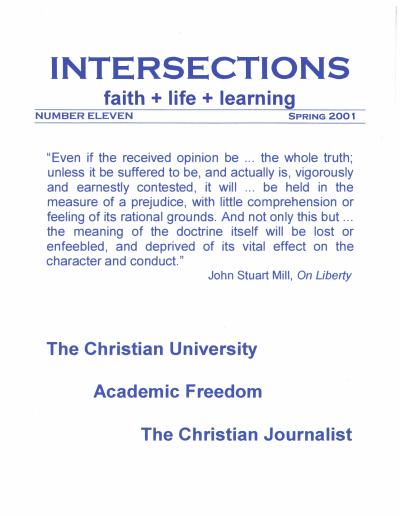 Article
Ivory Tower or Holy Mountain? Faith and Academic Freedom
Nicholas Wolterstorff
No. 11 · Spring 2001
Wolterstorff defines infringement of academic freedom as impairing a faculty member’s standing on account of the ideological content of her position, argues that academic freedom (like free speech) is “duly qualified” rather than absolute, and offers eight considerations bearing on religiously based institutions: Weber’s differentiation of Wissenschaft, religious pluralism within a liberal polity, the vitality of American civil society, a decentralized educational system, the “holistic” character of much American religion, the post-Kuhnian collapse of classical foundationalism and of the “generically human” academy, the fact that ideas matter, and the personhood violated by infringement (the desecration of an image of God). He concludes that the private sector offers wider academic freedom than the public, that religious qualifications are not inherently inappropriate (any more than St. John’s Great Books commitment), but that religiously based colleges too often apply them unjustly—arbitrarily, secretly, without recourse—and that the AAUP’s best service is model codes of procedure.
-
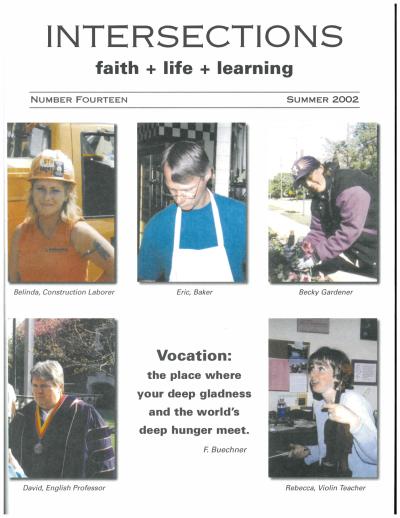 Article
Holy Odors
John P. Trump
No. 14 · Summer 2002
A one-act play by John P. Trump, premiered at Pacific Lutheran University, in which Maggie, a senior studying Reformation history in the library stacks, falls asleep over the Apology of Augsburg and dreams a 16th-century pickled-herring merchant—Herr Leonard Kopp, the man who smuggled Katie von Bora and eight other nuns out of the convent—into existence to argue that her call to archaeology (“digging up old bones”) is as holy as ordained ministry, with Luther’s joke that the church burns incense to insulate priests from the “holy odors” (not holy orders) of everyday life.
-
 Article
Welfare of the City and Why Lutherans Care about Education
L. DeAne Lagerquist
No. 38 · Fall 2013
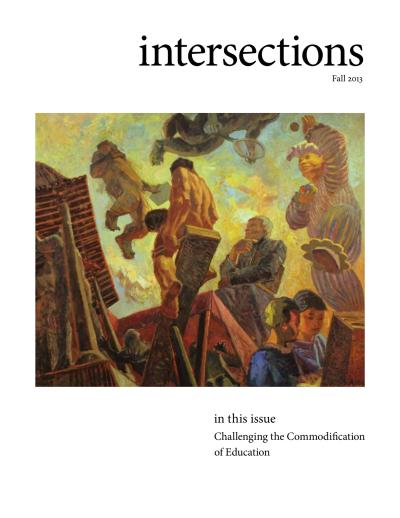
Lagerquist takes readers on a historical tour from sixteenth-century Saxony through the founding decades of Lutheran higher education in the United States to the present day, recovering Luther’s “gift economy” alongside Lewis Hyde and Oswald Bayer as a counter to the market logic that increasingly governs American higher education. She offers four propositions on vocation and commodification and proposes that Lutheran institutional vocation is to accept and pass along the gifts that come to our schools for the well-being of students, neighbors, and the world.
-
 Reflection
Vocation
Matt Peterson
No. 10 · Fall 2000
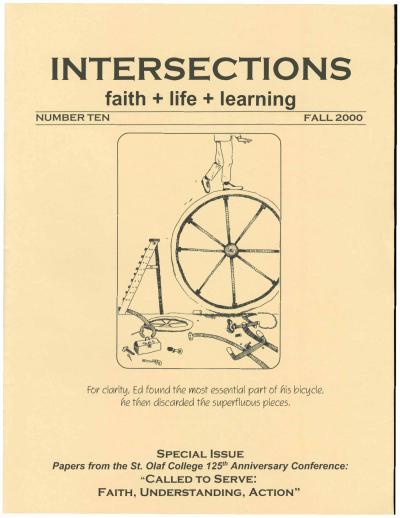
In a chapel homily, St. Olaf student Matt Peterson quotes former St. Olaf professor Howard Hong’s 1955 Our Church and the World—“the tragedy is that we seem to have lost the full grasp of the Christian vocation”—to argue that vocation, from the Latin vocare, is centrally a call into daily communion with God and into continually becoming Christian, not the title of a successful career marked by GPA, win-loss records, honorary degrees, or net worth. Drawing on Anthony Bloom on prayer that must be lived, he indicts the dread of Monday, the “come hell or high water” demand for production, and the “faith community” that we take on faith.
-
 Editorial
From the Editor: So That We, Too, May Flourish
Colleen Windham-Hughes
No. 58 · Fall 2023
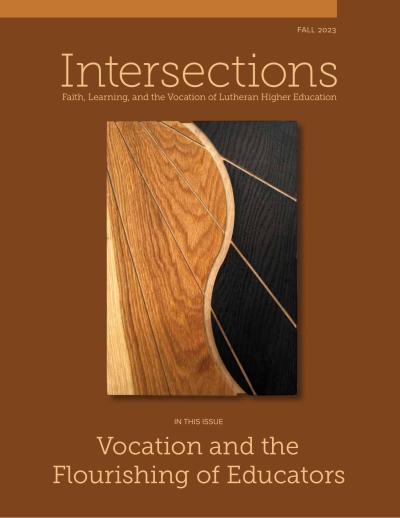
Windham-Hughes introduces the 2023 VLHE conference theme of educator flourishing, drawing on Dr. Monica Smith’s plenary challenge — “How can we flourish if only some are centered and others are at the margins?” — and invites readers to ground themselves in Us/We, the cover art by Augustana graduate William Hatchet, and join the conversation.
-
 Institutional Focus
Farming and Eating Locally: An Interview with Garry Griffith about Augustana's Farm2Fork Program
Garry Griffith
No. 36 · Fall 2012
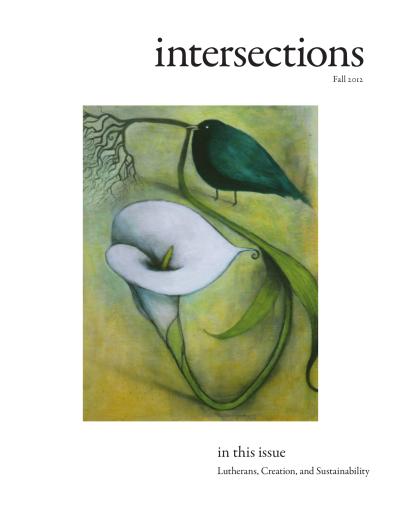
Griffith, Director of Dining at Augustana College (Rock Island), describes the Farm2Fork program’s shift from pre-packaged food to fresh produce sourced from local farms (beginning with Jim Johansen of Wesley Acres in Moline), the Augie Acres campus garden tended by students in learning-community courses, the bio-diesel conversion of used fryer oil for greenhouse heat and farm equipment, and the stewardship calling that grounds these efforts in Augustana’s Lutheran identity.