Alister McGrath: Glimpsing the Divine: The Search for Meaning in the Universe
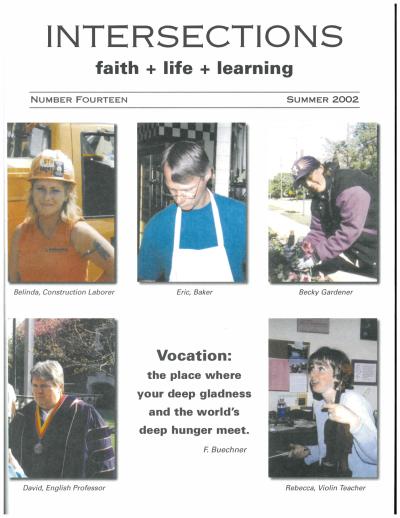
Intersections No. 14 · Summer 2002
Alister McGrath Glimpsing the Divine: The Search for Meaning in the Universe. Grand Rapids, Michigan: William B. Eerdmans Publishing Company, 2002. 123 pp. (Hardback)
Glimpsing the Divine offers twelve brief meditations on the human quest for meaning and the ways in which the Christian tradition has sought to respond to that quest. The book is very articulate, non-academic (in the good sense), and lavishly illustrated with beautiful photography. In an engaging style, McGrath, a professor of historical theology at Oxford University, offers the serious spiritual seeker glimpses into the ways in Western civilization have both thematized the human hunger for meaning and has fed its people with spiritual, largely Christian, wisdom. For people at the early stages of religious awareness, this book can serve as a fine introduction to Western spirituality.
Having said this, I am also of two minds about what I think about the book. On the one hand, the book touches the bases on all the principal theological themes of the Christian tradition. His presentation centers on incarnational themes in chapter seven where he presents Jesus as the interpretive key (logos) through which we can finally and adequately situate our wonder and awe before the mystery of the universe. He emphasizes the importance in the Christian tradition of having a “personal relationship” with the divine. In the Christ not only does the natural order of reality receive its definitive interpretation (chapter eight) but also our destiny, individually and as a species, before the great temporal horizon of the future (chapter eleven). Other chapters take up Christian teachings on the fall (chapter nine), the place of doctrine in the faith life (chapter ten), and the context of these Christian themes against the backdrop of Western civilization (chapters one through six). It is an admirable portrait narrated with skill and eloquence.
On the other hand, the book adopts a particular interpretive angle to these themes which a scholar of religion will be sensitive to, even if a novice to theology will not. I would characterize the theological vantage point from which McGrath paints his portrait as a relatively conservative neo-Barthian confessionalism. While there is nothing wrong with that orientation as such, yet honesty should dictate some acknowledgement that this is particular kind of theology and that is serves in this text as the normative location from which he writes. But nowhere does McGrath discuss this. Indeed, he repeatedly refers to “the Christian” view on the subjects he discusses as if Christianity were a monolithic tradition. Thus, readers can walk away from the text thinking of Christianity as a set of relatively singular answers to life’s questions rather than as a set of interrelated conversations which do not allow as much coherence as he seems to want to force on the subject matter. It is at this point that I think he has sacrificed too much to achieve the narrative coherency he wants.
In line with a neo-Barthian theological agenda, various assumptions seem to permeate the book that are troubling to me as I try to think theologically at the beginning of the 21st century. First, the book is dreadfully Eurocentric. When non-Western traditions are quoted, in good Barthian fashion they are treated as “taillights” illuminated by the “headlights” of Christianity. In a world where the majority of Christians now live south of the equator and where syncretistic Christian spin-offs are increasingly the norm, I wonder how convincing this hardline demarcation of Christian identity is. Second, McGrath seems to engage in dialogue with other sources of insight in the West, particularly the natural sciences, but the portraits are strangely one-sided. Science routinely fails adequately to explain life and Christianity routinely seems to rise to the occasion. Thus, a subtle host-guest mentality invades the dialogue where the power differential clearly falls on the side of Christianity, and science must content itself with making interesting observations destined to be subsumed under Christian categories. Again, I believe a more sophisticated set of relationships is better attuned to the times. Third, McGrath rather blithely buys into metaphysical dualism in two different ways. He suggests, for example, that “we are not at home” in the world and that our true place is “beyond.” Furthermore, he seems to extend the fall to the whole of creation where death, predation, and struggle are part of what is “wrong” with the world. He posits the hope for a world beyond all such phenomena at the end of time. Again, these are certainly historically available options within the Christian tradition, but they are not the only Christian options, nor, it seems to me, are they even the most attractive ones for a world in the midst of a full blown environmental crisis.
I would recommend this book, then, to people making their first ventures into Christian theology, but I would want also to see it contextualized within the more complicated cultural world that we inhabit. Pluralism is too pervasive a reality that we can hope to speak with one voice any more. Barthianism as a theological orientation seems strangely dated in this day and age, almost antiquated, I would venture to say. We have become too aware of the limits of human truth speaking to return to this theological stance.
(This is a section added to the review to address it to people preparing for ministry. Don Luck wanted this part added and to run it in the Trinity Journal)
So why does McGrath write Christian theology in this manner? And is this mode of discourse best attuned to our times as we seek to bring the Christian witness to the world? First, the why. Perhaps it is too much to ask of an introductory text that it evidence more sophistication about social location and religious epistemology. Nevertheless, the cultural context in which we theologize literally shimmers with postmodern nuance. Even untrained Christian thinkers understand the constructedness of Christian claims in the midst of a welter of competing claims. Moreover, few Christians can afford to be as arrogant as McGrath sounds in relation to other religious traditions. “The Other” is now our neighbor, our friend, our spouse, our children, our teacher. It is no longer our job to convert the other to support our own epistemological security. In Bonhoeffer’s sense of religionless Christianity, it is now time to serve Christ by being open to the invitation of “others,” to listen to God’s call in their claims.
As an historian of Christianity, McGrath is clear about the theological option I describe above. After all, it flows rather directly from the historical consciousness of the 19th century. Yet he rejects it and opts for a kind of self-contained confessionalism. For example, in his chapter on suffering he lapses into assertions without warrants and circular theological reasoning that calls out for challenge. He argues “if nature is just an accident, the result of blind natural forces, we should not be unduly disturbed by the presence of pain and suffering. It would just be the inevitable outcome of a pointless world, yet another meaningless aspect of a meaningless world.” We might ask if our only choice is between absolute meaningfulness and absolute meaninglessness, as he seems to suggest. Or we might ask what he means by such conceptions as “accident,” “blind,” “inevitability,” or “pointlessness,” words which call out for clarification, and which, of course, are chosen as polar opposites to the providentialism he wants to lead his reader to accept. The circularity of his constructive religious view appears when he offers his warrant for his theology, namely, “For the Christian, this makes sense.” (p. 94) In effect, he argues that fully to comprehend Christian claims, one must be a participant in the cultural-linguistic world of the Christian (a la Lindbeck). In other words, to know it, one has to believe it, and only by believing it, can one know it. Such strategies have been on the rise since the late 20th century because Christians believe that postmodern epistemologies no longer require accountability across cultural-linguistic boundaries.
Now the what. What I would prefer to see in contemporary theology is a growing awareness of the relativity of Christian claims. Such awareness will ask of Christians that they engage and feel encumbered by the relative truth claims of “the other” even as they seek to enrich their religious experiences and theologies within their own Christian communities. In H. Richard Niebuhr’s still useful phrasing, we are called to respond to all things as if we are responding to God’s actions upon us. Cultural-linguistic relativity does not justify theological isolationism. Far from it, it necessitates Christian engagement. Christians must come to hear their voice as simply one among many voices. It is not the voice that silences the falsehoods of “the Other.” It is not the witness that must keep “the heathen” in check. It is not the only path to communion with divine, even if it is our way of communing with God. Exclusivity needs to be a thing of the past. This, I believe, is the cultural setting in which we do find ourselves. It would be a poor service to future church folk—both lay and ordained—to train them in an overly simplistic picture of our cultural landscape. Moreover, with the rise of fundamentalisms of many different stripes—Christian and Muslim—to name the two most recently in the news, do we really need a Christian theology so convinced of its rectitude and interpretive adequacy? With attitudes that paint the world in black and white colors coming from all angles in American society—Christian America dedicated to freedom vs. Muslim Middle East dedicated to terrorism—is it not morally questionable to contribute to that mode of thinking?
-
 Editorial
From the Publisher
Arne Selbyg
Writing on behalf of the publisher, Sue Edison-Swift names vocation as one of the precious gifts Lutheran theology offers education, reflects on her first ELCA Vocation of a Lutheran College conference, and asks readers to gift future issues of Intersections with feedback—notes on what they read and skipped, and how they ended up with a copy.
-
Editorial
From the Editor
Tom Christenson
Christenson argues that whether or not the conversation is funded by the “Lilly lottery,” vocation should just be part of who we are and what we do at ELCA colleges, and proposes three low-cost conversations—among faculty (twenty dollars of wine, in vino veritas), with students throughout their four years, and with alumni—explaining why this issue is deliberately “fatter” than usual and inviting feedback on other single-topic issues.
-
Article
Vocational Discernment: A Comprehensive College Program
Darrell Jodock
Jodock, whose Gustavus Adolphus was one of twenty colleges to receive a Lilly “Theological Exploration of Vocation” grant in 2000, defines vocation not as occupation but as a self-understanding that nests the self in community. Reading Robert Putnam’s Bowling Alone on the collapse of secondary communities alongside Luther’s ethic of community benefit and five Lutheran principles (graciousness, Christian freedom, community, God active in the world, the theology of the cross), he walks through Gustavus’s three-level design—a definition of vocation open to other faith traditions, “middle principles” drawn from Sharon Parks’s Common Fire, and a long menu of programs coordinated by a new Center for Vocational Reflection—hoping that, in the language of Holocaust studies, graduates will be “resisters” and “rescuers” rather than bystanders.
-
Article
Renewing a Sense of Vocation at Lutheran Colleges and Universities: Insights from a Project at Valparaiso University
Marcia Bunge
Bunge, director of the process for writing Valparaiso’s nearly two-million-dollar Lilly grant on the Theological Exploration of Vocation, argues that contemporary culture’s reduction of vocation to either paid work or self-fulfillment requires Lutheran institutions to renew attention to a rich theological concept rooted in Luther’s expansion of vocation beyond the priesthood. She outlines eight low-cost “doorways”—caring adults, prayer, worship leadership, music and the arts, service, cross-cultural experience, church camps and wilderness, study and reflection—and describes Valparaiso’s two-program structure: a Campus-Wide Program weaving vocation into Freshman Core Courses and chapel life, and a Church Vocations Program for students considering full-time ministry. She closes with four troubling questions for any institution carrying out such a grant: what faith traditions can learn from one another, how to involve parents, whether faculty and staff have space to reflect on their own vocations, and whether daily institutional practices—family policies, treatment of low-paid staff, environmental responsibility, obligations to the wider community—actually reflect a commitment to love of neighbor.
-
Article
Martin Luther, Vocation, and Church Colleges: Nurturing Future Leaders for Faith and Community
Richard W. Rouse
Rouse, citing Arne Selbyg’s statistic that thirteen of sixteen newly elected ELCA bishops graduated from a Lutheran college (and 49 of 65 in the new Conference of Bishops), argues that ELCA colleges are training grounds for future church and community leaders because of Luther’s doctrine of the priesthood of all believers and his distinction between vocation and station—the basis of PLU’s motto “educating for lives of service, inquiry, leadership, and care.” He describes “Paths Unknown: Where is God Leading Me?” a Western Mission Cluster collaboration of California Lutheran, Luther Seminary, Pacific Lutheran Theological Seminary, PLU, and Trinity Lutheran College that used a dedicated web site (godleading.com), a January-February 2001 online virtual forum reaching over 300 participants in 40 states and Canada and Mexico, and one-day interactive video workshops featuring Trump’s play “Holy Odors,” and reports LECNA’s Reclaiming Lutheran Student Project findings on teaching, community, and faith integration at Lutheran schools.
-
Article
Holy Odors
John P. Trump
A one-act play by John P. Trump, premiered at Pacific Lutheran University, in which Maggie, a senior studying Reformation history in the library stacks, falls asleep over the Apology of Augsburg and dreams a 16th-century pickled-herring merchant—Herr Leonard Kopp, the man who smuggled Katie von Bora and eight other nuns out of the convent—into existence to argue that her call to archaeology (“digging up old bones”) is as holy as ordained ministry, with Luther’s joke that the church burns incense to insulate priests from the “holy odors” (not holy orders) of everyday life.
-
Article
Of Fathers and Feminism: How One Lutheran Woman Came to a Vocation
Karla G. Bohmbach
Bohmbach, a recently tenured Susquehanna University feminist biblical scholar one month shy of forty, traces her vocation back through a Vacation Bible School injury, an LCMS upbringing in which only men could preach or preside, her father’s contradictory message that she could do anything while modeling a church that limited women, St. Olaf’s revelation of a Lutheran female face, and a Duke graduate seminar on the History of Feminist Thought with Carol Meyers. Her published feminist work on biblical daughters and on the concubine of Judges 19 is read alongside Kathleen Norris’s account of word-bombardment in church, Michel Tournier on childhood as “ardent confusion,” and her own recent participation as both student and teacher in an Authorized Lay Worship Leaders Program.
-
Reflection
Discerning Vocation: Personal Recollections
Tom Christenson
Christenson recalls growing up two blocks from Concordia College, Moorhead, where his father—known to students as “Doc”—was the steam engineer, and afternoon wanderings past walrus-moustached biologists, Harpo-Marx-haired theologians, and a math professor who wrote proofs with one hand and erased them with the other. He came to see the campus as “an asylum for child-like minds building towers of intellectual blocks and then knocking them down,” and traces his philosophical bent back to a high school physics teacher who, asked why Bernoulli’s principle was true, finally growled, “Christenson, you’re nothing but a damn philosopher.”
-
 Article
Honesty of Mind: On the Uses and Abuses of Socratic Ignorance in Environmental Studies, Religion, and the Classroom
Don Braxton
No. 15 · Winter 2002
Braxton, taking his cue from David James Duncan’s defense of ignorance as a fly-fisher’s most crucial tool and from Socrates’ midwife’s art in the Theaetetus, defends a doctrine of “honesty of mind” resting on four premises—knowledge is constructed, judgments are wagered amid imperfect knowledge, expertise can disable learning, and we are encumbered by other ways of knowing. He field-tests the disposition against three domains: the climate-change and creationism debates in environmental studies, the post-September 11 turn toward religious pluralism (engaging Union Seminary’s Joseph Hough and Hauer and Young’s “three-world” approach to the Bible), and the liberal arts classroom where students “become democrats of the mind” through Reinhold Niebuhr’s balance of conviction and contrition.
-
 Article
A Response to Paul Santmire
Don Braxton
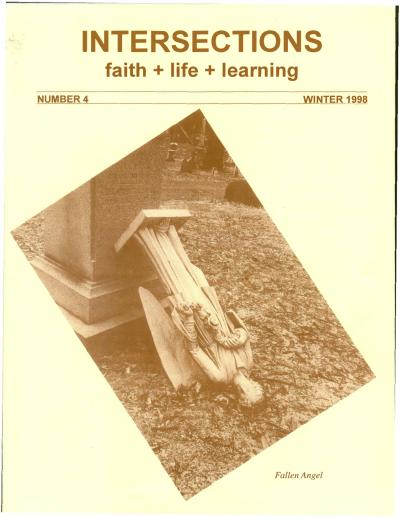
No. 4 · Winter 1998
Braxton appreciates the dialectical structure of Santmire’s mandates—“skeletons in our closets and riches in our own vaults”—and reads it as a faithful expression of the Lutheran tradition of Paul, Augustine, and Luther. He argues that Santmire is on target in warning against premature flight to non-Christian traditions for environmental wisdom (theoretical sensitivity does not translate into ecological behavior in practice), and that classical Lutheran social ethics has too often been quietistic. But Lutheran ethics at its best is dialectical, not dualistic—recognizing the interpenetration of church and world, Law and Gospel, eschatological Kingdom and present realities, as in Hegel, Ritschl, Bonhoeffer, Reinhold Niebuhr, and Larry Rasmussen. Braxton commends environmental responsibility, social criticism of unsustainable practices, and a liturgical practice of resistance to instrumentalism as appropriate next steps for Lutheran liberal arts colleges, especially Capital University.
-
 Article
Lutheran Identity, Academic Integrity, and Religious Diversity
Storm Bailey
No. 25 · Spring 2007
Bailey argues that one might rightly say of a college “that’s a pretty good school because it’s religious,” defending the proposition under three headings: academic and curricular virtues, free inquiry, and religious diversity. Drawing on Mark Schwehn’s Exiles from Eden, Richard Hughes on the Lutheran tradition’s “most potent theological resources” for the life of the mind, Parker Palmer, Lendol Calder, Mill’s On Liberty, Newman’s Idea of a University, and the AAUP’s 1940 Statement, he proposes a “critical mass” alternative in which the Lutheran commitment to truth-seeking and self-critique itself requires—rather than tolerates—a religiously diverse faculty whose opposing voices are needed for the mission to flourish.
-
 Article
Say Something Theological: A Meditation on the Vocation of Lutheran Colleges and Universities to Serve the Common Good
Paul C. Pribbenow
No. 42 · Fall 2015
Pribbenow expands Luther’s “priesthood of all believers” into a meditation on doing theology with the Bible in one hand and the New York Times in the other — reading Luke 14 alongside walls, immigration, and hunger in his Minneapolis neighborhood — and argues that the leadership of Lutheran colleges demands a willingness to engage the theological issues at the heart of their public vocation.
-
 Editorial
From the Publisher: Reflections on the 2024 Vocational Leaders in Higher Education Conference
Lamont Anthony Wells
No. 60 · Fall 2024
Wells reflects on the 2024 VLHE Conference theme — “Educational Access: Lutheran Roots, Contemporary Practices” — tracing today’s commitment to inclusivity back to Martin Luther’s radical 16th-century insistence that both boys and girls be educated, and previews NECU’s expanded engagement of student leaders alongside faculty and administrators.
-
 Article
Integrity and Fragmentation: Can the Lutheran Center Hold?
Robert Benne
No. 8 · Winter 2000
Benne answers the conference’s question pessimistically—“the Lutheran center cannot hold in many, if not most of our colleges, because it was never there in an articulated form in the first place”—and distinguishes “Christ of culture” colleges like the Midland Lutheran of his youth (Lutheran by ethno-religious ethos rather than by articulated theology) from James Burtchaell’s “confessional colleges” that operated from a theologically distilled Lutheran humanism. Drawing on Alasdair MacIntyre and Mark Schwehn’s First Things essay on Christian universities, he sketches what a Lutheran center looks like (unity, universality, integrity, a tradition of thought) and how its distortion—reducing the Gospel to justification and ceding everything else to autonomous reason—splits Christ and culture as dangerously as the German church separated Gospel and politics. For colleges that have lost their center, he proposes an “intentional, robust pluralism” that guarantees a Lutheran voice in every department and an “affirmative action for Christians” in hiring.
-
 Editorial
From the Editor
Tom Christenson
No. 6 · Winter 1999
Christenson explains that three of the five papers from the 1998 Wittenberg Vocation of a Lutheran College conference appear here (with Robert Scholz and Cheryl Ney to follow in the next issue), passes on Andy Sheppard’s “Books for Belarus” appeal from Southwestern College, and reflects on Douglas John Hall’s The End of Christendom and the Future of Christianity—its claim that disengagement from cultural dominance is the prerequisite for faithful re-engagement, and its retrieval of Christ’s metaphors of “a little salt, a little yeast, a little light” as a possible session topic for a future VLC Conference.
-
 Article
Hospitality is Not Enough: Claims of Justice in the Work of Colleges and Universities
Paul C. Pribbenow
No. 35 · Spring 2012
Pribbenow argues that Augsburg’s incarnational motto — “And the Word became flesh” — grounds a calling beyond hospitality to justice. Drawing on Stephen Carter on civility, Letty Russell on just hospitality, Henri Nouwen, Parker Palmer, Michael Sandel, Bonhoeffer, Niebuhr, and Teresa of Avila, he describes four components of Augsburg’s practice: education “off the main road,” co-created common life, abundance over entitlement, and the anchor-institution model in which colleges become economic and civic partners with their neighborhoods.