Five years ago I began teaching a one credit course for our biology majors entitled Becoming Biologists: Understanding our Place as Life Scientists. The story of the development of this course has been the story of my development as a teacher as well as the story of how I have come to understand the importance of discussing values in the development of a scientist. Creating an introductory course such as this one in any major presents an interesting challenge in backward curriculum design. Knowing the skills, abilities, and dispositions we would like to see in our graduating seniors, the question becomes: which conversations, lessons, and assignments are most relevant to have at the beginning of their development? As a biology teacher, I was asked to step back from the content of my discipline (the sweet comfort zone for many, including myself) and to view the discipline at large in an effort to piece together a story of how “biology” is conducted and what it involves.
Trained as scientists, biology professors instinctively begin with intellectual skills: How can we begin proposing hypotheses? How can we talk about the basics of experimental design? How can we connect learning to theory and physical elements of the brain to encourage metacognition? How can we apply scientific thinking to scientific arguments in order to test claims? But more difficult questions follow: How can we teach students to develop their own questions? How can we prepare them to speak articulately about themselves as learners and biologists? When we think about training our students to emerge as skillful scientists and thinkers, these are the sorts of intellectual acts we want them to practice throughout our curriculum, beginning in the Becoming Biologists course. However, the challenge in a course built from skills alone is that you still have to choose content or stories in order to test the skills.
The introductory course sounds absolutely brilliant from a curriculum design perspective. Yet, the story of the development of this course and my own teaching begins with student distaste for—and kick-back against—“skill lessons” and my subsequent desperate search for meaningful stories and conversations that might engage them. Frustrated by student resistance, I found myself in a state that Robert Pirsig articulates well in Zen and the Art of Motorcycle Maintenance as drifting laterally for a while to expand the roots of what I already knew, even though I was determined to expand the branches and move forward (169). I knew what I wanted to teach them, but I didn’t how to get them to embrace this particular kind of learning. The lateral drift sent me in two directions—toward conversations with students and to the college library. I needed to learn which stories the students perceived as missing in their understanding of how “biology” is conducted. I also needed to read more stories from biologists across the many subdisciplines of biology.
The first story I happened upon was an obvious choice given the title of the course I was stumped by, On Becoming a Biologist, by John Janovy Jr. The author, a well-known parasitologist and educator at the University of Nebraska-Lincoln, intertwines stories from philosophers, scientists, and educators about the ideals and practical matters of pursuing a professional academic life in the biological sciences. I recommend this book to every student I meet in the classroom. I include readings from it in my course, and have loaned my copy to several students to gather their thoughts about it. The roots of what I have known about biology and biologists have expanded greatly thanks to this small book. I hope a book like it exists in every discipline.
In the Spring of 2012, I was fortunate to have an ambitious, capable, and insightful student in my senior inquiry course with a natural curiosity for understanding disease in living systems. He had great potential to thrive as a graduate student and researcher. I loaned him Janovy’s book so that he might consider a vocational calling to organismal biology as a researcher and educator. He also agreed to meet again and discuss his thoughts about the book and his own undergraduate experience in biology as a recent alumnus. Returning the book, the student had flagged this passage:
In one critical area—the reason biologists study living organisms our whole lives through—education is left largely to chance, and the responsibility for those lessons falls on student shoulders. The idea that science classes must, from bell to bell, deal only with observations, interpretations, and experimental design is a delusion. (Janovy 7)
The student suggested that this passage might guide me in my efforts to generate better purpose and buy-in from students in the Becoming Biologists course. Janovy’s discussion of values in determining biological research interests and vocational choices had intrigued him. He couldn’t recall being asked to consider the values of biologists in our curriculum.
One of Janovy’s central arguments is that values are legitimate tools in biology because they allow us to work in areas of thought into which we would otherwise not have access (Janovy 7). Janovy describes a beloved teacher and mentor who often drew upon poetry and art as teaching devices in biology courses to explore abstractions and perceptions in the study of biology. By examining the values and meanings expressed by others in their work, whether of art or science, we can better express the realities conveyed in our observations and interpretations. By being exposed to the values of his teacher and mentor as well as being asked to consider his own values as a student, Janovy was able to expand his intellectual skills and find direction and legitimacy for his own biological interests. Through his personal experiences and story, Janovy challenges biology educators to integrate the life choices of scientists into our teaching of biology so that we might guide students toward answering some fundamental questions about vocational goals: “Should I become a biologist?” Or even: “Am I a biologist without knowing it?” (Janovy 8).
I took away two fundamental lessons from the student’s perceptions. First, perhaps the best approach in an introductory biology course with learning goals centered on intellectual skill development is to choose the biological worldview as the overarching theme. Skills, while necessary, are not actually the inspiration for a life’s work. Visions and values may very well be. Second, when integrating the stories and content of the introductory course I should always remember to talk about the fundamental curiosities, ideas, and values that have shaped scientists. These lessons helped me envision how I might completely deconstruct my course and rebuild it. I needed to meet students where they are—with their own values and goals—and to scaffold the intellectual skills into their own context. The lessons also made me think more critically and read more extensively about the scientists, philosophers, and educators I was teaching in order to be sure that curiosities and values were always brought to the forefront in our discussions on learning, thinking, and biology.
“Skills, while necessary, are not actually the inspiration for a life’s work. Visions and values may very well be.”
The course now begins with discussions and assignments about why students are interested in biology as a discipline of study and the many directions that a professional career within the life sciences may take. We then transition into stories about scientists and science. Before we begin looking at the work of any one scientist, I now spend more time developing the person behind the work. I explain his or her motivations, values, and the ideas and organisms that he or she has been most curious about.
For example, in one case study that we use in the course, we evaluate one of the arguments that Stephen Jay Gould makes in The Mismeasure of Man, a widely read popular science book that examines the argument that intelligence can be abstracted as a single number capable of ranking people by intrinsic mental worth (20). In the revised edition of his book, Gould explains his reasons for originally writing The Mismeasure of Man, including his family’s participation in campaigns for social justice, his own participation, and his strong feelings about fallacious arguments of biological determinism. Gould argues that the best form of objectivity lies in identifying preferences so that their influence can be recognized in the work of a scientist. He acknowledges that preferences often must be identified in order to be eliminated. But such preferences also help us decide what subjects we wish to pursue in our limited lifespan. Gould claims that “we have a much better chance of accomplishing something significant when we follow our passionate interests and work in areas of deepest personal meaning” (37). He thus advocates the use of values to guide biological research interests in combination with the scrutiny of personal biases to uphold the overall goal of objectivity in science. By presenting both Gould’s motivations and his science through the case study in my course, I now enable students to practice the skills of skepticism and critical evaluation while also opening the discussion to the values and worldviews that shape the lives and contributions of biologists.
Over the past five years, my many conversations with students have led to insights of two general forms. First, they would like to have more conversations about career possibilities in the biological sciences and receive immediate practical advice about the right experiences to prepare them for future work (internships, research experiences, resumes, etc.). Second (and in some tension with the first), students would like to have more philosophical discussions about the nature of science itself. But whether our conversations are philosophical or practical, students (and alumni) and I almost always end up talking about the stories of biologists, about science as a way of knowing the world, and about vocational possibilities in the life sciences. The former student who directed my attention to Janovy’s quotation as a guiding idea for the Becoming Biologists course is only one example. Most of my personal conversations with students could very easily transfer into formal discussions as the theme of my course: the biological worldview. Furthermore, this theme might be often overlooked by science teachers focused on developing students’ intellectual skills and abilities insofar as those skills and abilities direct us away from passions and stories.
“Whether our conversations are philosophical or practical, students (and alumni) and I almost always end up talking about the stories of biologists, about science as a way of knowing the world, and about vocational possibilities in the life sciences.”
What I have come to realize in rebuilding my course is how discussions of the biological worldview and values were the obvious thread connecting our students to the study of biology and, potentially, to engagement with the intellectual skills involved in this type of work. My department had designed a course to teach students how to study biology, but perhaps we hadn’t given enough thought to the reasons why one might study biology. We also needed to train students to make their own choices based on their own values and preferences among the many subdisciplines and career paths extending from the study of biology. If our goal in the introductory course was to begin to prepare students in the skills, abilities, and dispositions that would best serve them in the future, we had overlooked some important parts of the dispositions. And while values lead to bias in the process of science, they also lead toward the questions we are most interested in asking about the natural world. Values provide the foundation for lifetime engagement in the work of science.
“While values lead to bias in the process of science, they also lead toward the questions we are most interested in asking about the natural world. Values provide the foundation for lifetime engagement in the work of science.”
The changes to my course are new enough that I can’t make any grand claims about significant gains, but I can say that this year I have learned more about my students’ personal interests sooner on in the course. They also talked more openly in discussions, and many of them left the course with stronger responses about their understanding of the work of biology than they were able to provide at the beginning. I haven’t had the same level of kick-back that I’d previously experienced. I am hopeful that my students have left the course with some practice at the intellectual skills involved in science as well as an enlarged understanding of why they might study biology and what it might offer to their lives.
Works Cited
Gould, Stephen Jay. The Mismeasure of Man. 2nd ed. New York: W. W. Norton, 1996.
Janovy, John Jr. On Becoming a Biologist. 2nd ed. Lincoln: University of Nebraska Press, 1996.
Pirsig, Robert M. Zen and the Art of Motorcycle Maintenance: An Inquiry into Values. 2nd ed. New York: HarperCollins, 1999.
-
 Editorial
From the Publisher
Mark Wilhelm
Wilhelm reports that decisions at the February 2013 LECNA and ELCA presidents’ meetings authorized reviews of funding and organizational practices and appointed a working group to draft a presidential statement on what it means to be a college or university of the ELCA, signaling a more substantive future role for the annual presidents’ gathering in shaping the shared identity and common mission of ELCA schools.
-
Editorial
From the Editor
Jason A. Mahn
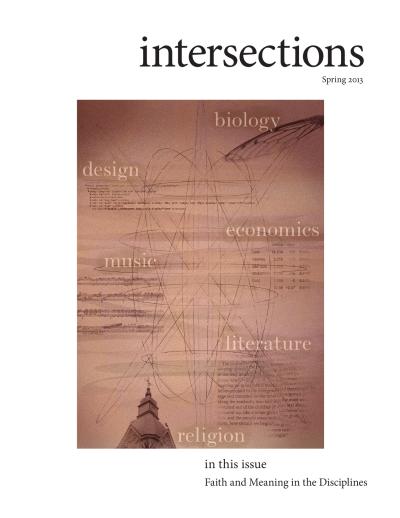
Mahn introduces the issue’s six essays as parallel attempts—from poetry, economics, choral music, biology, religion, and Lutheran higher education—to resist our culture’s fact-value split, and uses Augustana’s Fritiof Fryxell, a 1922 biology and English graduate who began teaching just as the Scopes Trial ignited, to illustrate how church-related colleges have long held faith and disciplinary inquiry together.
-
Article
Valuing Poetry
Allison Wee
Writing from California Lutheran University as “value” in higher education collapses into “can it get you a job?”, Wee makes a case for poetry as a life-saving discipline. Drawing on William Carlos Williams, Shakespeare, the Psalms, Wordsworth, Pattiann Rogers, Mary Oliver, and her own Environmental Literature assignment that sends students outside for an hour of attentive stillness, she argues that the poet’s skill of translation cultivates the close attention, fresh perspective, and immaterial dimensions of life her students need most.
-
Article
Calling Economists
Lynn Hunnicutt
Reading Luther’s Whether Soldiers, Too, Can Be Saved alongside Adam Smith’s Theory of Moral Sentiments and Wealth of Nations, Hunnicutt asks whether economists, too, can be saved—and whether economics can host a serious conversation about vocation. She traces her own move from Utah State to Pacific Lutheran University and its Wild Hope Center for Vocation, and turns to Deirdre McCloskey and George DeMartino as economists whose work makes room for vocation and the common good within the discipline.
-
Article
Singing Faith
Adam Luebke
Luebke describes the Waldorf College Choir as a community of faith whose daily devotions, century-long lineage from F. Melius Christiansen, and disciplined wrestling with sacred repertoire—from Fauré’s Requiem to African-American spirituals to Romans 8 sung backstage—form students spiritually as they form them musically, so that fully grasping what they sing becomes a discovery of why they sing.
-
Article
Professing Religion
John D. Barbour
Barbour reflects on the vocation of a Professor of Religion at St. Olaf College, asking when and how a teacher should disclose personal faith in the classroom. Drawing on his graduate teachers Anthony C. Yu and Langdon Gilkey, and on Augustine’s Confessions, Dorothy Day, Malcolm X, C. S. Lewis, and Kathleen Norris, he argues that teaching autobiography invites teaching autobiographically—and that professing religion is finally a matter of how one believes, not just what.
-
Article
A Lutheran Dialectical Model for Higher Education
Ernest L. Simmons
Drawing on “The Freedom of a Christian,” simul justus et peccator, Richard Hughes, Joseph Sittler, Martha Nussbaum, and Tom Christenson, Simmons argues that the Lutheran tradition informs an open, dialectical educational model that holds Christian and academic freedom together. He locates vocation at the intersection of the practical (why are you here?) and the existential (why are you here?) and proposes Lutheran higher education as education for self-transcendence and leadership Soli Deo Gloria.
-
 Article
What Does Ethical Leadership in a Changing World Require?
Kristina Frugé
No. 62 · Fall 2025
5 min audio
Frugé argues that ethical leadership in a changing — perhaps ending — world means cultivating trustworthy communities through patient, co-created relationship work, drawing on her experience stewarding the writing community behind Hungry for Hope: Letters to the Church from Young Adults.
-
 Article
Both Priest and Beggar: Luther among the Poor
Martha E. Stortz
No. 46 · Fall 2017
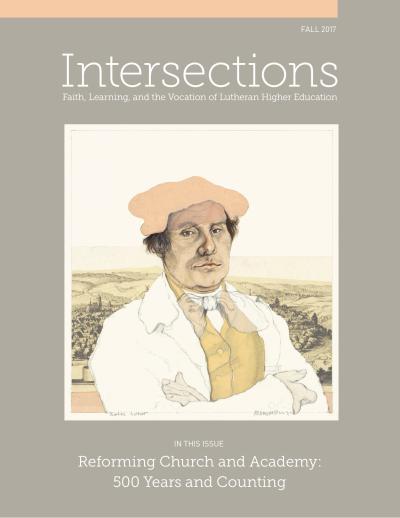
Reading Luther’s deathbed remark “We are all beggars” against his “priesthood of all believers,” Stortz argues that priest and beggar are two sides of a human reality — one that locates civic responsibility for the poor at the heart of the Reformation legacy and that pushes beyond paternalistic service toward the systemic question of justice.
-
 Article
Luther's Theology of Learning: Discovering the Vocation of Today's Small Lutheran Liberal Arts College
Eric Childers
No. 20 · Fall 2004
In an excerpt from his Wake Forest University Divinity School senior thesis, Childers profiles six students hand-picked by presidents and chaplains at Concordia College (Moorhead), Lenoir-Rhyne College, and Muhlenberg College—Nathan Gossai, Amy Nelson, Alison Schmidt, Ryan Sigmon, Julie Christianson, and Jeffrey Slotterback—as a living testament to Luther’s theology of learning. He then draws on Solberg, Mark R. Schwehn (in Paul J. Dovre’s The Future of Religious Colleges), Robert Benne, Ernest Simmons, Mark Noll, Richard Hughes, and James Burtchaell to argue that Lutheran colleges have not yet fully articulated their own theology of education and that their vocation is to embrace, engage, and galvanize a Lutheran tradition of learning rooted in the liberal arts, Scripture, the Confessions, and confident ecumenism.
-
 Response
Response to Mark Wilhelm: Adopting the Framework of ‘Because’ and ‘Therefore’
Paul C. Pribbenow
No. 56 · Fall 2022
Pribbenow describes how Augsburg University responded to its dramatic demographic transformation (from 18% to nearly 70% BIPOC entering students over sixteen years) by adopting an institutional vocational statement and a simple “because/therefore” framework for translating particular Lutheran theological convictions into institutional programs, policies, and practices.
-
 Response
Hitting a Moving Target
Harry Jebsen
No. 3 · Summer 1997
Jebsen, former Provost of Capital University, responds to Reichenbach by arguing that the institutions, the ELCA, congregations and pastors, students, and curriculum are all moving targets. Drawing on Alvin Toffler’s Future Shock and his own fifteen years of hiring as Dean and Provost (a candidate who hoped the cross out front didn’t mean anything), he traces the drift from the “Mr. Chips” faculty who personified Dana and Midland Lutheran to a campus culture where “everybody is nice to each other” has replaced theological substance, and where MBA programs, conservatories, law schools, and adult-education programs further dilute the focus of the residential Lutheran college.
-
 Article
Finding Flourishing: Teaching Self-Care as Course Content
Emily Kahm
No. 49 · Spring 2019
Kahm argues that teaching self-care, self-awareness, and stress-coping as explicit classroom content embodies the “radical hospitality” of Rooted and Open and supports vocational formation against a consumerist culture, then offers concrete classroom techniques — a one-to-five energy check-in, ninety-second silence exercises, and full-day spiritual practices — that can be adapted across disciplines at NECU institutions.