Reprinted with permission from the January/February 2001 issue of Academe.
As a group, religiously affiliated colleges are much like those with no religious connections. Some have a lot of money, but most get by on less. Some have wide name recognition; others enjoy a regional reputation or none at all. Some have sensitive and competent administrators who are on good terms with faculty, and some fall short of that blessed state. Some maintain high standards of academic excellence, but others achieve more modest (if not to say mediocre) levels of academic quality. Religiously affiliated institutions resemble their secular counterparts in these and other ways because they are subject to the same forces and circumstances that affect all of higher education. At the same time, however, the religious identity of these colleges has the potential to set them apart by making a distinct contribution to their character and quality. In the area of community life, for example institutional aspirations and policies are often explicitly linked to religious commitment or identity.
My own college is one of twenty-eight institutions affiliated with the Evangelical Lutheran Church in America. These colleges see lives of service, the integration of values and practice, and the ideals of character and community as essential to their identity. Insofar as people on campus—in or outside the religious tradition—value such goals, pursuing them and achieving them will be perceived as adding to the college’s quality.
It is not so surprising when the religious identity of a college or university is taken to contribute to its community life, but observers of higher education seem less likely to view religious commitment as integral to academic goals. Many people see religion and academics as uneasy partners, if not completely at odds. This inclination shows itself when we think or speak of schools as being pretty good academically in spite of their church or religious affiliation. It is only fair to note that we have a good deal of evidence—historical and contemporary—to justify such reactions. But the question is whether such a state of affairs must be. Are there ways in which the religious commitments of colleges and universities can and do serve their academic aspirations?
The answer to this question is yes on several grounds. Take, for example, the conception of service already mentioned in the context of campus life. Many church-related colleges were founded as mission institutions—not in a narrowly evangelical sense, but in that of service to individuals and society. Service is central to the academic purpose of these schools. In Models of Christian Higher Education, Pepperdine professor of religion Richard Hughes identifies the ongoing theological commitment to service as a chief contribution to the life of the mind in historically Mennonite colleges—which are but one group of colleges among many to have such a commitment. Service is learning in practice, and although neither the practice nor the pedagogy of applied learning is exclusive to church-related educational communities, the religious commitments of such institutions straightforwardly affect their academic quality through their emphasis on service.
I use the phrase “educational communities” advisedly, because it is plain that higher education is a communal activity. Even those who are inclined to view Plato’s allegory of the cave—a tale of individual enlightenment—as the paradigm of true learning cannot ignore the fact that the story, like all of Plato’s ideas, is offered in dialogue form. Teaching and learning take place in networks of committed relationships. (Plato’s own academy was a religious community of sorts that endured for nearly a millennium.) Religion is certainly not the only basis for community, but just as certainly, it is a common one. Is religious commitment, particularly in what has been called the Hebrew-Christian tradition, as fruitful a foundation for academic communities as other shared commitments? Education theorist Parker Palmer and Mark Schwehn, dean of Christ College at Valparaiso University, to name just two, believe that it is.
In Exiles from Eden, Schwehn emphasizes the role of community in knowing and, therefore, in learning. The intellectual life, he suggests, is inseparable from the moral life, and the Christian tradition, among others, nourishes both. The pursuit of truth, writes Schwehn, is linked inextricably to care taken with the lives and the thoughts of others. Thus, he argues, the academic life requires such spiritual values as humility, self-sacrifice, and charity. Whole-hearted acceptance of Schwehn’s communitarian epistemology is not necessary for the purposes of the present argument. To whatever extent readers recognize the role and importance of community in higher learning, religious commitment can be seen to support that learning.
Integration of Knowledge
At the institutional level, religious identity serves academic goals by providing a framework for integrating disciplinary pursuits and perspectives. We may be lucky enough to escape the extreme ideological and administrative strife leading to what English professors Cary Nelson and Stephen Watt, in Academic Keywords: A Devil’s Dictionary for Higher Education, call entrepreneurial disciplinarity, which despairs of identifying any common institutional mission, even within disciplines. But tension between disciplinary specialization and integrated understanding is a perennial academic problem, one that is increasingly acute in undergraduate liberal arts colleges but my no means restricted to such institutions.
Religiously affiliated colleges and universities have, it seems, a great advantage in addressing this problem. Insofar as the core claims of the affiliated religious tradition cut across disciplinary lines, and insofar as those claims are taken seriously, they provide a set of questions that can help to integrate the various elements of a course of study. (These core claims or questions serve this academic function for all members of the college community—whether they are in the affiliated religious tradition or not.)
Of course, if the religious commitment of the institution amounts to no more than lip service, or if the core questions are seen as being imposed on some by others or widely held to be irrelevant to serious scholarly inquiry, then this particular benefit is unlikely to result. It follows that the more substantive the religious commitment, the greater the academic benefit. Substantive religious commitment in an institutions means, in part, having a faculty and administration that take the core questions of the tradition seriously. Respect for these questions and attention to them does not imply an imposed consensus about their answers. In fact, having the broadest possible range of perspectives on the common questions would seem to facilitate the integration of a course of study. And such integration is a hallmark of educational quality.
Academic Excellence
If religiously affiliated universities are the natural habitats for applied learning, paradigm learning communities, and bastions against the malaise of fragmentation and disciplinary disintegration, why do we find ourselves so suspicious of their academic potential? What explains our propensity to say, “They are pretty good in spite of the religion”?
I acknowledged one answer earlier: religiously committed institutions and individuals do not have an exemplary track record. Readers of these pages are as likely as anyone to be aware of offenses against academic excellence in the name of religious commitment. The offenses most often take the form of undermining a key principle of such excellence: autonomous inquiry, or academic freedom. I do not propose to defend religious (or any other) encroachments on academic freedom. Some of them—past and present—simply cannot be justified.
Certain practices might be supported by the claim that religious commitment serves academic goals and therefore may legitimately qualify academic freedom. That may well be so, although all such qualifications face the danger of becoming self-defeating at some point for academic institutions. But I don’t wish to add to that long-standing discussion here. Instead, I’ll suggest two ways in which religious commitment nurtures academic excellence by supporting academic freedom. My remarks focus on the Christian religious tradition—with which I am most familiar—but their application goes beyond church-related institutions.
Truth Seeking
The first way in which religious commitment supports free inquiry is by emphasizing truth seeking. This key component of the Christian religious tradition straightforwardly allies it with the most influential modern thinking about free inquiry and expression. In On Liberty, for example, John Stuart Mill bases his defense of absolute freedom of expression on the value of truth and the imperative to seek it.
Why isn’t it obvious that religions professing to seek the truth, a task served by open inquiry, have a strong interest in academic freedom? One explanation comes immediately to mind: ironically, strong religious commitment is often suspected of being weak on academic inquiry precisely because of its dedication to truth. To profess to have the truth (as religions do, after all) is, one might suppose, to offer grounds for not continuing to look for it, or to ask questions. Such an approach has too commonly been characteristic of strong religious commitment—both in and outside the academy.
The approach pointedly fails, of course, to take sufficient account of uncertainty. One can do no better here than to quote Mill: All silencing of discussion, he writes, is an assumption of infallibility. To shut of the airing of the alternative views on grounds that the truth is known is implicitly to claim certainty. But Mill’s reminder about fallibility does not constitute an external restraint on the Christian religious tradition as institutionally expressed. The notion of human weakness—including epistemic weakness—is as central to the Christian tradition as any idea. Insofar as the possibility of being mistaken motivates free inquiry in the pursuit of truth, such inquiry might be a hallmark of the Christian tradition and its institutions of learning.
So the Christian tradition—and, by extension, the learning institutions associated with it—has internal reasons for allowing free discussion, even of its own basic truth claims. But it is not only when people suspect they might be mistaken that they ought to welcome questioning; even confidently held true beliefs require it. Mill argues that our highest intellectual ideal is not simply to hold true beliefs, but to hold them in a certain way:
“Even if the received opinion be … the whole truth; unless it be suffered to be, and actually is, vigorously and earnestly contested, it will … be held in the measure of a prejudice, with little comprehension or feeling of its rational grounds. And not only this, but … the meaning of the doctrine itself will be lost or enfeebled, and deprived of its vital effect on the character and conduct.”
The approach Mill recommends seems crucial to fostering active, engaged learning that will result in lives of informed service. If religious commitment, as I said above, stresses the need to seek truth, it would benefit as well from the rigorous free discussion Mill advocates.
My argument that religious commitment supports academic freedom through its emphasis on truth seeking can be read two ways: that it does so in principle, or that it does so in common practice. If read primarily in the first way, my argument will be understood to promote free inquiry on religious grounds. This might seem to be a bizarre sort of preaching to the choir, since readers of Academe are, by and large, in little need of persuasion that free inquiry is a good idea. But active religious support for free inquiry is, I think, more common than many people suppose—now and in history. Even if it is not, mentioning the religious argument for greater academic freedom reminds us, at the very least, that we need not choose between our religious commitment and our academic ideals.
Foundations for Free Inquiry
The final point I wish to make goes one step further: religious commitment may be more than merely congenial to our academic ideals—it may be the foundation for them. Ideals of free inquiry and expression come to us from a political tradition that has, in the estimation of some, fallen on hard times. A core aspiration of this tradition is content-neutral institutional policies (those that, for example, treat all religions in the United States or all ideas in the academy equally). It is especially important, in the liberal tradition, for policies to be neutral about substantive claims of value or the nature of persons. But their need to be so gives rise to a certain paradox, because justifying liberal institutional policies requires an appeal to specific claims about persons and value.
One response to this paradox has been to reject liberal policies—either because neutrality is impossible, or because the claims about the autonomy of persons that traditionally ground them are deemed false. But rejecting such policies is not an attractive option for defenders of academic freedom. If it’s impossible to make policies that are neutral all the way down, the alternative is to defend policies that are neutral in practice on the basis of substantive commitments about persons and values. The religious commitments that give rise to the liberal tradition are certainly not the only basis for doing so, but they are an important one.
The defense of academic freedom demands a foundation. Personal and institutional religious commitment provides one—not uniquely, but unquestionably. Nicholas Wolterstorff eloquently expresses this idea in his article in this issue of Academe when he argues that the abridgement of academic freedom constitutes a profound violation of the person. In this world of ours, he writes, there’s nothing of greater worth than persons, and correspondingly, no greater evil than the violation of persons. The violation of a person is the desecration of one of the images of God.
Injustice in the name of religion has, tragically, been as common inside the academy as outside of it. But to really make a stand in opposition to injustice, we need religion—or something very like it. Providing such support is potentially the greatest contribution of religious commitment to academic excellence and to the policies that promote and defend it. This contribution should not go unrecognized; nor should it be allowed to remain a mere possibility where it is as yet unrealized.
-
 Editorial
From the Publisher
Arne Selbyg
Selbyg admits that promoting Lutheran colleges and universities can feel Sisyphean—clueless faculty or staff, fundraising treadmills, students and parents treated poorly by admissions, pastors with no sense of the colleges’ mission—but reports that alumni satisfaction surveys, ELCA-college faculty seminars, an engaging bishop, Ernie Simmons’s Lutheran Higher Education: An Introduction, and renewed reader interest in Intersections all show the stone is not at the bottom of the hill.
-
Editorial
From the Editor
Tom Christenson
Christenson explains that this issue “borrows everything from other sources”—Richard Hughes’s talk at Pepperdine president Andrew K. Benton’s inauguration, Nicholas Wolterstorff’s and Storm Bailey’s essays from the AAUP’s Academe, and Catherine McMullen’s Concordia talk—and defends the blatant borrowing as appropriate to faculty work, hoping new faculty will find in these pieces a corrective to common misconceptions about faith-related education and academic freedom.
-
Article
The Idea of a Christian University
Richard Hughes
Hughes’s lecture at the inauguration of Andrew K. Benton as the seventh president of Pepperdine argues that a Pepperdine-wide “strategy of community-wide conversation,” carried by the new Pepperdine University Center for Faith and Learning, can sustain the school as a Christian university by leaning into the paradox of Christian particularity rather than around it. Drawing on the incarnation, the Matthew 5 and Luke 14 teachings of Jesus, the Quaker and Cane Ridge (Joseph Thomas) abolition traditions, Galatians 2 and Romans 8, and Luther’s simul Justus et peccator as the gospel that frees the scholar to be wrong, to doubt, and to confess “Lord I believe; help thou mine unbelief,” he mines the Churches of Christ heritage—Alexander Campbell, Barton W. Stone, and John Rogers of Carlisle, Kentucky—as a unity-and-freedom tradition that grounds both diversity and academic freedom.
-
Article
Ivory Tower or Holy Mountain? Faith and Academic Freedom
Nicholas Wolterstorff
Wolterstorff defines infringement of academic freedom as impairing a faculty member’s standing on account of the ideological content of her position, argues that academic freedom (like free speech) is “duly qualified” rather than absolute, and offers eight considerations bearing on religiously based institutions: Weber’s differentiation of Wissenschaft, religious pluralism within a liberal polity, the vitality of American civil society, a decentralized educational system, the “holistic” character of much American religion, the post-Kuhnian collapse of classical foundationalism and of the “generically human” academy, the fact that ideas matter, and the personhood violated by infringement (the desecration of an image of God). He concludes that the private sector offers wider academic freedom than the public, that religious qualifications are not inherently inappropriate (any more than St. John’s Great Books commitment), but that religiously based colleges too often apply them unjustly—arbitrarily, secretly, without recourse—and that the AAUP’s best service is model codes of procedure.
-
Article
Can a Christian Be a Journalist?
Catherine McMullen
McMullen recounts how Ernie Mancini’s alumni-program invitation forced her to articulate what a print-journalism major at Concordia might be, then surveys the annus horribilus of 1998—Chiquita and the Cincinnati Enquirer, CNN/Time’s retracted Tailwind story, Patricia Smith and Mike Barnicle fired at the Boston Globe, Stephen Glass at The New Republic, and Matt Drudge and the White House scandal—before contrasting Concordia’s liberal-arts approach with Pat Robertson’s Regent University, whose “Christian journalism” produces one-sided vampire-cult stories and graduates who conclude journalism is no place for a Christian. Drawing on Richard Baker’s The Christian as a Journalist, Tom Christenson on the “law of niceness,” Ernie Simmons, Harmon Smith and Louis Hodges on Christian ethics, Robert Benne’s Lutheran four orders and his “Christian cobbler makes good shoes, not poor shoes with little crosses on them,” Mel Mencher, Robert Bugeja, Walter Cronkite, Pete Hamill, Jeremy Iggers, David Remnick, the Northwestern Death Row exoneration of Dennis Williams, Verneal Jimerson, and William Rainge, and Pulitzer citations for Katherine Boo, Eric Newhouse, George Dohrman, and Mark Schoofs, she argues that journalism is a Lutheran vocation and that Christian cobblers—and Christian journalists—make good shoes.

-
 Article
Low-Hanging Fruit, Moonshots, and Coffee: Dreaming Big Within and Beyond Our Limitations
Jeremy Myers
No. 59 · Spring 2024
Myers shares the process used by Augsburg’s Christensen Center for Vocation to help teams move from a shared experience to next steps — an Ignatian-rooted Awareness Examen followed by naming low-hanging fruit, moonshots, and the coffee conversations that build the coalition to make it all happen.
-
 Reflection
On Sharing the Sacred Sauna
Rosemary Radford Ruether
No. 30 · Fall 2009
Reprinted from the National Catholic Reporter (August 1968), Ruether’s reflection from her time as a theologian on the faculty of Holden Village describes Lutheran community life in the mountains of northern Washington from a Catholic perspective — finding more catholicity in this Lutheran retreat than in many Roman Catholic communities — and culminates in a celebration of the Holden sauna as “the new sacrament, the new fellowship, the new theology.”
-
 Article
The Lutheran Theological Tradition and Recruiting Lutheran Students
Ernest L. Simmons
No. 13 · Winter 2002
Simmons opens with an Abraham-and-Isaac “Windows 98” joke to illustrate the dialectic of faith and learning, then argues that in a new market era of limited religious background, intentional mission and marketing go together. Drawing on Levine and Cureton’s When Hope and Fear Collide for the Millennial Generation born in 1982 and Tom Beaudoin’s Virtual Faith for their GenX parents, he reads “Reclaiming Lutheran Students” survey results showing 86% strong community at ELCA colleges versus 54% at flagship publics and 61% alumni mentoring versus 39%. He then develops three areas where the Lutheran tradition uniquely equips its colleges—community, mentoring and vocation, and the integration of faith and values—using Luther’s “two kingdoms” image of the “Left Hand” (reason) and “Right Hand” (faith) of God, with academic freedom as a product of Ahlstrom’s “Critical Current” in the tradition, and closes with three challenges: recruiting and retaining mentoring faculty, educating church leaders, and reaching potential students and parents.
-
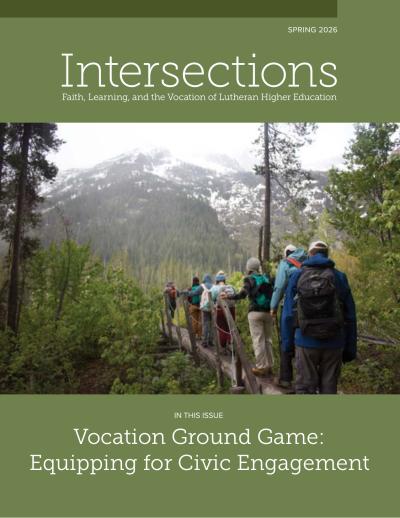 Article
Leaning-In to the Civic Lessons of Our Namesakes
A. Lanethea Mathews-Schultz
No. 63 · Spring 2026
6 min audio
Mathews-Schultz uses the civic legacy of the Muhlenberg family — from General Pete’s Revolutionary call to action to President Muhlenberg’s inaugural address on the “education of conscience” — to invite students at Muhlenberg College into a shared civic inheritance.
-
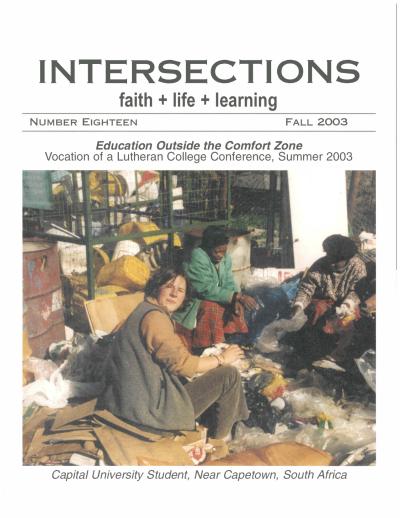 Article
Educating for Peace: 21st Century Models for Thinking Globally and Acting Locally
Janet E. Rasmussen
No. 18 · Fall 2003
Rasmussen opens with a rabbinic story about the one-step distance between East and West and describes Pacific Lutheran University’s four-phase “Global Education Continuum”—Introductory, Exploratory, Participatory, Integrative—developed with Teagle Foundation support and grounded in Perry, Bennett, and Musil. She illustrates intentional global/local partnership through three case studies: Barbara Temple-Thurston’s Trinidad-and-Salishan initiative; the China Partners Network with the Amity Foundation, Good Samaritan Hospital, and PLU’s Wang Center; and Ann Kelleher’s three-institution “Norway in Namibia” partnership with Hedmark University College, the University of Namibia, NAMAS, and the Ondao mobile schools for the Himba people. She closes with Daloz, Keen, Keen, and Parks’s Common Fire research and Lee Knefelkamp’s call to be “communities of peace.”
-
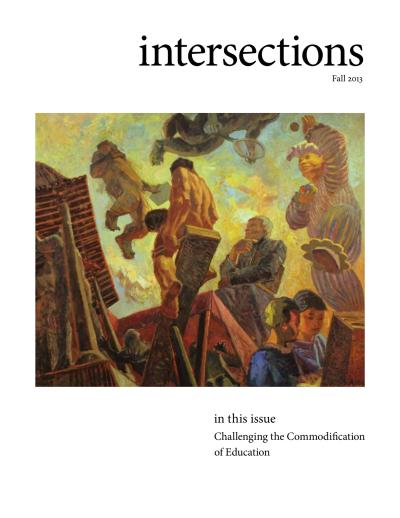 Article
More Value than Many Sparrows: A Sermon on Matthew 10:26-31
Patricia Lull
No. 38 · Fall 2013
Preaching at the 2013 Vocation of a Lutheran College conference, Lull recalls her own arrival at the College of Wooster the summer after Kent State and contrasts that era’s sense of students as participants in a college’s mission with today’s talk of “butts in seats.” Reading Matthew 10:26-31, she promises that the way of the cross—and its hard opportunities for slow-paced learning, genuine debate, and access for students who cannot pay the full cost—is the easy yoke, the lightest burden of all.