I have a big problem with civil discourse and civility itself. I wonder if they are broken beyond repair. If not irreparably broken, then I think it is time for a major overhaul.
On June 29, 2018, The New York Times published a piece with the title, “White America’s Age-Old, Misguided Obsession with Civility.” In it, the Rev. Dr. Martin Luther King, Jr.’s “Letter from Birmingham Jail” is quoted: “I have almost reached the regrettable conclusion that the Negro’s great stumbling block in his stride toward freedom is not the White Citizen’s Council-er or the Ku Klux Klanner, but the white moderate, who is more devoted to ‘order’ than to justice; who prefers a negative peace which is the absence of tension to a positive peace which is the presence of justice” (Sugrue).
The day before, on June 28, Vann Newkirk II wrote for The Atlantic, “As has so often been the case, the demands for civility function primarily to stifle the frustrations of those currently facing real harm…. Poor people, immigrants, black activists, and perhaps LGBT employees at a restaurant in Virginia1 are bludgeoned into silence by the constant cry for civility, made to hold still as injustices are visited upon them.” Newkirk concludes, “Civility is the sleep-aid of a majority inclined to ignore the violence done in its name—because in the end, they will be alright” (Newkirk).
From Policing Civility to Neighboring and Accompaniment
The rules of civility regularly translate into the majority’s rules—play “nice” and behave (because I say so!)—so count me in among those who say it is time to set them aside and look elsewhere. The two pieces I mentioned resonate deeply with some of the most unsettling challenges from my own Christian faith journey. How often are the words civility and Christianity, and their related networks of ideas, used to shut up, to shut down, and to shut out? How frequently do people, in the names of both civility and Christianity, sustain the status quo of systems that scold and dismiss, that harm people and perpetuate injustice? Thankfully, the parallel I see between civility and Christianity does not end here. I yearn for a Christianity that is durable and resilient enough to carry our greatest suffering and biggest problems as well as our deepest compassion. I have the same longings for civility and civil discourse.
“How frequently do people, in the names of both civility and Christianity, sustain the status quo of systems that scold and dismiss, that harm people and perpetuate injustice?”
Over the past few years, my longings for Christianity have brought me to focus less on beliefs and more on practice. It is not that I don’t find discussions of Christian theology important. I do. And it is not that I see myself and my actions as of ultimate concern. I don’t. What I find important and urgent is my need for finding my way in this world day in and day out. So I am practicing Christianity. These days I am listening deeply and listening daily to the words of Jesus as he tells me to love God and love my neighbor as myself. I am practicing loving: loving God, neighbor, and self. I am practicing Christianity as neighboring and it seems to me that neighboring ought to be the beating heart of civility and civil discourse. Not the majority’s rules. Not play nice. Not behave (because I say so!). Neighboring.
“Neighboring ought to be the beating heart of civility and civil discourse.”
When I consider Christianity as neighboring, the most helpful guidance I know comes from the model of accompaniment used by the Evangelical Lutheran Church in America. Originating in the ELCA’s Global Mission Unit, accompaniment is journeying together in solidarity, living with the understanding that our lives are interwoven and interdependent.2 Accompaniment is first, foremost, and always relational. Accompaniment puts flesh on the bones of neighboring. While nearly all of its ideas are appealing to me, it is the five values of accompaniment that I find concrete and specific enough to be practical, to be practice-able. This is why I aspire to practice them on a daily basis; this is why we’ve adopted the five values of accompaniment as the values of service for Campus Ministry at Concordia College; and this is why I propose we all carry these five values with us whenever we set out to practice civility and civil discourse. The five values of accompaniment are as follows:
- Mutuality
- Inclusivity
- Empowerment
- Sustainability
- Vulnerability
I propose that at each of our ELCA colleges and universities we rewrite civility as neighboring and use the five values of accompaniment as our guide.
Unpacking the Values of Accompaniment
I would now like to share some of the richness of how the ELCA specifically unpacks these universal values. At the same time, I will share some examples of the five values in action from within the Concordia community. These are my examples. They are from my perspective and they are not necessarily drawn from civil discourse, but I hope they can still serve to get our creative juices flowing as we consider rewriting civility as neighboring by using the five values of the model of accompaniment.
Mutuality is grounded in the belief that we all have strengths, resources, challenges, fears, hopes, dreams, and shortcomings to share in every circumstance (Global Mission). When I design reflection on service, mutuality is almost always the starting point. Was this experience mutual? How do you know this? These short questions can go a long way while reflecting after a service engagement. They can reveal and contribute to rewiring the “white savior complex” and to disrupting feelings of, “Hey, good job! That’s all done. Back to (my) life!” They focus attention on people and relationships as opposed to tasks and self-congratulation.
The value of inclusivity as upheld within the accompaniment model recognizes that someone is always excluded; accepting this as given, we “seek to build relationships across boundaries that exclude and divide” (Global Mission). Thanks to a Circle Keepers training organized by my colleague, Amena Chaudhry, I’m committed to “keeping circle” as a vital, equitable, and relational practice. An example from circle keeping is to pass a talking piece around a circle of conversation (Pranis 35). Everyone gets a turn to speak without interruption and a person’s turn only ends when she/he chooses to end it by passing on that talking piece.
The ELCA translates the value of empowerment into the following intention: “We seek to identify and correct imbalances of power, which may mean recognizing and letting go of our own” (Global Mission). I find the explicit naming of this need to let go important, especially because I hold a lot of power and privilege and I am accustomed to this status. This past academic year I collaborated with four black male Concordia students, inviting them to explore the topic of black male anger as a Chapel during the week of MLK. I am grateful that they answered with an enthusiastic and inspiring yes. My job was not to shape the message; my job was to create an environment, tend to relationships, and design a process whereby these four students could discover, draft, and refine what they wanted to say, including questions that they wanted to pose.
In the context of accompaniment, sustainability recognizes that tending to relationships and community leads to more durable shared efforts (Global Mission). Last spring, after listening to the insistence of compassionate students and in partnership with the disaster relief team of the Gulf Coast Synod of the ELCA, a group of 40 members of the college community travelled down to Pasadena, Texas to spend time with neighbors impacted by Hurricane Harvey. This fall, another group of students will head down to a nearby community, this time to learn about immigration, citizenship, and the mapping of community resources. Across campus, from week-long Justice Journeys to global learning partnerships, we’re increasingly putting our energies into sustaining ongoing relationships rather than initiating one-off transactions.
The article by Sarah Ciavarri in this issue of Intersections discusses vulnerability, the last value associated with accompaniment, and I am very thankful for her work. One of the ways I practice vulnerability is quite basic, but holds the potential to transform conversations, relationships, and me: when listening to another person, I practice presence instead of figuring out what I’m going to say next.
Clearly, I practice these five values a lot. Every day I practice not because I think practice makes perfect but because I think it’s important to exercise these muscles.
Concluding Thoughts
If civility is the sleep-aid of the majority (Newkirk), it is time for those of us who are the majority to wake up. Together, all of us must redefine the rules of civility so that “the frustrations of those currently facing real harm” are not “regularly stifled” (Newkirk). Let us commit to a civility that has neighboring as its beating heart and not the majority’s rules of playing “nice” and upholding the status quo. We need a civil discourse which can hold the biggest problems of our whole “glocal” neighborhood and the deepest compassion we have for each other as neighbors. Let us rewrite civility as neighboring using the five values of the ELCA’s model of accompaniment: mutuality, inclusivity, empowerment, sustainability, and vulnerability. Let us get started and start practicing today. And today will be a beautiful day in the neighborhood.
“Let us commit to a civility that has neighboring as its beating heart and not the majority’s rules of playing ‘nice’ and upholding the status quo.”
Endnotes
1. Both of these pieces were published in the days after Sarah Huckabee Sanders was asked to leave The Red Hen by Virginia restaurant owner, Stephanie Wilkinson.
2. While I’d previously heard of the model of accompaniment, my more thorough introduction to the model was in the context of an ecumenical training prior to serving as Associate Country Coordinator for the ELCA’s Young Adults in Global Mission Program in Southern Africa. Held in Toronto, this training also introduced me to the forced residential schooling of aboriginal peoples in Canada, a history we share in the United States. When I speak of the painful past of Christian (mission) history, such stories shape my perceptions and practices.
Works Cited
“Global Mission.” The Evangelical Lutheran Church in America. Accessed 15 September 2018, www.elca.org/Our-Work/Global-Church/Global-Mission.
Newkirk II, Vann. “Protest Isn’t Civil.” The Atlantic. June 28, 2018. Accessed 15 September 2018, www.theatlantic.com/politics/archive/2018/06/the-civility-instinct/563978/
Pranis, Kay. The Little Book of Circle Processes: A New/Old Approach to Peacemaking. Intercourse, PA: Good Books, 2005.
Sugrue, Thomas. “White America’s Age-Old Misguided Obsession with Civility.” The New York Times. June 29, 2018. Accessed 15 September, 2018, https://www.nytimes.com/2018/06/29/opinion/civility-protest-civil-rights.html
-
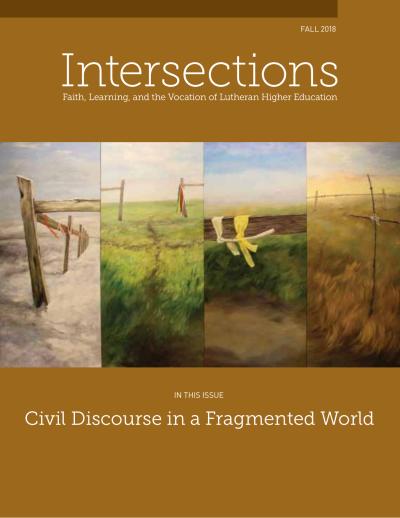 Editorial
From the Publisher
Mark Wilhelm
Wilhelm frames the issue by reflecting on the Letter of James and the Lutheran tradition of “calling a thing what it is” — arguing that the standards of academic discourse, deeply rooted in Lutheran insistence on frankness and honesty alongside concern for the common good, give NECU institutions a solid platform for sustaining honest but not hateful discourse about divisive issues.
-
Editorial
From the Editor
Jason A. Mahn
Mahn recounts how a participant’s probing questions at the 2018 Vocation of a Lutheran College Conference turned “civil discourse” from an innocuous theme into a contested one — and previews essays that variously urge listening and common ground, or speaking truthfully even when those words sound angry.
-
Article
Vocation and Civil Discourse: Discerning and Defining
Lynn Hunnicutt
Hunnicutt draws on Rabbi Amy Eilberg’s reading of Moses’ calling to identify four features of vocational discernment — attention, wonder, communal consciousness, and humility — and argues that these same qualities are also key aspects of civil discourse, so that forming students for vocational discernment is simultaneously forming them for civility.
-
Article
Polarization, Incivility, and a Need for "Change"
Guy Nave
Nave argues that when Americans demand “change,” they usually mean that “others” need to see things their way — and that meaningful transformative change requires acknowledging the provisional nature of our perspectives, seeking to understand as much as to be understood, and bursting the ideological echo chambers of social media through projects like Clamoring for Change.
-
Article
Putting the Kind Back in Human
Sarah Ciavarri
Drawing on Brené Brown’s research on vulnerability and Edwin Friedman’s family systems theory, Ciavarri distinguishes “kind” from “nice” and argues that courageous, vulnerable, and playful truth-telling — rather than yelling louder or trading pithy memes — is the path back to one another and to our common humanity.
-
Poem
Original Song Lyrics: "Just a Little"
Mike Blair
Lyrics for an original song inspired by biblical images and stories, by Emma Lazarus’ “The New Colossus,” and by the faith, hope, love, and courage of immigrant friends and neighbors — led as a devotion during the 2018 Vocation of a Lutheran College conference.
-
Article
The Musician's Vocation
Jeffrey Bell-Hanson
Bell-Hanson argues that musicians, who exercise profound influence over the emotional flavor of a moment, are called not merely to technical proficiency but to a sense of vocation: understanding their art well enough to use it responsibly, to intend truthfulness rather than manipulation, and to articulate its significance in dialog with other disciplines.
-
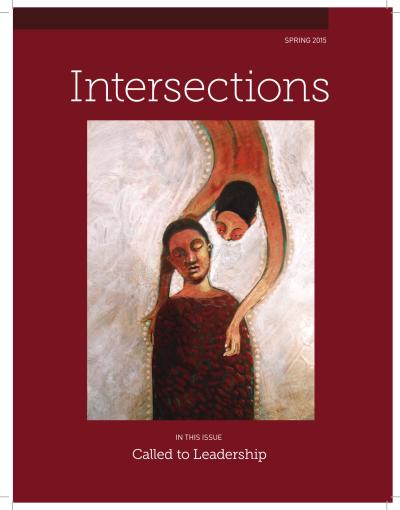 Article
Women in Leadership: Obstacles, Opportunities, and Entry Points
Susan Hasseler
No. 41 · Spring 2015
Drawing on two focus-group conversations with female faculty and academic administrators at Augustana College (Sioux Falls), Hasseler traces four obstacle/opportunity themes for women in academic leadership — valuing the intellectual work of leadership, religious and cultural interpretations of gender roles, caregiving realities, and embracing a strong voice — and proposes deliberate next steps for cultivating inclusive excellence on ELCA campuses.
-
 Editorial
From the Editor
Tom Christenson
No. 9 · Summer 2000
Christenson introduces a varied issue: the VonDohlen / Ratke discussion of the two kingdoms doctrine, Rachel Hammond’s “real gem” of a talk on her time in Ecuador (with an invitation to send contributions to the Home for Perpetual Hope orphanage via her home church in Oberlin, Ohio), Chuck Huff’s essay on the effect of liberal learning on the practice of psychology, and John Reumann’s reflection on a scholarly life lived between academy and church—and notes that the cover artist is his eight-year-old daughter Zoé, whose post-circus drawing of a balancing act struck him in light of Reumann’s opening line.
-
 Editorial
From the Editor
Jason A. Mahn
No. 35 · Spring 2012
Mahn introduces five essays from the 2011 Vocation of a Lutheran College Conference at Augsburg, framing how Torvend, Anderson, Svennungsen, Tunheim, and Pribbenow press Lutheran colleges to turn outward—recovering the public character of Luther’s gospel, forming students for moral deliberation, investing in the infrastructure of civic renewal, and pursuing justice and education “off the main road.”
-
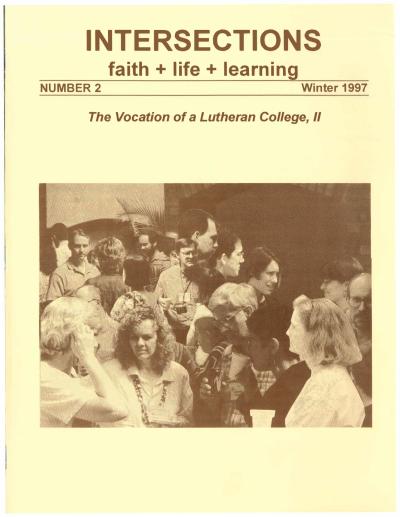 Editorial
From the Editor
Tom Christenson
No. 2 · Winter 1997
Christenson opens with an invitation for reader submissions to balance the conference-paper format of the first two issues, then asks how college and universities can turn students positively toward learning. Drawing on Aristotle’s claim that study is loved for its own sake (which students greet with disbelieving laughter) and Neil Postman’s The End of Education, he argues that students lack narratives within which learning makes sense and proposes four Lutheran mega-narratives—stewardship of creation, the freedom of the Christian, the sacramental presence of the transcendent in the concrete and ordinary, and vocation—that could inspire learning at the 28 ELCA colleges and universities.
-
 Article
The Diversity Dilemma: Dealing With Difference
Kathy Fritz
No. 8 · Winter 2000
Fritz reports from Newberry College—83% Caucasian, 16% African-American, 22% Lutheran, the smallest college in NCAA football—on a 1998–1999 year of crisis in which the Board of Trustees Executive Committee asked the president to resign over financial issues, the president fired three vice presidents, four trustees including the chair and treasurer resigned, and the controversial “veterinary technology” major became a flashpoint between the president’s recruitment-driven vision and the faculty’s commitment to “preparation for LIFE.” Turning to ethnic diversity, she frames three sociological approaches—“feed them all” to reduce conflict, the “3 A’s” (academics, athletics, arts) to create common identity, and Aguirre and Turner’s case for “weak ethnic identification” against the post-Yugoslavia failures of strong pluralism—and grounds the search for institutional unity in St. Paul’s body-of-Christ imagery from 1 Corinthians 12 and Ernest Simmons’s claim that diversity yields “creative adaptations that assist mutual survival.”
-
 Editorial
Maintaining Our Lutheran Identity: A Source of Strength
Lamont Anthony Wells
No. 58 · Fall 2023
Wells reflects on the well-being of staff, faculty, and administration in Lutheran higher education across four pillars — rest, creativity and innovation, religious diversity and pluralism, and the preservation of Lutheran identity — and addresses the painful reality of Finlandia University’s closure as a reminder of the network’s shared mission.