To you, O Lord,
I lift up my soul.
My God, I put my trust in you;
let me not be put to shame,
nor let my enemies
triumph over me.
Let none who look to you be put to shame;
rather let those be put to shame who are treacherous.
Show me your ways, O Lord,
and teach me your paths.
Lead me in your truth and teach me,
for you are the God of my salvation; in you have I trusted
all the day long.—Psalm 25:1-5
When Psalm 25 is used in Christian liturgy, the refrain is taken from verse 4:
Show me your ways, O Lord
and teach me your paths.
The writer knows there are more ways to see the world than just one. The psalmist is asking directly for eyes that can see new things in a new way. There is a desire to take a new trail.
You can read this as a brave ask of the psalmist or—as I read it—a nervous one. Show me your ways, but please, please, please remember that I’m in deep need of your compassion, love, forgetfulness, grace, and justice.
In the summer of 2018, when I was attending the Vocation of a Lutheran College conference and saw the 2019 topic (“Diversity, Equity, and Inclusion”) printed in the back of the program book, I knew that an email or phone call would come with a request. You see, there are two non-white pastors within the Network of ELCA Colleges and Universities: Pastor Hazel Davidson of California Lutheran University and me. I’m the only black campus pastor at an ELCA school and that is why I was pretty sure I would be asked to lead devotions at the “Diversity” gathering. I almost said no, because, well, sometimes it can all just be too much to be the token black pastor in the room.
Non-white leaders need to be the ones to share their stories, which is our story.
So why did I say yes? Because the other side of “it can be too much” is the fact that, in order for the ELCA to move beyond privilege and into equity and inclusion, we need to get used to people of color being in front of the room. Non-white leaders need to be the ones to share their stories, which is our story. It is time to see people of color, as Rev. Dr. King put it, not simply by the color of their skin, but by the content of their character—by their own individual stories that, although part of our whole story, can still stand on their own.
The theology of the ELCA, when we live it out, is so life giving that I can’t stop proclaiming it, even when I think being a manager at the local Kwik Trip, sounds like a good option as my new vocation. Our theology, deeply rooted in having been saved by grace through faith, is so powerful that it overrides and out-shadows all the years that I have had to spend making folks in the ELCA comfortable with my presence as a black female pastor.
I share my story simply because it is what makes me me. I share it because we believe we can learn more about God in the world by walking in another person’s shoes and seeing the world in a new way.
— —
One of the most familiar stories in the New Testament is the story of the Good Samaritan from Luke 10:25-37. The story is so familiar that we sometimes implicitly identify with its lead character and forget to see in other ways, to imagine ourselves in other characters.
We all want to be the Good Samaritan. I want to believe that I have at times in my life actually been inspired to act rightly because of this text. However, I also know that I have been one of the folks in the crowd simply listening to the exchange between Jesus and the lawyer and wondering if it has anything to do with my life. Honestly, though, I have never imagined myself to be the victim on the side of the road.
I was blown away this past summer when I opened up and started reading Pastor Lenny Duncan’s new book Dear Church: A Love Letter from a Black Preacher to the Whitest Denomination in the U.S. Rev. Duncan helped me see this text in a new way. He writes as a black minister to his 96 percent white ELCA church:
White Supremacy is the system that separates us. Take for example, our reading of the parable of the Good Samaritan. I read it from the perspective of the one lying in the road, who has been waylaid by bandits. You see yourself as the Good Samaritan. Or, best-case scenario, you wonder why you keep passing me by on the road. Our neighborhoods are being colonized by well-meaning hipsters, and our deaths are on display on social media for all of Jerusalem to see. We carry our lynching tree up the hill like our Savior before us. (17)
Today is about new eyes. We must see our institutions, classrooms, residence halls, dinning spaces, study areas, and worship spaces through the lens of students who are not coming from the place of privilege.
We must see our institutions, classrooms, residence halls, dinning spaces, study areas, and worship spaces through the lens of students who are not coming from the place of privilege.
— —
I didn’t read any writings by Rachel Held Evans until after her death this past spring. This past summer, I began reading her book, Inspired: Slaying Giants, Walking on Water and Loving the Bible Again. In it she takes an honest look at the painful pieces of scripture that you can’t ignore. In her chapter on deliverance stories, she introduced me to the work of Allen Dwight Callahan and his book, The Talking Book: African Americans and the Bible. In that book he writes,
African slaves and their descendants discerned something in the Bible that was neither at the center of their ancestral cultures nor in evidence in their hostile American home, a warrant for justice in the world. They found woven in the texts of the Bible a crimson thread of divine justice antithetical to the injustice they had come to know all too well. (iv)
The Crimson Thread of Divine Justice. I was captured by the image when I read it. It made me think of the students who return from their J-term experience in India with Jim Lochetfeld with the red bracelet on their wrist, changed from the experience. It made me think of my Advanced Heart Failure Specialist, who loves to travel, and has the red string around his wrist as well.
For Callahan, the crimson thread is the thread of hope, the thread of justice, the thread of freedom that oppressed people can so clearly see in the tapestry of scripture. What is more, in Hinduism and across India the crimson thread has many meanings. Red—the color of fire and blood—can point to energy, strength, power, and determination. It can ward off evil. It can drive away fiends and bind together new friends.
I ended my series of devotionals at the 2019 Vocation conference inviting participants to tie a crimson thread around their wrists as a symbol of our collective commitment to moving beyond privilege to work toward inclusion and equity in all that we do. I asked that it be a reminder to start a conversation or two at home institutions about the share valued of creating spaces on our campuses where all can thrive. As “Rooted and Open” has it, each of us is indeed called and empowered to serve the neighbor so all may flourish.
— —
I’ll close here as I closed each devotional at the conference—with a prayer. Two prayers, actually. The first was written for the International Commission on English in the Liturgy for The Sacramentary:
God of justice, you adorned the human race with a marvelous diversity, yet clothed each of its members with a common dignity that may never be diminished. Put within us respect for that dignity and a passion for the rights which flow from it, that we may always champion for others the justice we would seek for ourselves. Grant this through our Lord Jesus Christ, your Son, who lives and reigns with you in the unity of the Holy Spirit, God forever and ever. Amen
The second is in my own words:
God of restoration. God of reconciliation. Reflector of all humanity. We gather in these days to do hard work. We gather to challenge the ways things have always been done to open up new ways and new opportunities for all to thrive. We gather to build relationships that can be transformative to our hearts and minds, and to the work of education to which we are called. We gather to dare be a part of your healing work here on earth, where all people will be welcomed to develop their gifts and talents for the sake of the world. Open our eyes and hearts to the paths before us. Lead us in the ways that are life-giving to your whole creation. Amen.
Works Cited
Callahan, Allen Dwight. The Talking Book: African Americans and the Bible. Yale UP, 2008.
Duncan, Lenny. Dear Church: A Love Letter from a Black Preacher to the Whitest Denomination in the U.S. Fortress, 2019.
Evans, Rachel Held. Slaying Giants, Walking on Water and Loving the Bible Again. Nelson Books, 2018.
-
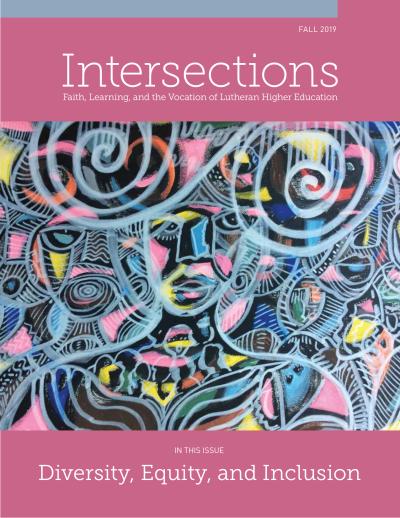 Editorial
From the Publisher
Mark Wilhelm
Wilhelm frames the issue by noting that a federal court’s vindication of Harvard’s race-conscious admissions process is a win for higher education’s commitments to diversity, equity, and inclusion — and argues that for Lutheran higher education, the commitment to diversity is an old and foundational claim, rooted in Christianity’s openness to all and reflected in the four diverse gospels of the New Testament.
-
Editorial
From the Editor
Jason A. Mahn
Mahn opens with Lenny Duncan’s observation that the ELCA is 96 percent white — the whitest denomination in the U.S. — and asks how teachers and administrators at historically, predominantly, and persistently white institutions can turn from white privilege and white supremacy toward spaces where people of color thrive and white people are re-formed into antiracist allies.
-
Article
Making Diversity Matter: Inclusion is the Key
Monica Smith
Smith, Augustana’s inaugural Vice President for Diversity, Equity and Inclusion, frames the work of a Chief Diversity Officer as that of a disrupter and argues that while diversity in higher education is already happening, inclusion is a choice — one requiring a fundamental institutional transformation that diversifies faculty and staff, infuses diversity into the curriculum, invests in professional development, and draws on senior leadership to dismantle barriers.
-
Article
The Perils and Promise of Privilege
Guy Nave
Nave argues that privilege is always used in one of two ways — to preserve privilege by promoting inequity, or to challenge privilege by promoting diversity, inclusion, and equity — and uses examples from Indianapolis Catholic schools, Martin Luther, and equity-mindedness research to call Lutheran institutions to address the racist practices and policies that reproduce whiteness on their campuses.
-
Article
The Vocation of White People in a Racist Society
Caryn Riswold
Riswold proposes that whiteness is a weakness borne of apathy, atrophy, and ignorance — an atrophied muscle of race-consciousness — and offers concrete practices (reading, adjusting one’s gaze, consuming media differently, drawing on ELCA social statements like the repudiation of the Doctrine of Discovery) for exercising that muscle and naming the vocation of white people in a racist and white supremacist culture.
-
Article
Learning the Language of Inclusive Pedagogy
David Thompson
Thompson frames inclusive pedagogy as a foreign language with its own vocabulary, grammar, and cultural values, and reflects on a year of immersing himself in readings, conversations, and workshops — arguing that proficiency grows when instructors study and practice these languages repeatedly and atrophies when ignored.
-
Article
The "V" Word: Different Dimensions of Vocation in a Religiously Diverse Classroom
Martha E. Stortz
Stortz responds to a sea of blank stares when she used the word “vocation” in a religiously diverse required course by offering five metaphors — place, path, relationships, lens, and story — that point to different dimensions of vocation across the world’s religions and help students articulate their callings on their own terms.
-
Book Review
The American Myth of White Supremacy: A Review of Myths America Lives By
Susan VanZanten
VanZanten reviews Richard T. Hughes’s Myths America Lives By: White Supremacy and the Stories that Give Us Meaning, which argues that the United States grounds its identity in five myths — Chosen Nation, Nature’s Nation, Christian Nation, Millennial Nation, and Innocent Nation — all informed by the primal myth of white supremacy, and considers what Lutheran theological values can offer for resisting that myth.
-
Article
Conciliatory and Queer: The Radical Love of Lutheran Higher Education
Kiki Kosnick, Sharon Varallo
Kosnick and Varallo reflect in conversation on how Augustana’s Five Faith Commitments and its conciliatory ecumenical roots in the Augsburg Confession have given them — a non-binary queer first-generation faculty member and a twenty-one-year veteran — the “street cred” to act on radical love, build bridges to imprisoned and non-binary communities, and discover that Augustana is welcoming not despite the fact that it is Lutheran, but because of it.
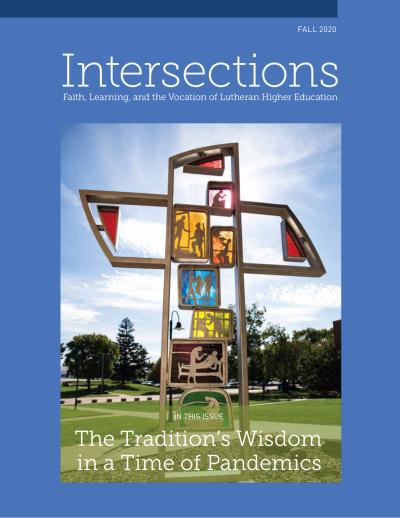
-
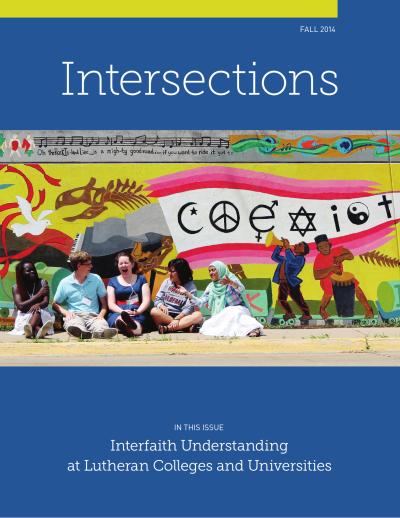 Editorial
From the Publisher
Mark Wilhelm
No. 40 · Fall 2014
Wilhelm draws a parallel between the rediscovery of vocation and the rediscovery of interfaith understanding in Lutheran higher education, arguing that previously under-emphasized aspects of the Lutheran tradition point us to interfaith work and that an authentic Lutheran college or university will make interfaith understanding a feature of its mission.
-
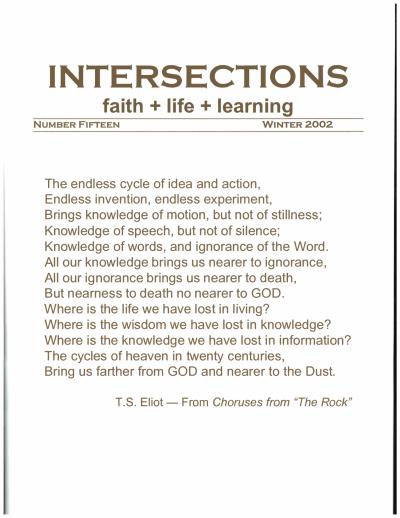 Book Review
Paul Dovre, ed.: The Future of Religious Colleges
Baird Tipson
No. 15 · Winter 2002
Tipson, president of Wittenberg University, reviews Paul Dovre’s edited proceedings of the October 2000 Harvard Conference on the Future of Religious Colleges (Eerdmans, 2002), summarizing essays by Douglas Sloan on the failure of the “two-realm theory of truth,” George Marsden on faith-shaped scholarship, DeAne Lagerquist, Father David O’Connell, Mark Noll, Robert Benne, Mark Roche on Notre Dame, Joel Carpenter on neo-Calvinist Kuyperianism, and Mark Schwehn on a Lutheran “college-related church” and the centrality of vocation. Against Benne’s suggestion that only two or three robustly Lutheran colleges can be sustained, Tipson defends a less robust but still authentically Lutheran model embodied at places like Wittenberg, Gettysburg, and Roanoke, arguing for the enlightenment commitment to subjecting all truth claims to rigorous criticism and for hiring Marsden-style faith-shaped scholars rather than counting Lutheran heads.
-
 Article
Ivory Tower or Holy Mountain? Faith and Academic Freedom
Nicholas Wolterstorff
No. 11 · Spring 2001
Wolterstorff defines infringement of academic freedom as impairing a faculty member’s standing on account of the ideological content of her position, argues that academic freedom (like free speech) is “duly qualified” rather than absolute, and offers eight considerations bearing on religiously based institutions: Weber’s differentiation of Wissenschaft, religious pluralism within a liberal polity, the vitality of American civil society, a decentralized educational system, the “holistic” character of much American religion, the post-Kuhnian collapse of classical foundationalism and of the “generically human” academy, the fact that ideas matter, and the personhood violated by infringement (the desecration of an image of God). He concludes that the private sector offers wider academic freedom than the public, that religious qualifications are not inherently inappropriate (any more than St. John’s Great Books commitment), but that religiously based colleges too often apply them unjustly—arbitrarily, secretly, without recourse—and that the AAUP’s best service is model codes of procedure.
-
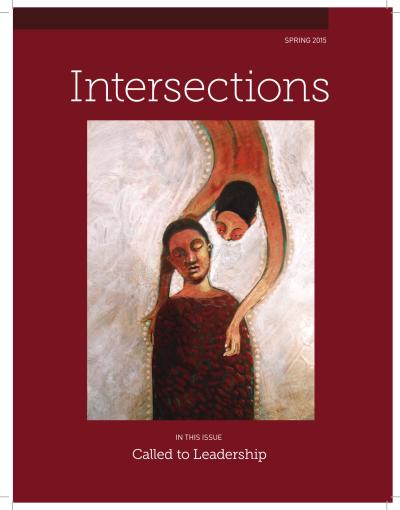 Editorial
From the Publisher
Mark Wilhelm
No. 41 · Spring 2015
Wilhelm celebrates the leadership of ELCA colleges and universities within American higher education — from presidential service in major higher-education agencies to recognized leadership in global education and interfaith understanding — and lifts up the health of the ELCA network of schools as a church-related community that maintains shared identity while living as good citizens of the larger academy.
-
 Article
Integrity and Fragmentation: Can the Lutheran Center Hold?
Robert Benne
No. 8 · Winter 2000
Benne answers the conference’s question pessimistically—“the Lutheran center cannot hold in many, if not most of our colleges, because it was never there in an articulated form in the first place”—and distinguishes “Christ of culture” colleges like the Midland Lutheran of his youth (Lutheran by ethno-religious ethos rather than by articulated theology) from James Burtchaell’s “confessional colleges” that operated from a theologically distilled Lutheran humanism. Drawing on Alasdair MacIntyre and Mark Schwehn’s First Things essay on Christian universities, he sketches what a Lutheran center looks like (unity, universality, integrity, a tradition of thought) and how its distortion—reducing the Gospel to justification and ceding everything else to autonomous reason—splits Christ and culture as dangerously as the German church separated Gospel and politics. For colleges that have lost their center, he proposes an “intentional, robust pluralism” that guarantees a Lutheran voice in every department and an “affirmative action for Christians” in hiring.
-
 Editorial
Maintaining Our Lutheran Identity: A Source of Strength
Lamont Anthony Wells
No. 58 · Fall 2023
Wells reflects on the well-being of staff, faculty, and administration in Lutheran higher education across four pillars — rest, creativity and innovation, religious diversity and pluralism, and the preservation of Lutheran identity — and addresses the painful reality of Finlandia University’s closure as a reminder of the network’s shared mission.