There seem to be very few “commons” left. Indeed, if someone should utters this quaint, traditional term, there is a good chance he or she is referring to a central dining hall on one of our campuses. (Quaint, traditional words have a way of sticking around longer in small, church-related colleges and universities; others include “liberal arts,” “collegiate,” and “calling.”) As a term to indicate those natural or cultural resources that are shared by all (common land to graze livestock, a park for all to enjoy, public art for many to behold, clean water for the taking, and so on), “the commons” seem to be not only an outdated term but also an outdated idea. Increasingly, industries within our global economy privatize and sell what used to be shareable, public goods—or pollute and make unusable what is left. Most of us adjust accordingly to this tragedy of the commons—happily buying bottled water and sometimes even paying for access to toilets.
And how about education? Have we come to consider education as private property—another commodity to be securely transacted between our institutions (the sellers) and our students (the buyers and consumers)? More to the point: What and whom is higher education for? Is it primarily to credential the educated—full stop? Or does it also emanate outward, bettering those who haven’t paid for it but still receive the service of others, those who are freed along with those educated in the art of making free? One irony of church-related, so-called “private” colleges and universities in the United States is that they may be one of the least fully-privatized resources left. At best, education is for vocation, and vocation is always a calling on behalf of the common good. Church-related colleges know and teach this.
The essays in this issue of Intersections lift up the common good and show how education for vocation strives to preserve and strengthen it. Most were delivered at the 2015 Vocation of a Lutheran College Conference at Augsburg College under the theme, “Vocation and the Common Good.” Among the authors are some leaders of the “vocation conversation” (Samuel Torvend, Paul Pribbenow, Kathi Tunheim, and Mark Wilhelm); others bring fresh perspectives to questions around technology use (Amy Weldon), draw on work with interfaith engagement to ensure that commonality does not dilute religious and cultural difference (Rahuldeep Singh Gill), or claim that support for the common good might entail very ordinary—but no less important—service (René Johnson).
Two short announcements to close: First, please be aware that Intersections is now also published online through Digital Commons, an open source database for scholarly work; see more information and the web address on page 4. Second, please look for a special anniversary edition of Intersections in Spring 2016, which will showcase some of our twenty years of reflecting on the intersection of faith, learning, and the vocation of Lutheran higher education.
-
 Article
Vocation and the Common Good
Mark Wilhelm
Wilhelm argues that ELCA colleges and universities are Lutheran not by ethnic culture or institutional checklists but because they stand in a 500-year-old intellectual tradition that educates for vocation. He draws out two insights from that tradition — a common walk of life shared across callings, and a humility about claims to know the good — to ground the schools’ commitment to prepare students for the common good.
-
Article
Making the Common Good Common
René Johnson
Johnson reflects on the Servant Leadership House for women at Finlandia University — from a sweaty trip to the local landfill to weekly habits of campus presence — to argue that the common good becomes truly common when it is embedded in the ordinary details of vocational living, and that Luther’s sense of neighbor calls servant leaders to “little bits of good” as well as to more radical pursuits of justice.
-
Article
"Greed is an Unbelieving Scoundrel": The Common Good as Commitment to Social Justice
Samuel Torvend
Torvend uses his Lutheran Heritage course at Pacific Lutheran University to ask what “the common good” might mean concretely — fresh air, clean water, food, shelter, healthcare — and traces the early Lutheran reform of literacy and social welfare to argue that the first gift of Lutheran education is the capacity to question the status quo and to push beyond charity into the pursuit of social justice.
-
Article
Grinding for the Common Good and Getting Roasted
Rahuldeep Singh Gill
Reading Starbucks’ ill-fated “Race Together” campaign as a parable for campus work on the common good, Gill argues that interfaith cooperation, vocational reflection, and the “re-storying” of our campuses require us to err boldly across lines of difference — not pretending that difference doesn’t matter, but inviting students to imagine and realize what the common good might mean to them.
-
Article
Attentional Commons and the Common Good: Technology and Higher Education
Amy Weldon
Weldon argues that the electronic devices our students (and we) reach for are designed to monetize attention and fragment the very capacities — tolerance for complexity, sustained focus, real conversation — that build lives of meaning and service to the common good. Drawing on Crawford, Lanier, Arendt, and Palmer, she sketches practical tech-mindfulness for the small-college classroom as a defense of the “attentional commons.”
-
Article
Say Something Theological: A Meditation on the Vocation of Lutheran Colleges and Universities to Serve the Common Good
Paul C. Pribbenow
Pribbenow expands Luther’s “priesthood of all believers” into a meditation on doing theology with the Bible in one hand and the New York Times in the other — reading Luke 14 alongside walls, immigration, and hunger in his Minneapolis neighborhood — and argues that the leadership of Lutheran colleges demands a willingness to engage the theological issues at the heart of their public vocation.
-
Article
Women Presidents in Higher Education: How They Experience Their Calling
Aimee Goldschmidt, Gary McLean, Katherine A. Tunheim
Drawing on in-depth interviews with fifteen women college presidents and a transformative-learning-theory framework, Tunheim, McLean, and Goldschmidt trace a three-stage journey — identifying, interpreting, and pursuing the call — and ask what the language of vocation contributes to the preparation and mentoring of women leaders in higher education.
-
 Article
Vocation at Full Stretch: Reflections on Follow Your Bliss and Other Lies about Calling and its Use among College Students
Jason A. Mahn
No. 61 · Spring 2025
43 min audio
Mahn engages Bonnie Miller-McLemore’s Follow Your Bliss and Other Lies about Calling as required reading in a sophomore religion course, showing how her categories of missed, blocked, conflicted, fractured, unexpected, and relinquished callings empower young adults to perceive embodied, unplanned, and often painful dimensions of life as essential parts of vocation — and help close the gap between mission-driven and tuition-driven realities.
-
 Article
On Recruiting Diverse Students, Rooted in Mission
Eric Rowell, Jason A. Mahn
No. 59 · Spring 2024
Jason Mahn interviews Eric Rowell, Assistant Director of Admissions and Diversity Outreach at Augustana College, about how recruiting students from a wide variety of backgrounds — rooted in Augustana’s Lutheran commitment to vocation and educating across difference — remains essentially unchanged in the wake of the Supreme Court’s 2023 decisions on affirmative action.
-
 Editorial
From the Outgoing Editor
Jason A. Mahn
No. 55 · Spring 2022
Mahn closes out a decade of editing Intersections, passes the duties to Colleen Windham-Hughes, gives thanks to Mark Wilhelm and Augustana College, and introduces an issue largely drawn from comments by Lutheran faculty, staff, and administrators at the 2022 NetVUE national gathering.
-
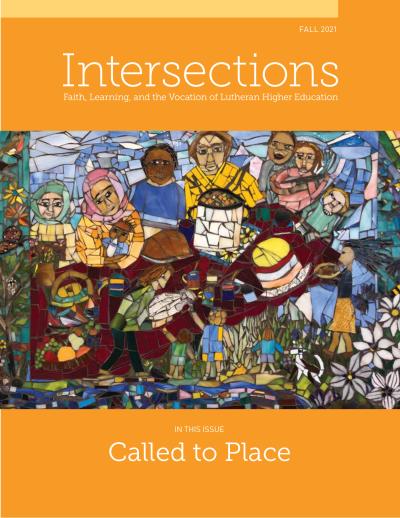 Editorial
From the Editor
Jason A. Mahn
No. 54 · Fall 2021
Mahn introduces the “Called to Place” theme of the 2021 VLHE Conference, arguing that Lutheran higher education’s emphasis on vocation must be grounded in particular geographies and embodied communities — for, as Wallace Stegner put it, “If you don’t know where you are, you don’t know who you are.”
-
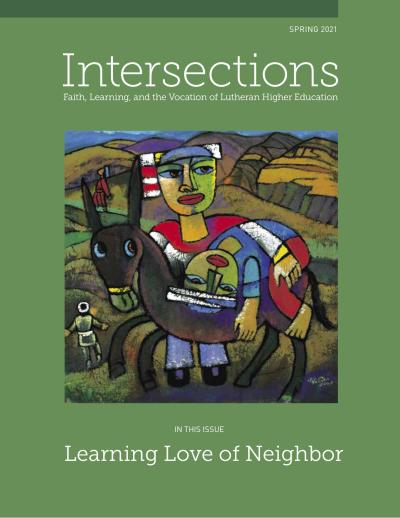 Reflection
Shelter in Place: Reflections from March 22, 2020
Jason A. Mahn
No. 53 · Spring 2021
On the fourth Sunday of Lent in 2020, Mahn meditates on the etymology of “shelter” (from shield) and on an email from a former student in Boston whose mutual-aid organizing models a Lutheran understanding of vocation: the upending of ego by divine love that frees us, finally, to see and serve the neighbor.
-
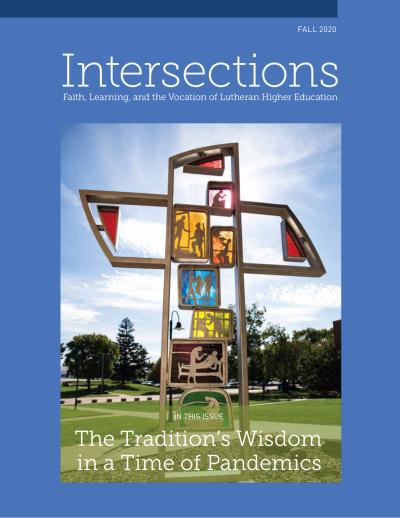 Editorial
From the Editor
Jason A. Mahn
No. 52 · Fall 2020
Mahn narrates a year of crisscrossing pandemics — Covid-19, economic collapse, partisan politics, and the long pandemic of white supremacy revealed anew by the murder of George Floyd — and argues that Lutheran liberal arts schools, by educating for vocation, are uniquely poised to help students respond with character and capable callings.
-
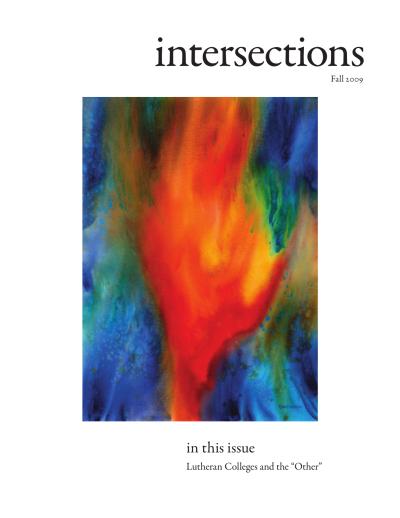 Article
Bringing an Ecumenical Milestone Out of the Shadows
Ronald D. Witherup, S.S.
No. 30 · Fall 2009
Witherup draws attention to the tenth anniversary of the Lutheran-Catholic “Joint Declaration on the Doctrine of Justification” signed on Reformation Day 1999, summarizes the document’s claim that justification is the work of the triune God received by grace alone through faith, surveys the remaining questions raised by Pope John Paul II and the 2006 endorsement by the World Methodist Conference, and proposes a pastoral strategy for bringing this ecumenical milestone out of the shadows in Catholic parishes.
-
 Editorial
From the Editor
Robert D. Haak
No. 27 · Spring 2008
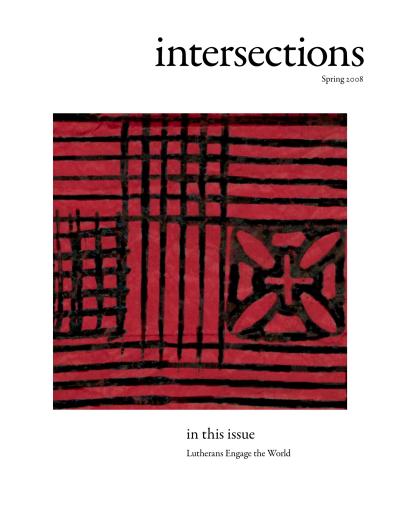
Haak frames the issue around the question of why Lutherans engage the world rather than retreat from it, locating the answer in the doctrines of creation and incarnation, and introduces essays by Erwin on globalism, Carlsen on local community engagement, Marty on multiple callings, and Mattes on the Grundtvigian heritage at Grand View. He also bids farewell to publisher Arne Selbyg, noting the fittingness of the Adinkra (“farewell”) cloth on the cover of this final issue under Selbyg’s leadership.
-
 Article
The Search for a Just Peace in a Globalized World
Munib A. Younan
No. 18 · Fall 2003
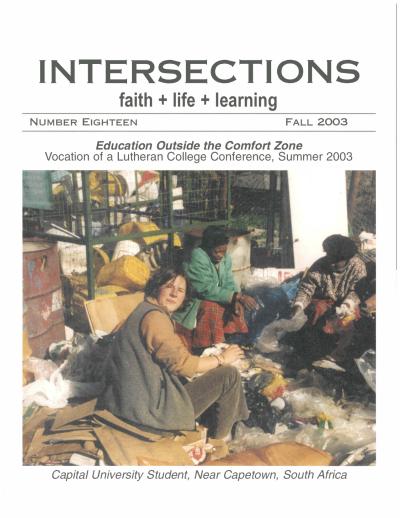
Younan, Lutheran Bishop in Jerusalem, grounds Palestinian Christian identity in Incarnation theology and a Lutheran theology of grace and the cross, then surveys the Evangelical movement’s nineteenth-century legacy in the Middle East—the 1864 Arabic Bible, ELCJ schools, women’s ordination, and the Middle East Council of Churches. Engaging Edward Said’s critique of Samuel Huntington, he calls for international and local mutual-recognition agreements (including the Jerusalem Lutheran-Anglican agreement and a Lutheran-Reformed agreement in the Middle East), four marks of interfaith dialogue, and a sharp distinction between Lutheran “Evangelical” identity and the Dispensationalist evangelistic Right whose Israel-Palestine scenarios he names a heresy. He closes by proposing concrete scholarship, faculty exchange, and sabbatical partnerships between U.S. Lutheran colleges and the ELCJ’s churches, schools, and Dar al-Kalima Lutheran Academy.
-
 Editorial
From the Publisher
Arne Selbyg
No. 17 · Summer 2003
Selbyg explains that the four essays in this issue grew out of the first Lutheran Academy of Scholars in Higher Education—a two-week seminar funded by the Lutheran Brotherhood Foundation and the Lilly Endowment, led for its first three years by Dr. Ronald Thiemann of Harvard Divinity School—whose official theme “Finding Our Voice—Christian Faith and Critical Vision” became informally “What’s Faith Got To Do With It?”
-
 Article
Rooted and Open: Background, Purpose, and Challenges
Mark Wilhelm
No. 49 · Spring 2019
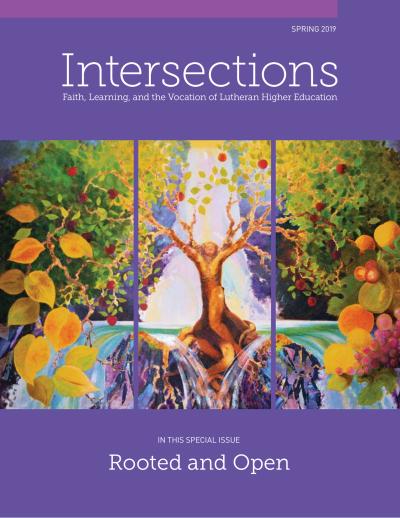
Wilhelm traces Rooted and Open’s seventy-year backstory — from Conrad Bergendoff’s 1948 call for a Lutheran philosophy of education through the recovery of the vocation tradition — and describes the document’s process, purpose as a teaching and study resource, and the embodiment, contextual, and cultural challenges it implies for NECU institutions.
-
 Article
Bringing Core Values to Life through Civic Engagement
Austin Trantham
No. 63 · Spring 2026
5 min audio
Trantham shows how Saint Leo University’s Benedictine Core Values shape his civic engagement work — from advising a “Why Vote?” campaign and Constitution Day panels to engaging students in the Unify Challenge for respectful cross-institutional discourse.