“The trouble is, I don’t think the common good is all that common,” said Miranda, a resident of the Servant Leadership House for women at Finlandia University. Two students and I were driving a truckload of broken furniture, unusable building materials, and long forgotten belongings from the attic of the Servant Leadership House to the local landfill.1 It was a good time for a conversation about how the Servant Leadership House women would embody the common good at Finlandia in the coming school year. We were dirty and sweaty and lamenting the fact that we would be just one customer among too many that day tossing construction and junk waste into a crushing bin. We were also overwhelmed by the idea that this was happening in thousands of places across the country, and even the world, on any given day. Even with improved methods of waste disposal where much is recycled, the three of us wondered at the recklessness of our throw-away habits that are regarded as normal. Shouldn’t we be leaving the landfill in tears? Might we ever consider it deviant behavior to produce and toss so much waste? We left the landfill with an empty truck and encumbered hearts, having this deed made far too painless with a charge of only $22.50.
The Common Good as Commonplace
Whether we’re talking about actions that express care for the earth or care for each other, the common good becomes truly common when it is embedded in the ordinary details of our lives. When combined, these two words, common and good, are rich in complexity and ambiguity of meaning. What do we mean by good? Is the “good” actually shared in common? How do we measure if the “good” that is pursued is genuinely for the sake of the common? And Miranda’s comment begs us to consider if the common good is something we conceive of as commonplace or if our tendency is to associate the common good with big, bold endeavors.
As Lutherans we take our primary cues for deliberation of the common good from the Lutheran notion of vocation. Vocational living is “good” because the task of vocation is to be instruments of God’s healing purposes in ways that are always and only for the sake of the neighbor’s well-being. In the words of Gustaf Wingren, “our only care ought to be what we should do with all the good that God has made, so that it may benefit our neighbor” (8). The “good” that benefits the neighbor through vocation is “common” because it is an all-inclusive idea of the neighbor. The neighbor who is the beneficiary of the good of vocation should not be confused with a convenient, geographical, or familiar sense of relationship. The neighbor is not defined by location but by his or her need for wholeness and healing.
The common good can also be regarded as necessarily commonplace in a Lutheran sense of vocation. For Luther, there are no actions, interactions, or occupations that are more sacred than others. Luther’s vocational perspective recognizes the sacred purpose in the seemingly mundane tasks and in the totality of our everyday lives. The visible common good enacted through vocation is intended to be commonplace. This is not to deny that we are also called to exercise the common good in more difficult and unexpected ways as well. We know from listening to the voices of the prophets and the poor that a broader vision of the neighbor and a more careful listening to the neighbor and his or her need is required. We begin to see new neighbors who were previously hidden from our consciousness and experience. We encounter neighbors who are denied healing and wholeness because of unjust, systemic poverty and the scandalous deprivation of human rights. These are circumstances which can stir the heart toward a sense of call to participate in a more radical pursuit of the common good that addresses the most serious concerns of the world. But God also calls his servants to take part in the healing of the world in the everyday occurrences of our lives.
Common, Little Bits of, Good
As we strive to stimulate thinking and action for the common good on the campuses of our Lutheran colleges and universities it is helpful to acknowledge the temptation to associate the common good only with programs and opportunities that are extraordinary. Indeed, there are fantastic things being accomplished at our schools which push our students to address the needs of marginal communities through action and advocacy. But we cannot lose sight of the simpler aim of nudging our students toward an enduring awareness of the call to do their “little bit of good” in their everyday relationships and actions.2
Finlandia University’s Servant Leadership House gives the women residents the opportunity to grow in their capacity to promote and contribute their little bits of good to the common good. A servant leader’s persistent concern is for the growth of people and consequently the growth of a better, more sustainable society. The women of the Servant Leadership House define serving as having an enriching net effect on others; they enrich campus and community primarily by carrying out awareness-raising campaigns for social justice concerns.
But it is really their understanding of leadership that fosters the women’s sense of call to do their little bits of the common good. They understand that leadership is not simply about being in charge. After all, only a few are actually in leadership positions with this kind of authority. The servant leader is much more interested in having an influence than having a position of leadership because “at its core, servant-leadership is a long-term, transformational approach to life and work—in essence, a way of being—that has the potential for creating positive change throughout our society” (Greenleaf, Servant Leader Within 16). This type of leadership can be exercised by anyone.
“The little bits of the common good—executed in the routine encounters and daily habits of servant leaders—define their way of being, subtly influence others, and carry the potential for significant positive change.”
The Servant Leadership House women are genuinely concerned about many of the world’s ailments. But as students of servant leadership they understand that “if a flaw in the world is to be remedied, to the servant the process of change starts in here, in the servant, not out there” (Greenleaf, Servant Leadership 44). So the women struggle to make the common good commonplace in their own lives. Examining their actions and motivations in relation to the common good, even if it is something as conventional as disposing a truckload of garbage into a landfill, is hard work, although it’s not the kind of work toward the common good that usually gets attention. None the less, this cultivation of the common good as commonplace in the lives of these women rests on the assumption that the only way to address the urgent problems of our world is “one person and one action at a time because there isn’t anything else to work with” (Greenleaf, The Servant Leader Within, 72).
Endnote
1. The Servant Leadership House is a women’s special interest housing option inaugurated in 2014. Students were somewhat involved in the renovation of the 100-year old house situated on the corner of the campus that is now a beautiful living space for six women.
2. The phrase is borrowed from a quotation by Desmond Tutu: “Do your little bit of good where you are. It’s those little bits of good put together that overwhelm the world.”
Works Cited
Greenleaf, Robert K. The Servant Leader Within: A Transformative Path. Ed. Hamilton Beazley, Julie Beggs, and Larry C. Spears. Mahwah, NJ: Paulist, 2003.
———. Servant Leadership: A Journey into the Nature of Legitimate Power and Greatness. Ed. Larry C. Spears. Mahwah, NJ: Paulist, 2002.
Wingren, Gustaf. Luther on Vocation. Trans. Carl C. Rasmussen. Eugene, OR: Wipf and Stock, 1957.
-
 Editorial
From the Editor
Jason A. Mahn
Mahn introduces the “Vocation and the Common Good” issue by asking what is left of “the commons” in an age of privatized goods and education-as-commodity, and frames church-related colleges — with their stubborn vocabulary of “liberal arts,” “collegiate,” and “calling” — as among the least fully-privatized resources left in American life.
-
Article
Vocation and the Common Good
Mark Wilhelm
Wilhelm argues that ELCA colleges and universities are Lutheran not by ethnic culture or institutional checklists but because they stand in a 500-year-old intellectual tradition that educates for vocation. He draws out two insights from that tradition — a common walk of life shared across callings, and a humility about claims to know the good — to ground the schools’ commitment to prepare students for the common good.
-
Article
"Greed is an Unbelieving Scoundrel": The Common Good as Commitment to Social Justice
Samuel Torvend
Torvend uses his Lutheran Heritage course at Pacific Lutheran University to ask what “the common good” might mean concretely — fresh air, clean water, food, shelter, healthcare — and traces the early Lutheran reform of literacy and social welfare to argue that the first gift of Lutheran education is the capacity to question the status quo and to push beyond charity into the pursuit of social justice.
-
Article
Grinding for the Common Good and Getting Roasted
Rahuldeep Singh Gill
Reading Starbucks’ ill-fated “Race Together” campaign as a parable for campus work on the common good, Gill argues that interfaith cooperation, vocational reflection, and the “re-storying” of our campuses require us to err boldly across lines of difference — not pretending that difference doesn’t matter, but inviting students to imagine and realize what the common good might mean to them.
-
Article
Attentional Commons and the Common Good: Technology and Higher Education
Amy Weldon
Weldon argues that the electronic devices our students (and we) reach for are designed to monetize attention and fragment the very capacities — tolerance for complexity, sustained focus, real conversation — that build lives of meaning and service to the common good. Drawing on Crawford, Lanier, Arendt, and Palmer, she sketches practical tech-mindfulness for the small-college classroom as a defense of the “attentional commons.”
-
Article
Say Something Theological: A Meditation on the Vocation of Lutheran Colleges and Universities to Serve the Common Good
Paul C. Pribbenow
Pribbenow expands Luther’s “priesthood of all believers” into a meditation on doing theology with the Bible in one hand and the New York Times in the other — reading Luke 14 alongside walls, immigration, and hunger in his Minneapolis neighborhood — and argues that the leadership of Lutheran colleges demands a willingness to engage the theological issues at the heart of their public vocation.
-
Article
Women Presidents in Higher Education: How They Experience Their Calling
Aimee Goldschmidt, Gary McLean, Katherine A. Tunheim
Drawing on in-depth interviews with fifteen women college presidents and a transformative-learning-theory framework, Tunheim, McLean, and Goldschmidt trace a three-stage journey — identifying, interpreting, and pursuing the call — and ask what the language of vocation contributes to the preparation and mentoring of women leaders in higher education.

-
 Article
The Lutheran Liberal Arts College and Care for the Earth
H. Paul Santmire
No. 3 · Summer 1997
Santmire, author of The Travail of Nature, proposes three mandates for the Lutheran liberal arts college: take responsibility for spiritual particularity by confronting the ambiguities of the classical Christian tradition (Lynn White’s charge against anthropocentric Christianity vs. the Franciscan ecological tradition from Irenaeus through Luther) and of classical Lutheran social ethics (the Two Kingdoms, Romans 13, the Third Reich, Bonhoeffer); promote responsible cultural criticism (against Thoreau’s sociopathic anti-urban suburbanism); and promote a holistic environmental ethos through an interdisciplinary core curriculum with ecology as the queen of the sciences, a community that liberates the social imagination (Mumford, Marcuse), a cosmic Liturgical praxis rooted in the Colossians 1:15–20 hymn to the cosmic Christ, and an academy that models ecological responsibility.
-
 Article
Toward an Adequate Theology of Christian Higher Education
Robert Benne
No. 10 · Fall 2000
Drawing on his forthcoming Eerdmans volume Quality With Soul—Thriving Ventures in Christian Higher Education, which studies St. Olaf, Valparaiso, Notre Dame, Baylor, Wheaton, and Calvin, Benne argues that these schools have kept their souls because a critical mass of boards, administrators, faculty, and students treat the Christian account as comprehensive, unsurpassable, and central. He critiques four inadequate theologies of Christian higher education—pietism, liberal theology (Whitehead, Henry Nelson Weiman, the “values” turn, and accommodation to diversity and multiculturalism), “First Article” approaches (including Merrill Cunninggim’s Methodist version and a Lutheran two-kingdoms quietism), and reactionary/triumphalist theology—and contrasts the Catholic (Notre Dame), Reformed (Calvin, Wheaton, Baylor), and Lutheran (St. Olaf, Valpo) ways of relating faith and learning, calling Lutherans to recover “Christ and culture in paradox” as serious extended conversation rather than as a lazy excuse.
-
 Response
Renewing Our Journey: Some Thoughts on Pursuing the Truth
John Rehl
No. 1 · Summer 1996
Rehl, a Capital University graduate pursuing doctorates in theology at Chicago and in economics at Wisconsin, takes up Schwehn’s invitation to think again on the nature of truth. He sets aside truth as information, as object, and as mere words; recasts the church-related college’s task as a renewed emphasis on classroom teaching (Kierkegaard’s teacher as midwife) and on brave, articulate professors. He calls for moral education in courage, discipline, patience, and love, illustrates the costs of the fact-value split with examples from economics, and argues that we honor Lutheran heritage not by preserving it as a museum piece but by testing it—Luther’s theology of the cross over a theology of glory—and by preparing students for a world of Untruth, strengthened (with Julian of Norwich) by the promise that they will not be overwhelmed.
-
 Article
Critical Engagement in Public Life: Listening to Luther's Troubling Questions
Samuel Torvend
No. 35 · Spring 2012
Torvend narrates the medieval “spiritual/temporal” division and the neo-platonic devaluation of the body that shaped the world into which Luther was born, then traces the disruptive questions Paul’s letters provoked in Luther: about indulgences, the two estates, vocation, and the public reach of baptism. He argues that Luther’s reform — expressed in Kirchenordnungen, social welfare reform, public schools, and writings on lobbyists, usury, and monopolies — carries a “genetic encoding” of public engagement that Lutheran colleges should reclaim against the temptations of holy apathy and Christian nationalism.
-
 Editorial
From the Publisher & Editor
Colleen Windham-Hughes, Lamont Anthony Wells
No. 63 · Spring 2026
6 min audio
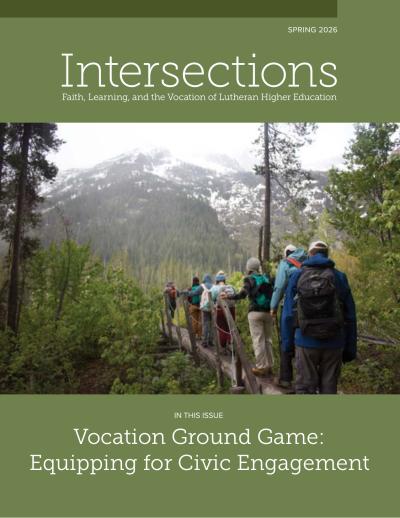
Wells and Windham-Hughes frame vocation as “ground game” — the practical, public living-out of faith through civic engagement — and introduce the issue’s focus on how Lutheran higher education equips students to repair the world.
-
 Article
The Vocation of a Lutheran College—Living the Legacy of the Reformation in the Twenty-first Century
Sabine U. O'Hara
No. 26 · Fall 2007
O’Hara reflects on Luther’s understanding of education as Bildung — “becoming in the image of God” — through four key aspects: education must be relevant, education demands engagement with the community, education requires attention to place, and education demands engagement with the world. Drawing on her German upbringing, her work as president of Roanoke College, and on Darrell Jodock and Dietrich Bonhoeffer, she argues that Luther’s vision of a well-educated citizenry as the priesthood of all believers calls Lutheran colleges to messy, interdisciplinary, communal scholarship in service to the neighbor.