From its inception, this journal has been published in order to contribute to an ongoing discussion of why there is such a thing as Lutheran higher education. Many people wonder why the Evangelical Lutheran Church in America still sponsors colleges and universities, and many wonder why colleges and universities still choose to maintain a relationship with a church.
Some of the answers to these questions have been presented at the annual conferences called “The Vocation of a Lutheran College,” and then those presentations have been given wider circulation by being published in Intersections.
But the discussion does not take place only at those conferences. Last year St. Olaf College in Northfield, Minnesota, celebrated its 125 years of existence by publishing a book, Called to Serve, edited by Pamela Schwandt, available from St. Olaf’s college bookstore, with many excellent articles about these questions. The college also hosted several other events, and I had the pleasure to attend a conference where the Lutheran identity of the college and the relationship between the college and the church was discussed. Those presentations led to some interesting discussions, and at the end of the conference some other participants suggested to me that the presentations deserved wider circulation. I agreed, and so it was decided to publish an issue of Intersections that was not based on the “Vocation” conferences, but dealt with the same theme as the “Vocation” conferences.
Both the conference and the book take the specific history of St. Olaf as the point of departure. But in both, many arguments are made that would apply to any Lutheran college, and the theology and educational perspectives behind the presentations have general relevance. Therefore, we hope that you will find that the articles in this issue help clarify what it is about our church related colleges that make them excellent institutions for the higher education of students of any faith, and excellent examples of how the church should respond to the needs of the people.
September, 2000
Arne Selbyg
Director for Colleges and Universities
ELCA-DHES
-
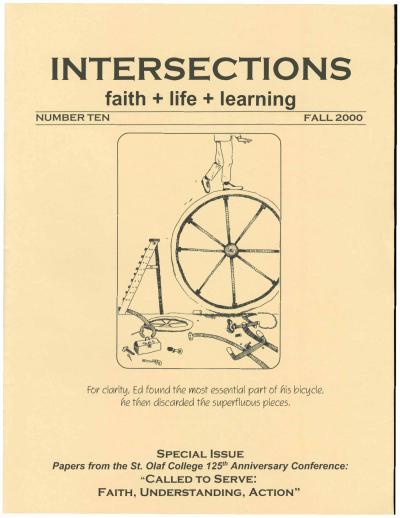 Editorial
From the Editor
Tom Christenson
Christenson recommends the St. Olaf 125th-anniversary volume Called to Serve—edited by Pamela Schwandt with Gary de Krey and L. DeAne Lagerquist—particularly Walter Sundberg’s “What Does It Mean To be Lutheran?” and Darrell Jodock’s “The Lutheran Tradition and the Liberal Arts College.” He notes that the volume’s biographical sketches of Lars Boe, F. Melius Christiansen, Ole Rolvaag, Emil Ellingson, Agnes Larson, John Berntsen, Arne Flaten, and Howard and Edna Hong show, against an outsourcing age, that the life of an institution like St. Olaf is the committed life of the people who work there.
-
Article
Faith, Understanding, and Action
Paul J. Dovre
Dovre frames the St. Olaf 125th anniversary—originally read as part of a presentation with the St. Olaf Cantorei and organist Paul Manz—around T.F. Gullixson’s story of an immigrant woman who “turned her face to the west wind” and the 1874 gathering at the Holden parsonage of B.J. Muus, Harold Thorson, O.K. Finseth, K.P. Haugen, and O.O. Osmondson. He weaves Anselm’s “faith seeks understanding,” Harold H. Ditmanson on the universal relevance of Christian faith, and the music of Venatius Honorius Fortunatas, John Rutter, Herbert Brokering, Ralph Vaughan Williams, and John Tavener into a meditation on faith as motive, understanding as modus, and action as consequence, against the “ill winds” of poverty, child homicide, AIDS, and consumer gluttony.
-
Article
Toward an Adequate Theology of Christian Higher Education
Robert Benne
Drawing on his forthcoming Eerdmans volume Quality With Soul—Thriving Ventures in Christian Higher Education, which studies St. Olaf, Valparaiso, Notre Dame, Baylor, Wheaton, and Calvin, Benne argues that these schools have kept their souls because a critical mass of boards, administrators, faculty, and students treat the Christian account as comprehensive, unsurpassable, and central. He critiques four inadequate theologies of Christian higher education—pietism, liberal theology (Whitehead, Henry Nelson Weiman, the “values” turn, and accommodation to diversity and multiculturalism), “First Article” approaches (including Merrill Cunninggim’s Methodist version and a Lutheran two-kingdoms quietism), and reactionary/triumphalist theology—and contrasts the Catholic (Notre Dame), Reformed (Calvin, Wheaton, Baylor), and Lutheran (St. Olaf, Valpo) ways of relating faith and learning, calling Lutherans to recover “Christ and culture in paradox” as serious extended conversation rather than as a lazy excuse.
-
Article
Education for Peace and Justice
David J. O'Brien
O’Brien surveys justice and peace education in Catholic higher education from Vatican II through the 1980s pastoral letters on nuclear weapons and the American economy, contrasting evangelical radicals (“what would Jesus do?”) with comfortable accomodationists, and argues that Catholic social teaching remains the church’s “best-kept secret.” Drawing on Bryan Hehir, David Hollenbach, Pope John XXIII, Patricia Hample’s “placing ourselves in the world to be of use,” and Martin Luther King’s last book on the “world house,” he develops pastoral care, solidarity (rooted in the mystical Body of Christ), and a realistic vocation-and-citizenship as the three needed responses for Catholic and Lutheran colleges alike.
-
Article
The Literature of Spiritual Reflection and Social Action
Shirley Hershey Showalter
Showalter, president of Goshen College, opens with Garrison Keillor’s “Singing with the Lutherans” and Walter Sundberg’s account of the Anabaptist “radical reformers” to locate Mennonite identity in a theology of suffering, humility, narrative, and song—tracing it through John S. Coffman’s 1904 “The Spirit of Progress,” Harold S. Bender’s 1944 “Anabaptist Vision,” John Howard Yoder’s The Politics of Jesus, and J. Lawrence Burkholder. She uses her Senior Seminar “Pedagogy of the Holy Spirit” reading of Viktor Frankl’s Man’s Search for Meaning, Madeleine L’Engle’s “Be a namer” and Walter Wink on the angels of institutions, and a Goshen Study-Service Term (SST) journal entry by student David Roth returning from Haiti—closing with two poems by Sarah Klassen—to argue for naming as the redemptive practice of church-related education.
-
Reflection
Vocation
Matt Peterson
In a chapel homily, St. Olaf student Matt Peterson quotes former St. Olaf professor Howard Hong’s 1955 Our Church and the World—“the tragedy is that we seem to have lost the full grasp of the Christian vocation”—to argue that vocation, from the Latin vocare, is centrally a call into daily communion with God and into continually becoming Christian, not the title of a successful career marked by GPA, win-loss records, honorary degrees, or net worth. Drawing on Anthony Bloom on prayer that must be lived, he indicts the dread of Monday, the “come hell or high water” demand for production, and the “faith community” that we take on faith.
-
 Article
From Alien to Citizen
Arne Selbyg
No. 29 · Spring 2009
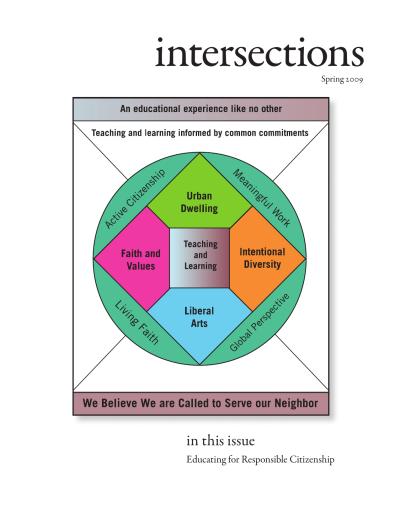
Selbyg reflects on three experiences of being educated for citizenship—growing up in Norway under the legacy of Lutheran pastors and public school teachers who resisted the Nazi occupation, arriving in America as a resident alien, and becoming a naturalized American citizen—and proposes the jazz ensemble as a better metaphor for American society than the melting pot, one in which different citizens learn skills, study other instruments, and dialog with one another in service to the common music.
-
 Editorial
From the Publisher
Arne Selbyg
No. 27 · Spring 2008
Selbyg, retiring this summer as Director for ELCA Colleges and Universities, reflects on his decade serving as spokesperson between the church and its twenty-eight colleges and universities, and argues that the link between the colleges and the church has grown stronger over the last ten years — sustained by supportive church leaders like Presiding Bishop Mark Hanson, the annual Vocation of a Lutheran College conference, and a Lutheran theology of higher education whose principles (questioning authority, returning to the sources, including the excluded, serving the neighbor) remain a strong basis for operating colleges and universities in the twenty-first century.
-
 Editorial
From the Publisher
Arne Selbyg
No. 26 · Fall 2007
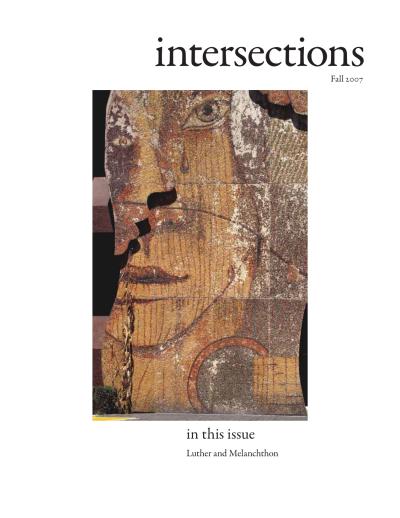
Selbyg notes that, while a stated purpose of Intersections over its twelve years and twenty-six issues has been the intersection of faith, learning, and teaching, surprisingly few articles have addressed how Lutheran faculty teach and why — and credits the editor for assembling essays from authors whose teaching has benefited from the ELCA Wittenberg Center, on the eve of the City of Wittenberg’s “Luther Decade” leading up to the 2017 Reformation anniversary.
-
 Editorial
From the Publisher
Arne Selbyg
No. 25 · Spring 2007
Selbyg notes that most papers in this issue grew out of a pan-Lutheran conference organized by the Association of Lutheran College Faculties in fall 2006 rather than the annual Vocation of a Lutheran College conference, and argues that the ELCA’s ecumenical posture—truthful but open to learning from others—is a good foundation for institutions of higher education whose faculty likewise profess while remaining subject to change based on new research and insights.
-
 Editorial
From the Publisher
Arne Selbyg
No. 24 · Fall 2006
Selbyg situates this issue in the ongoing ELCA conversation about education that began with the 2005 conference and is feeding into the second draft of the ELCA Social Statement on Education, previews the 2007 conference (“The Vocation of a Lutheran College — Engaging the World”) at Augustana College, Rock Island, and lifts up Luther’s insistence that the church and its members contribute to their wider communities rather than retreat into self-centered enclaves.
-
 Editorial
From the Publisher
Arne Selbyg
No. 23 · Summer 2006
Selbyg features articles based on presentations at the 2005 Vocation of a Lutheran College conference focused on the upcoming ELCA Social Statement on Education, and urges members of the ELCA higher-education community to download the first draft (“Our Calling in Education”) from the ELCA website and submit feedback to the Task Force on Education before the October 15 deadline. He worries that the sexuality social statement on a 2009 timeline will draw more attention than the education statement, but reminds readers that, for Martin Luther and for those who work in Lutheran higher education, education is as important as sex.
-
 Editorial
From the Editor
Robert D. Haak
No. 30 · Fall 2009
Haak frames the issue around the question of Lutheran college identity as formed in distinction from some “other,” introducing essays by Witherup on the Joint Declaration, Reuther on Holden Village, Afzaal on Christian-Muslim dialogue, Dovre on the history of Midwestern Lutheran colleges, Radecke on service-learning, and Ratke on Wilhelm Löhe — each making the claim that the “other” is an essential partner in conversation who helps us know who we are and shape who we will become.
-
Editorial
Guest Editor
Madeleine Forell Marshall
No. 25 · Spring 2007
Marshall introduces the four papers in this issue from the 70th annual meeting of the Association of Lutheran College Faculties, held at California Lutheran University in October 2006 on the theme “Identity and Diversity in the Lutheran College.” She notes a geographic pattern—the two East Coast contributors (Balmer and Bailey) defend Christian liberal arts against perceived suspicion, while the two Westerners (Marichal and Brubaker) treat Lutheran identity as advantage and diversity as a Lutheran given—and announces the 2007 ALCF meeting at Newberry College on “Beyond ‘Whatever’: Values Based Learning in Lutheran Higher Education.”
-
 Article
The Lutheran Liberal Arts College and Care for the Earth
H. Paul Santmire
No. 3 · Summer 1997
Santmire, author of The Travail of Nature, proposes three mandates for the Lutheran liberal arts college: take responsibility for spiritual particularity by confronting the ambiguities of the classical Christian tradition (Lynn White’s charge against anthropocentric Christianity vs. the Franciscan ecological tradition from Irenaeus through Luther) and of classical Lutheran social ethics (the Two Kingdoms, Romans 13, the Third Reich, Bonhoeffer); promote responsible cultural criticism (against Thoreau’s sociopathic anti-urban suburbanism); and promote a holistic environmental ethos through an interdisciplinary core curriculum with ecology as the queen of the sciences, a community that liberates the social imagination (Mumford, Marcuse), a cosmic Liturgical praxis rooted in the Colossians 1:15–20 hymn to the cosmic Christ, and an academy that models ecological responsibility.
-
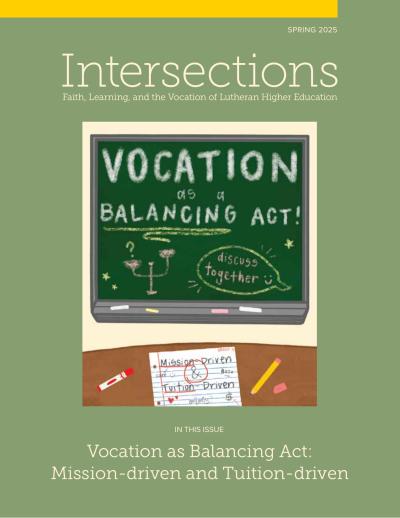 Editorial
From the Publisher
Lamont Anthony Wells
No. 61 · Spring 2025
5 min audio
Wells introduces So That All May Belong: Lutheran Roots for Diversity, Equity, Inclusion, and Justice as a theological and institutional articulation of NECU’s commitments, and previews four accompanying essays that frame vocation as a societal responsibility rooted in justice and not solely an individual pursuit.
-
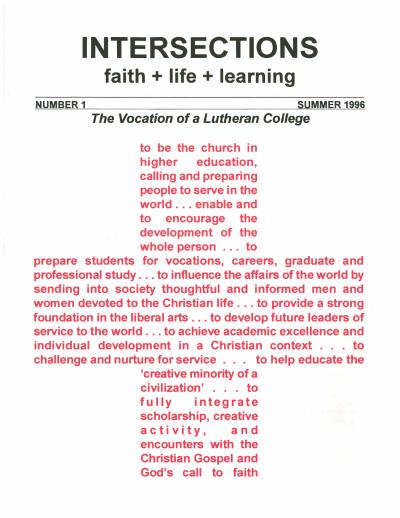 Editorial
From the Publisher
James M. Unglaube
No. 1 · Summer 1996
Unglaube welcomes readers to the inaugural issue of Intersections, crediting Editor Tom Christenson and Capital University, and announces the new annual Vocation of a Lutheran College Conference whose continuing dialogue the journal exists to enhance. He gives thanks to the Lilly Endowment for a sizable grant supporting the 1996 conference, campus dialogues, and the birth of the publication.
-
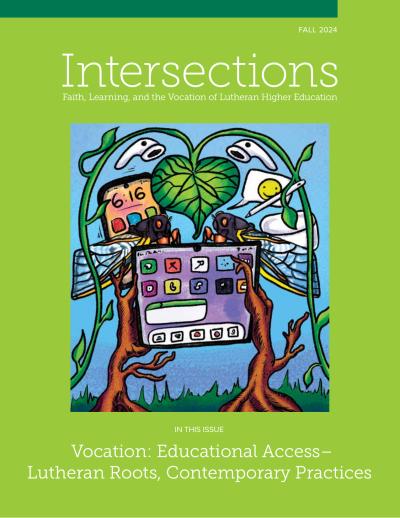 Editorial
From the Editor
Colleen Windham-Hughes
No. 60 · Fall 2024
Windham-Hughes welcomes newcomers and seasoned colleagues to the conversation, lifts up Mary Elise Lowe’s three Lutheran “whys” for educational access, and commends Rev. Jen Rude’s “Sacred Pause” practice as a way to humanize one another and make opening access both easier and more joyful.