As of September 2019
More information available at www.elca.org/socialstatements
Social Statements (address social institutions, provide frameworks)
The Church in Society: A Lutheran Perspective (1991)
Abortion (1991) — Aborto
The Death Penalty (1991) — Pena de Muerta
Caring for Creation: Vision, Hope, and Justice (1993) — Medio ambiente
Freed in Christ: Race, Ethnicity, and Culture (1993) — Raza, Etnicidad y Cultura
For Peace in God’s World (1995) — Por la paz
Sufficient, Sustainable Livelihood for All (1999) — Vida Economica
Caring for Health: Our Shared Endeavor (2003) — Salud y asistencia sanitaria
Our Calling in Education (2007) — Educación
Human Sexuality: Gift and Trust (2009) — La sexualidad humana
Genetics, Faith and Responsibility (2011)
The Church and Criminal Justice: Hearing the Cries (2013) — La Iglesia y la justicia penal
Faith, Sexism, and Justice: A Call to Action (2019) — (Translation in process)
Social Messages (briefer, topically focus, dependent on statements)
“AIDS/HIV” (1988) — El SIDA
“Israeli/Palestinian Conflict” (1989)
“Homelessness: A Renewal of Commitment” (1990) — Gente sin Vivienda
“End of Life Decisions” (1992) — Final de la Vida
“Community Violence” (1994) — Violencia Comunidad
“Sexuality: Some Common Convictions” (1996) — La Sexualidad
“Immigration” (1998) — Inmigración
“Suicide Prevention” (1999) — Suicido
“Commercial Sexual Exploitation” (2001) — Explotaćion Sexual
“Terrorism” (2004) — Terrorismo
“People Living with Disabilities” (2010) — Personas Discapacidades
“The Body of Christ and Mental Illness” (2012) — Las enfermedades mentales
“Gender-based Violence” (2015) — (Translation in process)
“Human Rights” (2017) — (Translation in process)
150+ Social Policy Resolutions (policy specific)
Examples of two different kinds:
a) Adopted by Church Council (include theological and analytical background)
“The Sponsorship of Legal Gaming by American Indian Tribes” (2007)
“Toward Compassionate, Just, and Wise Immigration Reform” (2008)
b) Adopted by Churchwide Assembly (little background, very brief)
“Rural Economic Crisis” (1999)
“Opposition to the War in Iraq” (2005)
-
 Editorial
From the Publisher
Mark Wilhelm
Wilhelm frames the issue by tracing how Lutheran educational ideals — once a primary source of contemporary higher education — were masked in the United States, and introduces a NECU initiative that uses the case of business ethics to explore Lutheran social teaching as an academic resource.
-
Editorial
Guest Editorial: Moral Deliberation in NECU Classrooms
Ernest L. Simmons
Simmons introduces the guiding question of the NECU working group: could the ELCA’s twelve social statements and thirteen social messages — expressions of Lutheran social teaching originally formulated for congregational use — turn campuses into “academic communities of moral deliberation”?
-
Article
The Responsible Professional: Vocation and Economic Life
Martha E. Stortz, Tom Morgan
Stortz and Morgan argue that the “value-added” of Lutheran higher education is a responsibility ethic — one that frames the professional as a first responder “called and empowered to serve the neighbor so that all may flourish” — and unpack the four criteria of the 1999 ELCA social statement Sufficient, Sustainable Livelihood for All as a framework for economic deliberation.
-
Article
ELCA Social Teaching for the Classroom?
Roger A. Willer
Willer argues that the body of ELCA social teaching, taken as a whole, constitutes an actual social ethic — relatively comprehensive, responsibly consistent, and remarkably cogent — whose mode of responsibility ethics commends it as a classroom resource for any discipline that wrestles with moral questions.
-
Article
The Challenge of Inclusion in the Ethics Classroom
Faith Wambura Ngunjiri
Ngunjiri, the only Black woman tenured faculty member at Concordia College, reflects on her students’ resistant and resonant responses to MLK Day programming on “Not Racist: A White Moderate Myth” — and on what it takes to make the ethics classroom a place where students can “BREW”: Becoming Responsibly Engaged in the World.
-
Article
Business as Usual? Marketing, God, and the Limits of Christian Callings
Emily Beth Hill
Hill, a former corporate marketing consultant turned theologian, returns to Luther’s claim that no vocation is more holy than another — and uses Luther’s Large Catechism definition of God to argue that the modern practice of branding intentionally redirects the love and worship of human beings toward capital, raising the question of whether Christian neighbor-love places limits on what professions Christians should pursue.
-
Article
Responding to Student Hunger at NECU Institutions
Kristen Glass Perez
Glass Perez recounts how her work as college chaplain at Augustana and Muhlenberg evolved after a student offhandedly declared, “I am always so hungry at this school,” and shares five lessons learned from launching campus pantries, emergency grant programs, and the HOPE Survey to address food insecurity as a defining calling of NECU institutions.
-
Article
Gen Z is Made for Lutheran Higher Education
W. Kent Barnds
Barnds argues that Generation Z’s defining traits — socially responsible, purpose-driven, cost-conscious, culturally open, and tech-expectant — align almost perfectly with the missions of NECU institutions, and offers concrete suggestions (from replacing “vocation” with “purpose” to embracing Gen X parents as co-pilots) for Lutheran colleges seeking to attract and serve this generation.
-
 Article
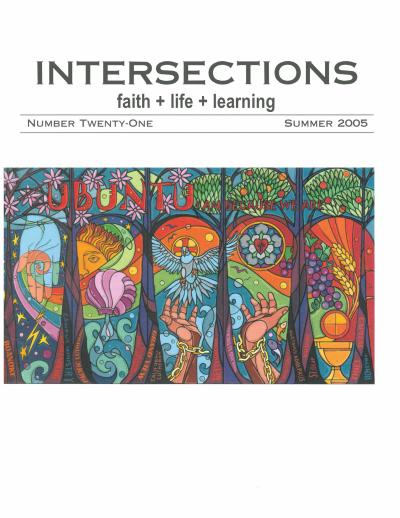
Money, Sex and Power: An Exploration of Some Controversial Issues in the Public Witness of the Church
Pamela K. Brubaker
No. 21 · Summer 2005
Brubaker explores two controversial issues in the church’s public witness—homosexuality and economic life—and the challenges they present for both church and college. Drawing on Beverly Harrison, Elizabeth Bounds, Ron Thiemann, Linell Cady, Marcia Bunge, Richard Hughes, Darrell Jodock, Ernest Simmons, Karen Bloomquist, Garth Kasimu Baker-Fletcher, and Larry Rasmussen, and on episodes at California Lutheran University around “Harmony Week” and Bishop Paul Egertson’s participation in Anita Hill’s ordination, she argues that colleges related to the ELCA are called to educate for “critical citizenship” by hosting rigorous, bold, and unfettered debate—including debate over the neo-liberal globalism that she names a form of economic fundamentalism.
-
 Article
The Power of Ritual Action and George Floyd Square
Mary Clare Tiede Hottinger
No. 57 · Spring 2023
A California Lutheran University senior examines how George Floyd Square in Minneapolis has been transformed into sacred space through ritual action, and considers what this site of remembrance, mourning, and ongoing struggle for justice can teach us about the power of ritual to unify and sustain community.
-
 Reflection
The Neglected Miracle of Pentecost
Susan M. O'Shaughnessy
No. 32 · Spring 2010
O’Shaughnessy, in a homily delivered at Concordia College in 2008, reads the Pentecost narrative of Acts 2 through Maria Lugones and Elizabeth Spelman’s 1983 critique of white feminism’s cultural imperialism. She argues that the miracle is not the disciples’ speaking but the immigrant Jews’ hearing—and that the writer of Acts withholds the content of what was said precisely to teach disciples that people of privilege know less than the foreigner, the immigrant, the oppressed, the woman, the child, and must learn to listen in new languages before they can speak.
-
 Reflection
Truth, Reconciliation, and Redemption in South Africa
Brian Forry Wallace
No. 13 · Winter 2002
Wallace, a 24-year veteran political science professor at Capital University, recounts five weeks of post-apartheid peace-building travel-study with students living south of Cape Town—visiting townships, schools, day-care centers, a children’s AIDS hospital, Robben Island, and Nelson Mandela’s cell—and offers vivid sketches of his student companions Amy, Brian, Meghan, Karrie, Patrick, Meredith, Cheryl, Corin, Debbie, April, and Audra. He concludes that these students—atheists and agnostics and Buddhists and Methodists and Baptists, headed for social work, nursing, teaching, ministry, and parenthood—embody vocation by responding to a voice that calls them out of themselves to be present and to heal in this world, and that they are his link to the redemption of a lost and broken soul.
-
 Editorial
From the Incoming Editor
Colleen Windham-Hughes
No. 55 · Spring 2022
Windham-Hughes introduces herself as incoming editor by reclaiming the root of assess — “to sit by” — and committing to the question “What does this mean?” as she sits with readers in the worth of our work and the universality of vocation.
-
 Article
Vocare: A Spiritual Practice for the Spaces Between
Charlene Rachuy Cox
No. 58 · Fall 2023
Cox introduces Vocare, a six-word spiritual practice developed through the Nourishing Vocation Project at St. Olaf, that uses the acronym V-O-C-A-R-E to help individuals and communities honor the spaces “between no longer and not yet” and discern their callings for the common good.