Concordia College observed MLK Day 2020 on the theme of “Not Racist: A White Moderate Myth.” My ethics students were required to attend the events and reflect on three questions: What was the primary message? How did that message resonate with you? And: What questions did the speeches and workshops raise for you? Inevitably, as a predominantly white institution (PWI) working on equality, diversity, and inclusion (EDI) ideals, Concordia met the topic with some resistance. I am the only Black woman tenured faculty member, so the resistance came as no surprise. How are we ever going to get to sufficient, sustainable livelihoods for all (as the ELCA social statement has it), if we cannot discuss one of the reasons for economic inequality—racism and racist structural arrangements in the United States? As an intersectional scholar, I introduce my students to issues of race, gender, sexual identity, religion, and other sources of diversity and marginalization in organizations. MLK Day offered the perfect entry point for talking about race in class this semester.
As I read through my students’ reflections, it was clear that, on the one hand, they were profoundly moved and informed by the messages from the speakers. One of the speaker’s talk focused on the question of “who has a right to belong here”—an issue we obviously struggle with as a PWI. We are not yet an inclusive campus; in fact, most minority students would describe the climate as hostile. As such, our retention rates for minority students are insufferable. My ethics students’ comments such as “everyone belongs here and everyone should be accepted here” suggests that some students are open to expanding their worldview. As an example, through student activism, a meal bank fund was begun last semester to help food insecure students.
On the other hand, statements such as “white people do not have to interact with colored people,” or “the power behind [white privilege] is considerably smaller and less impacting to colored people”—and, indeed the fact that they use the term “colored people” to refer to minorities—suggests that we have a lot of work to do to educate our students to become more culturally competent. We have far to go to become a welcoming institution for all.
During our next class period, I led the class through a discussion on race and racism, beginning with a five-minute New York Times documentary, “Conversations with White People about Race.” My goal was to help the students collectively process what their experiences in a safe space, and to help to destigmatize these taboo topics. We can only truly learn how to be ethical leaders in the issues of race and diversity by openly engaging with these topics. Students resonated with the views expressed about the discomfort that white people have towards talking about race. They also talked about how they first came to realize that they were of a certain race. My goal in bringing such difficult conversations to the ethics classroom is to equip my students with the ethical tools to engage in dialogue. We must do better, as an institution committed to helping our students “BREW”: Becoming Responsibly Engaged in the World.
-
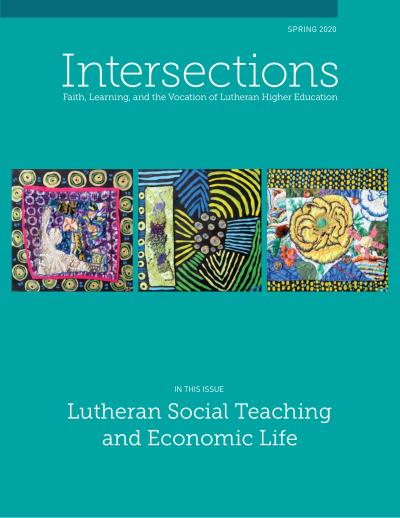 Editorial
From the Publisher
Mark Wilhelm
Wilhelm frames the issue by tracing how Lutheran educational ideals — once a primary source of contemporary higher education — were masked in the United States, and introduces a NECU initiative that uses the case of business ethics to explore Lutheran social teaching as an academic resource.
-
Editorial
Guest Editorial: Moral Deliberation in NECU Classrooms
Ernest L. Simmons
Simmons introduces the guiding question of the NECU working group: could the ELCA’s twelve social statements and thirteen social messages — expressions of Lutheran social teaching originally formulated for congregational use — turn campuses into “academic communities of moral deliberation”?
-
Article
The Responsible Professional: Vocation and Economic Life
Martha E. Stortz, Tom Morgan
Stortz and Morgan argue that the “value-added” of Lutheran higher education is a responsibility ethic — one that frames the professional as a first responder “called and empowered to serve the neighbor so that all may flourish” — and unpack the four criteria of the 1999 ELCA social statement Sufficient, Sustainable Livelihood for All as a framework for economic deliberation.
-
Institutional Focus
A List of ELCA Social Teaching and Policy Documents
A reference list, as of September 2019, of the ELCA’s twelve social statements, fourteen social messages, and over 150 social policy resolutions — with Spanish translations where available.
-
Article
ELCA Social Teaching for the Classroom?
Roger A. Willer
Willer argues that the body of ELCA social teaching, taken as a whole, constitutes an actual social ethic — relatively comprehensive, responsibly consistent, and remarkably cogent — whose mode of responsibility ethics commends it as a classroom resource for any discipline that wrestles with moral questions.
-
Article
Business as Usual? Marketing, God, and the Limits of Christian Callings
Emily Beth Hill
Hill, a former corporate marketing consultant turned theologian, returns to Luther’s claim that no vocation is more holy than another — and uses Luther’s Large Catechism definition of God to argue that the modern practice of branding intentionally redirects the love and worship of human beings toward capital, raising the question of whether Christian neighbor-love places limits on what professions Christians should pursue.
-
Article
Responding to Student Hunger at NECU Institutions
Kristen Glass Perez
Glass Perez recounts how her work as college chaplain at Augustana and Muhlenberg evolved after a student offhandedly declared, “I am always so hungry at this school,” and shares five lessons learned from launching campus pantries, emergency grant programs, and the HOPE Survey to address food insecurity as a defining calling of NECU institutions.
-
Article
Gen Z is Made for Lutheran Higher Education
W. Kent Barnds
Barnds argues that Generation Z’s defining traits — socially responsible, purpose-driven, cost-conscious, culturally open, and tech-expectant — align almost perfectly with the missions of NECU institutions, and offers concrete suggestions (from replacing “vocation” with “purpose” to embracing Gen X parents as co-pilots) for Lutheran colleges seeking to attract and serve this generation.
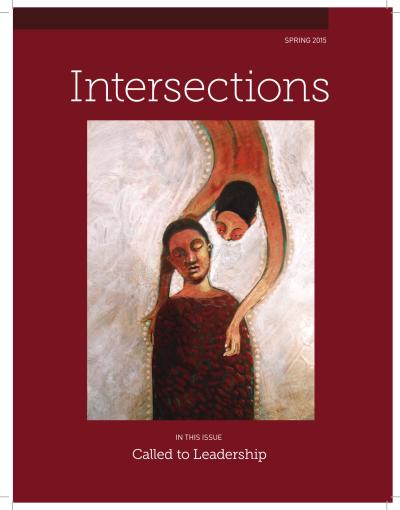
-
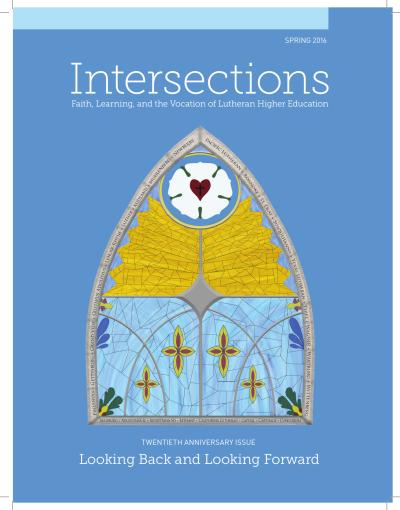 Article
Diversity and Dialogue: Twenty Years and Counting
Florence D. Amamoto
No. 43 · Spring 2016
Twenty years after her essay “Diversity and Dialogue” in the first issue of Intersections, Amamoto returns to Gustavus Adolphus College to reflect on what has changed and what has not: rising numbers of students of color and international students, faculty turnover and increased publication pressures, the disappearance of the Center for Vocational Reflection, and the renewed importance of articulating Gustavus’s Swedish Lutheran heritage and inclusive sense of community in a tuition-dependent, cost-cutting environment.
-
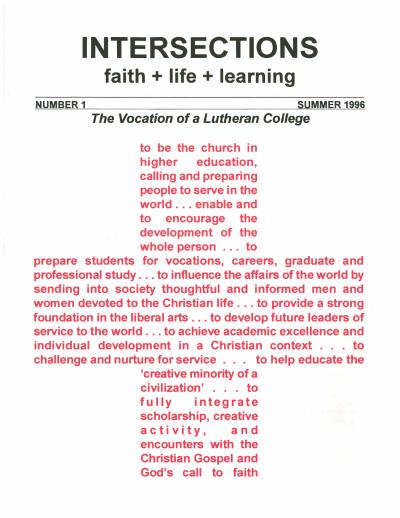 Institutional Focus
Continuing the Dialogue: Augustana College
Sandra C. Looney
No. 1 · Summer 1996
Looney describes Augustana College, Sioux Falls, debating and renaming its values—Christian, Liberal Arts, Community, Excellence, Service—under the leadership of religion professor Dr. Arthur Olsen and the T’N’T (“Through Thick and Thin”) committee, in the wake of ELCA Region III’s “What Does It Mean to be a College of the Church?” conversations. She describes Augustana’s 56% Lutheran student body, daily 10 a.m. chapel, dual Christmas Vespers in Our Savior’s Lutheran Church and St. Joseph’s Cathedral, the Capstone classes on moral and aesthetic issues, and the ongoing work of enlarging Augustana’s conversation to include Native American, Jewish, and Islamic voices.
-
 Institutional Focus
LibGuide: Introduction to Womanist Theology
Elli Cucksey
No. 56 · Fall 2022
Cucksey, the head librarian at Trinity Lutheran Seminary, recounts how Beverly Wallace’s Introduction to Womanist Theology class — the first offering of the ELCA Seminaries’ Womanist Theology Initiative — led her to build a publicly available LibGuide that amplifies Black women’s voices and gathers the resources of the course for future students.
-
 Article
Turning to a Reproductive Justice Framework for Inclusive Dialogue across Differences
Jenny M. James
No. 57 · Spring 2023
James makes the case that a reproductive justice framework, rooted in the work of black feminist scholars and activists, gives educators tools to overhaul polarized pro-choice/pro-life conversations and to host inclusive dialogues across differences of race, sexuality, gender identity, and faith.
-
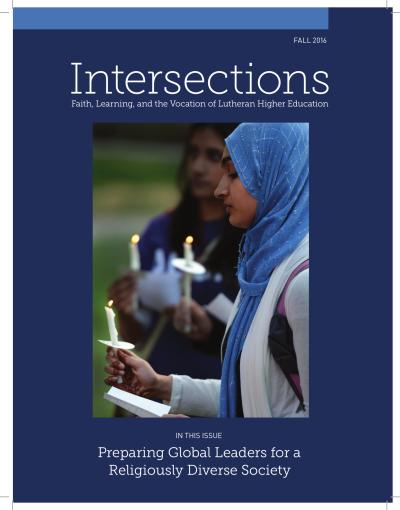 Editorial
From the Publisher and Editor
Jason A. Mahn, Mark Wilhelm
No. 44 · Fall 2016
Writing weeks after the 2016 presidential election, Wilhelm and Mahn frame interfaith engagement as the urgent and ongoing work of ELCA colleges and universities, recap NECU’s growing commitments to inter-religious leadership, and introduce essays first delivered at the summer 2016 Vocation of a Lutheran College Conference under the theme “Preparing Global Leaders for a Religiously Diverse Society.”
-
Institutional Focus
Diversity and Dialogue: Gustavus Adolphus College
Florence D. Amamoto
No. 1 · Summer 1996
Amamoto, a third-generation Japanese-American Buddhist who teaches American literature at Gustavus Adolphus and regularly attends daily chapel, writes as an “inside outsider.” Engaging Schwehn’s closing call to refurbish the Lutheran college, she argues that church-related colleges are vitally important to society, that “refurbishing” must take up diversity, and describes how Lutheranism is manifest at Gustavus: Christ Chapel as the highest point on campus, the ecumenical chapel program led for thirty years by Chaplain Richard Elvee, the Nobel Conferences that pair scientists with philosophers and theologians, the First-term Seminar and Tuesday Conversations, the India study-abroad program organized by Deane Curtin, and the Sponberg Chair in Ethics. She names the pressures of money, secularization, and the publications-driven push for “excellence” that threaten this creative tension.