“Just a Little”
(August 2018)
Weary from the rising tides of malice,
families separated in the land of liberty.
How have we become a nation callous
to huddled masses yearning to breathe free?
Prophets’ wisdom, like a bell resounding,
justice bearing mercy and a generous feast for all,
parables of need and grace abounding,
last handful of flour becomes a widow’s generous call.
I just need a little light from Bethlehem,
it would be enough just to reach and touch the
garment’s hem.
join the great refrain, “We shall overcome,”
even dogs will get the master’s table crumbs.
All I need is a little, all I need, just a little.
Immigrant Naomi suffered losses,
like so many refugees, a tale of deep lament,
the faithfulness of Ruth, a new colossus,
“I will go where you go,” a sacred testament.
Mother of all citizens and exiles,
bless us by your welcome with so many things amiss,
courage grant amidst the chaos hostile,
what if we are born for a time such as this?
I just need a little light from Bethlehem,
it would be enough just to reach and touch the
garment’s hem.
Take and bless the gifts counted last and least,
hearts are hungry for a loaves and fishes feast.
All I need is a little, all I need, just a little.
Torch of liberty and faithful beacon,
burn with pilgrim hunger for a world more just and whole,
luminous and wise with fire of freedom,
summon forth the kindred spark in every blessed soul.
I just need a little light…
-
 Editorial
From the Publisher
Mark Wilhelm
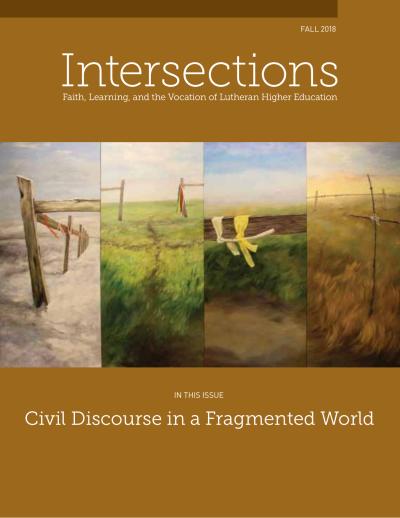
Wilhelm frames the issue by reflecting on the Letter of James and the Lutheran tradition of “calling a thing what it is” — arguing that the standards of academic discourse, deeply rooted in Lutheran insistence on frankness and honesty alongside concern for the common good, give NECU institutions a solid platform for sustaining honest but not hateful discourse about divisive issues.
-
Editorial
From the Editor
Jason A. Mahn
Mahn recounts how a participant’s probing questions at the 2018 Vocation of a Lutheran College Conference turned “civil discourse” from an innocuous theme into a contested one — and previews essays that variously urge listening and common ground, or speaking truthfully even when those words sound angry.
-
Article
Vocation and Civil Discourse: Discerning and Defining
Lynn Hunnicutt
Hunnicutt draws on Rabbi Amy Eilberg’s reading of Moses’ calling to identify four features of vocational discernment — attention, wonder, communal consciousness, and humility — and argues that these same qualities are also key aspects of civil discourse, so that forming students for vocational discernment is simultaneously forming them for civility.
-
Article
Polarization, Incivility, and a Need for "Change"
Guy Nave
Nave argues that when Americans demand “change,” they usually mean that “others” need to see things their way — and that meaningful transformative change requires acknowledging the provisional nature of our perspectives, seeking to understand as much as to be understood, and bursting the ideological echo chambers of social media through projects like Clamoring for Change.
-
Article
Putting the Kind Back in Human
Sarah Ciavarri
Drawing on Brené Brown’s research on vulnerability and Edwin Friedman’s family systems theory, Ciavarri distinguishes “kind” from “nice” and argues that courageous, vulnerable, and playful truth-telling — rather than yelling louder or trading pithy memes — is the path back to one another and to our common humanity.
-
Article
It's Time to Rewrite the Rules of Civility
Jon Micheels Leiseth
Leiseth contends that the prevailing rules of civility too often function as the majority’s rules, stifling those facing real harm — and proposes that NECU institutions rewrite civility as “neighboring,” guided by the ELCA’s five values of accompaniment: mutuality, inclusivity, empowerment, sustainability, and vulnerability.
-
Article
The Musician's Vocation
Jeffrey Bell-Hanson
Bell-Hanson argues that musicians, who exercise profound influence over the emotional flavor of a moment, are called not merely to technical proficiency but to a sense of vocation: understanding their art well enough to use it responsibly, to intend truthfulness rather than manipulation, and to articulate its significance in dialog with other disciplines.
-
 Article
More Value than Many Sparrows: A Sermon on Matthew 10:26-31
Patricia Lull
No. 38 · Fall 2013
Preaching at the 2013 Vocation of a Lutheran College conference, Lull recalls her own arrival at the College of Wooster the summer after Kent State and contrasts that era’s sense of students as participants in a college’s mission with today’s talk of “butts in seats.” Reading Matthew 10:26-31, she promises that the way of the cross—and its hard opportunities for slow-paced learning, genuine debate, and access for students who cannot pay the full cost—is the easy yoke, the lightest burden of all.
-
 Response
Response to Mark Wilhelm: Vocation—Wide Perspective Questions
Mary-Paula Cancienne
No. 56 · Fall 2022
Cancienne, drawing on Iain McGilchrist, asks whether higher education has prioritized micro lenses at the expense of the macro view, and invites educators to hold the drama of individual vocation stories within a wider plot that includes James Webb Telescope wonder, climate grief, the long shadow of enslavement, and the resilience of native populations.
-
 Editorial
From the Editor
Tom Christenson
No. 11 · Spring 2001
Christenson explains that this issue “borrows everything from other sources”—Richard Hughes’s talk at Pepperdine president Andrew K. Benton’s inauguration, Nicholas Wolterstorff’s and Storm Bailey’s essays from the AAUP’s Academe, and Catherine McMullen’s Concordia talk—and defends the blatant borrowing as appropriate to faculty work, hoping new faculty will find in these pieces a corrective to common misconceptions about faith-related education and academic freedom.
-
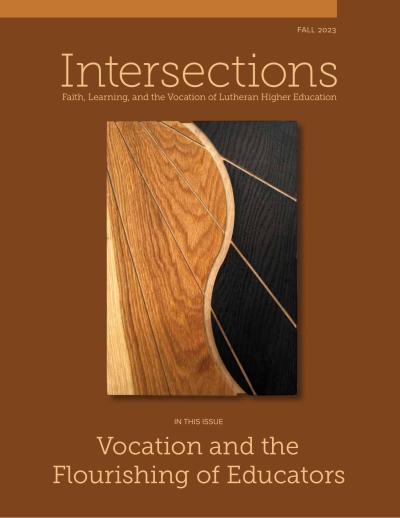 Article
Beyond Deep Gladness: Coming to Terms with Vocations We Don’t Choose
Deanna Thompson
No. 58 · Fall 2023
Thompson, living with incurable cancer, expands Frederick Buechner’s definition of vocation to make room for deep sadness — drawing on Arthur Frank, Shelly Rambo, Beverly Wallace, and Ross Gay to argue that practices of lament, including the public lament of Friday Flowers at St. Olaf, open space for gladness, joy, and even flourishing to emerge.
-
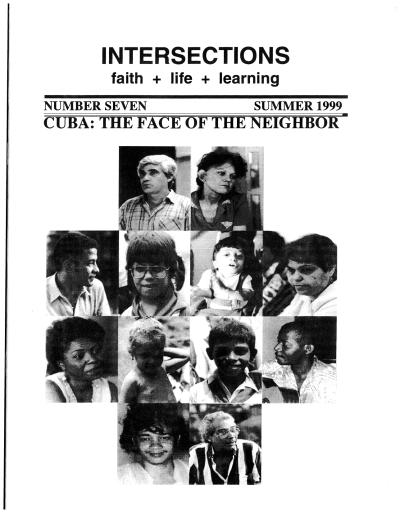 Article
How Can We Keep From Singing?
Robert Scholz
No. 7 · Summer 1999
Scholz, professor of music at St. Olaf, responds to Tom Christenson’s “Freedom of a Christian” by walking through his own Nunc dimittis for the St. Olaf Christmas Festival, an Elderhostel choir of singers aged 60 to 95, and the four liberating arts (enablement and change, melioristic, embodying, and critical) as they shape conducting, composition, and music education. He defends the fine arts and folk traditions over “contemporary Christian” soft pop-rock and taped accompaniments, citing Luther’s preface to Georg Rhau’s Symphoniae iucundae and the family of God’s need to interact in song against the virtual community of TV evangelism and the Crystal Cathedrals of the air.
-
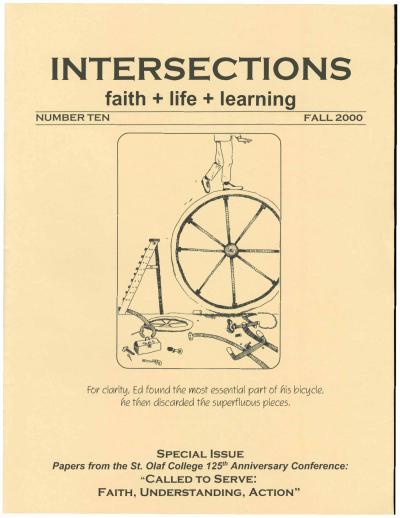 Article
Toward an Adequate Theology of Christian Higher Education
Robert Benne
No. 10 · Fall 2000
Drawing on his forthcoming Eerdmans volume Quality With Soul—Thriving Ventures in Christian Higher Education, which studies St. Olaf, Valparaiso, Notre Dame, Baylor, Wheaton, and Calvin, Benne argues that these schools have kept their souls because a critical mass of boards, administrators, faculty, and students treat the Christian account as comprehensive, unsurpassable, and central. He critiques four inadequate theologies of Christian higher education—pietism, liberal theology (Whitehead, Henry Nelson Weiman, the “values” turn, and accommodation to diversity and multiculturalism), “First Article” approaches (including Merrill Cunninggim’s Methodist version and a Lutheran two-kingdoms quietism), and reactionary/triumphalist theology—and contrasts the Catholic (Notre Dame), Reformed (Calvin, Wheaton, Baylor), and Lutheran (St. Olaf, Valpo) ways of relating faith and learning, calling Lutherans to recover “Christ and culture in paradox” as serious extended conversation rather than as a lazy excuse.