What is the nature of our identity as “Lutheran colleges”? That is the question that is the focus of the pages of Intersections—this issue and those of the past. We know that identity is often (always?) formed in distinction from some “other.” Who the “other” is and how we relate to it changes over time, as does our understanding of our own identity. This issue comes together primarily around the issue of exploring the “other” in relation to our Lutheran colleges.
Three of the articles do this explicitly. Ron Witherup draws our attention to an anniversary that we don’t seem to have celebrated—the tenth anniversary of the “Joint Declaration on the Doctrine of Justification” by Lutherans and Roman Catholics. His call was directed at his Roman Catholic brothers, but serves as a call to us also. If the central point of contention for the past five-hundred years between Catholics and Lutherans has been agreed upon, what does this have to say about our identity. If we are not “those folks who disagree with Rome about justification,” then who are we? This is particularly important for those of us who have significant populations of Roman Catholic students at our schools. Augustana has significantly more Catholic students than Lutheran.
In a piece that has been around for a while, Rosemary Radford Reuther helps us to see ourselves from the outside—a Catholic looking at us from inside the sauna at Holden Village. This gathering place is well known to many of us. For some, it exemplifies Lutheranism at its ecumenical best. What do we look like (or did we look like?) “huddled together on shelves… sweat pouring out like salvation by grace alone”? Sometimes we can see ourselves most clearly through the eyes of the “other.”
Ahmed Afzaal calls us in another direction. In today’s American culture, the “other” is often and easily defined as anyone identifying themselves as Muslim. Where and how do we find common ground with this “other” in our culture? Afzaal makes an interesting and important attempt to claim that the common ground should lead us back to a more fundamental understanding of our own identity—as followers of Jesus. As a Muslim, he calls us to be more truly who we are. Only by doing that can we make the most of the opportunity to put our faith into practice.
Paul Dovre reminds us that it is not a new thing for Lutheran colleges to respond to the changes around them. He traces the changing nature of the understanding of the relationship between the college and the church, principally by tracing this relationship for six Midwestern colleges. Tellingly, he points to the growing diversity of our campuses and the attendant change in our self-understanding. This leads us, in his opinion, to one of our strengths as Lutheran colleges—“a commitment to engage in conversation with other faith traditions.” Afzaal has shown how this conversation can lead us to see and claim our identity even more clearly. Dovre shows how this is part of our very nature.
One place where our students often encounter the “other” is in the process of participating in service-learning on our campuses. Mark Radecke reminds us of the promise and the danger of such experiences. This paper (in a bit more C.S. Lewis form) was given at a Vocation of a Lutheran College conference held at Luther College. He (or rather Horatio Gumnut) reminds us that we have much to learn from those we encounter as the “other.”
David Ratke reminds us that our resources for understanding ourselves are not only from without, but that at times we could learn more from within our own tradition. He draws on the life and work of Wilhelm Löhe to better understand our work today.
In a culture which often sees the “other” as a foil to be attacked or brought into submission, the articles in this issue make a different claim—that the “other” is an essential partner in conversation who can help us to know who we are and help shape who we will become as Lutheran colleges and universities.
-
 Editorial
From the Publisher
Mark Wilhelm
Wilhelm reports on the difficult financial season facing the ELCA churchwide organization — a ten-percent budget reduction announced in November and significant cuts to unrestricted grants for colleges and universities — while affirming that the ELCA’s commitment to the mission of its schools remains strong, including its commitment to engaging the “other,” the theme of this issue.
-
Article
Bringing an Ecumenical Milestone Out of the Shadows
Ronald D. Witherup, S.S.
Witherup draws attention to the tenth anniversary of the Lutheran-Catholic “Joint Declaration on the Doctrine of Justification” signed on Reformation Day 1999, summarizes the document’s claim that justification is the work of the triune God received by grace alone through faith, surveys the remaining questions raised by Pope John Paul II and the 2006 endorsement by the World Methodist Conference, and proposes a pastoral strategy for bringing this ecumenical milestone out of the shadows in Catholic parishes.
-
Reflection
On Sharing the Sacred Sauna
Rosemary Radford Ruether
Reprinted from the National Catholic Reporter (August 1968), Ruether’s reflection from her time as a theologian on the faculty of Holden Village describes Lutheran community life in the mountains of northern Washington from a Catholic perspective — finding more catholicity in this Lutheran retreat than in many Roman Catholic communities — and culminates in a celebration of the Holden sauna as “the new sacrament, the new fellowship, the new theology.”
-
Article
Between Suspicion and Trust
Ahmed Afzaal
Afzaal argues that scholars and educators have a unique vocation to shift Christian-Muslim relations from suspicion to trust, drawing on the 2007 Muslim open letter “A Common Word,” Robert Shedinger’s Was Jesus a Muslim?, and Muhammad Iqbal’s Reconstruction of Religious Thought in Islam to argue that Christianity and Islam converge in the insight that religion is a spiritual force for social justice and human liberation — an insight obscured by the modern Western discourse of sui generis religion.
-
Article
Lutheran Colleges: Past and Prologue
Paul J. Dovre
Dovre offers a reminiscence rather than a research paper, drawing on Aristotle’s ethos, logos, and pathos to trace fifty years of change at Midwestern Lutheran colleges through the key issues of survival, respectability, faithfulness, and relationship to the church — from the dependence of the 1950s through the independence of the late twentieth century to the partnership of the 2000s — and identifies key variables (the student marketplace, faculty formation, and the identity/diversity paradox) for shaping the identity and mission of Lutheran colleges into the future.
-
Article
SCAM-ing Service-Learning and Mission Trips: A Satirical Essay
Mark Wm. Radecke
Radecke couches his research on best/worst practices in service-learning and short-term mission trips in a fictional Screwtape-style correspondence between Horatio Gumnut, CEO of “Spiritual Consultants and Mercenaries, Incorporated” (SCAM, Inc.), and Dwayne Pipe, an untenured professor seeking to sabotage a colleague’s Nicaragua mission trip — cataloging through indirection the disorienting dilemmas, commodification of the poor, exhaustion of reflective practice, and false noblesse oblige that derail such ventures, while pointing toward the genuine philoxenia, accompaniment, and structural awareness that mark a transformative experience.
-
Article
Wilhelm Löhe and Higher Education
David Ratke
Ratke recovers the educational vision of Wilhelm Löhe (1808–1872), spiritual father of Wartburg College and Wartburg Seminary, drawing on Löhe’s “Aphorismen über Schule und Schulunterricht” and other writings to argue that education is about the formation of whole persons by whole teachers in whole institutions, that all education is religious and never neutral, and that education is for eternity as well as the present — a vision in which the values of Christianity sanctify the so-called worldly means of education.
-
 Book Review
Assessing the Value of Liberal Arts: A Review of The Evidence Liberal Arts Needs, by Richard A. Detweiler
Robert D. Haak
No. 55 · Spring 2022
Haak reviews Richard A. Detweiler’s The Evidence Liberal Arts Needs, in which the former president of the Great Lakes Colleges Association analyzes 240 college mission statements and interviews more than 1,000 graduates to argue that liberal arts educational experiences have a measurable impact on adult lives of consequence, inquiry, and accomplishment — and invites NECU institutions into a further conversation about how Detweiler’s methodology applies to Lutheran higher education.
-
 Article
The Vocation of Intersections on its Twentieth Birthday
Jason A. Mahn, Robert D. Haak, Tom Christenson
No. 43 · Spring 2016
The three editors of Intersections — Bob Haak, Jason Mahn, and Tom Christenson (in spirit, following his death in 2013) — trace the twenty-year vocation of the journal itself: its 1996 birth at Capital University; its coming-of-age years of debate over institutional markers, two-kingdoms theology, and Lutheran identity; the ascendancy of “education for vocation” as the central marker of Lutheran higher education; and its ongoing identity in relation to a changing ELCA and to the broader cultural conversation about purpose, wholeness, and the vocation of higher education.
-
 Editorial
From the Outgoing and Incoming Editors
Jason A. Mahn, Robert D. Haak
No. 34 · Fall 2011
Outgoing editor Robert D. Haak reflects on a six-year run inheriting Intersections from founder Tom Christenson, the “powerful voices” that have driven the conversation (Dovre, Jodock, Christenson, Simmons, Morgan, Olsen, Wilhelm) and the newer ones now entering (Mahn, Bussie); incoming editor Jason A. Mahn, picked up from the airport in Bob’s pickup truck five years ago, names central issues that “Lutherans on Faith and Learning” engages and previews essays by Dovre, Jodock, McDonald, Hill, Turnbull, and Jodock again.
-
 Editorial
From the Editor
Robert D. Haak
No. 33 · Spring 2011
Haak frames the issue by asking how Lutheran colleges and universities understand the changing landscape of religious identification on their campuses, and argues that Lutheran theological commitments — including the work of the Spirit and the Incarnation — call institutions to create places where the voice of “the other” is heard and valued.
-
 Article
Called to Serve
Robert D. Haak
No. 31 · Winter 2010
Haak describes Augustana’s Center for Vocational Reflection (CVR) and its threefold framework of skills/gifts/talents, passions/values, and needs of the community. He surveys the CVR’s Working with Faith group, seminary visits, spiritual companioning, Servant Leader Internships, international travel reflection, and the major Senior Inquiry curriculum revision—then reports the lessons learned at Augustana: that multiple exposures matter more than any single program, that the language of vocation works even for non-religious students, that student-initiated ideas (like Erin Blecha’s Athletes Giving Back) often succeed most, and that the CVR will soon merge into a new Community Engagement Center.
-
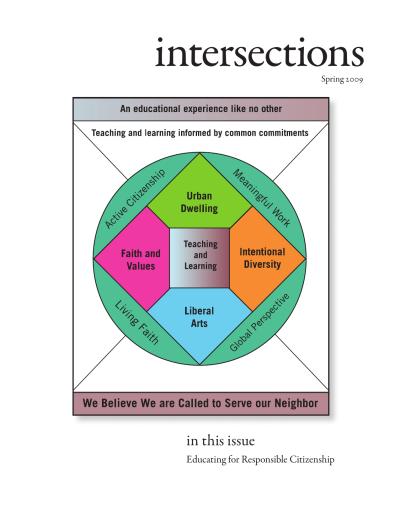 Editorial
From the Editor
Robert D. Haak
No. 29 · Spring 2009
Haak frames the issue’s essays around the question of Lutheran colleges and the role of citizen, noting H. Richard Niebuhr’s typology in Christ and Culture and Luther’s own complex understanding of Christian and state, and offers a fitting farewell to Arne Selbyg with Mike Blair’s tribute song “A Fine Norwegian.”
-
 Editorial
From the Publisher & Editor
Colleen Windham-Hughes, Lamont Anthony Wells
No. 63 · Spring 2026
6 min audio
Wells and Windham-Hughes frame vocation as “ground game” — the practical, public living-out of faith through civic engagement — and introduce the issue’s focus on how Lutheran higher education equips students to repair the world.
-
 Reflection
Reflecting on Belonging
Melissa Woeppel
No. 60 · Fall 2024
Woeppel, campus pastor at her own alma mater, wrestles with a Bethany student’s plea — “I want to feel like this is my home, like I belong” — and Mindy Makant’s reminder that we don’t choose the story of the past but do choose how we tell it forward, opening space for students from 35 faith traditions to find Lutheran institutions to be their home.
-
 Editorial
From the Editor
Robert D. Haak
No. 24 · Fall 2006
Haak introduces the issue’s essays by Stanley N. Olson, Kathryn L. Johnson, Gail Summer, Lake Lambert, and Steven C. Bahls; argues that on Lutheran campuses, professional programs in business, education, and nursing are not “second-class citizens” but integral to the institution’s vocation; cites Olson’s mantra (“Because of Christ, the world; because of the world, vocation; because of vocation, education”); and thanks Matt Marohl for assisting with the editing.
-
 Article
Private University, Public Witness: Life in the "None Zone"
Loren J. Anderson
No. 21 · Summer 2005
Drawing on sixteen years at Concordia College in Moorhead and twelve at Pacific Lutheran University, Anderson contrasts the Lutheran heartland with the Pacific Northwest’s “None Zone”—Patricia Killen and Mark Silk’s name for the country’s least churched region—and argues that a faithful Lutheran witness is possible in this changing context. He proposes five callings for the colleges—an academic program shaped by both educational philosophy and Lutheran theology, vibrant campus communities of faith and learning, inclusiveness and ecumenical outreach, global vision, and vocational exploration—and closes by sketching PLU’s shift toward “partnership” congregations and a new Center of Religion, Culture and Society in the Western United States.
-
 Article
Women Presidents in Higher Education: How They Experience Their Calling
Aimee Goldschmidt, Gary McLean, Katherine A. Tunheim
No. 42 · Fall 2015
Drawing on in-depth interviews with fifteen women college presidents and a transformative-learning-theory framework, Tunheim, McLean, and Goldschmidt trace a three-stage journey — identifying, interpreting, and pursuing the call — and ask what the language of vocation contributes to the preparation and mentoring of women leaders in higher education.
-
 Editorial
From the Publisher
Mark Wilhelm
No. 51 · Spring 2020
Wilhelm frames the issue by tracing how Lutheran educational ideals — once a primary source of contemporary higher education — were masked in the United States, and introduces a NECU initiative that uses the case of business ethics to explore Lutheran social teaching as an academic resource.