For the past few weeks I have been a theologian on the faculty of a Lutheran camp in the mountains of northern Washington. Holden Village is a mixture of religious retreat, think shop and wilderness playground. Sponsored by the youth departments of the three major American Lutheran churches [Now related to the ELCA—rdh], it is one of those crazy places with a style all its own.
I suppose I should recount what it is like to live, work, play, think and worship with Lutherans. Well, except that most of the people are blond, well tanned, have Scandinavian names, come from some place in Minnesota and graduated from places with names like St. Olaf, it is very much like being with fellow Christians. Again I become aware of how very much alike we are, how the same spectrum of ideas and possibilities cut across all denominations (or at least those that have some breadth of membership and some depth of tradition). There is the conservative wing, who have more in common with churchly American conservative attitudes in general than they differ among themselves on denominational particulars. There are the moderate church reformers who believe that we must do something with the system. There are the underground radicals who talk sympathetically with Black and New Left militants and boast their friendship with the secular city and Post-Christendom thinkers. There is much the same aversion to the institutional church as a self-perpetuating oligarchy sunk into ethnocentric introversion.
One difference is that these people are not as hung up on the scandal of the church because they do not dogmatize its indefectibility. The revelation of the fall of the church throws doubt on man, but not on God, as it tends to do among Catholics. For this reason Lutherans seem to spend more time talking Christ and faith, rather than church.
Another difference is that this community seems more catholic than most of the (Roman) Catholic communities I have experienced lately. It has more catholicity both in terms of Christianity and humanity (recognizing that Holden represents American Lutheranism at its creative best). There is a sense of the totality of the spiritual and the physical. Mountain climbing, prayer and heated discussion on all topics flow into each other in easy rhythm. No one is ashamed of their bodies, their minds or their faith. There is a range of human interest from science and the arts to the most abstruse philosophy and theology. It is the first religiously oriented community I have seen which has a full range of participation from the scientific community. The range of topics from botany, geology and conservation to urbanization and international revolution is sometimes overwhelming.
But finally there is a Catholicity of the Christian tradition as well; despite the supposed parochialism of American Lutheranism. My friends are heirs of a good theological tradition. We pray the three major monastic hours. I envy the Lutheran Eucharistic liturgy which transmits more harmoniously the Mass of the Western rite than the rootless monstrosity that inhabits many of our parishes. I envy the hymnal too which puts one immediately in the goodly fellowship of the saints from the Psalmists of the Old Testament to the ancient Latin poets, the medievals, Reformation hymnists, and the hymns that flow down through the nineteenth century by many church and national routes.
Perhaps this sounds too enthusiastic. Like all visitors, I can appreciate strengths, because I am not burdened with the weaknesses. Doubtless, this is why many Protestants sound so much more optimistic and enthusiastic about the “new things” in Catholicism than many Catholics.
There have been some poignant moments when the ghost of churches past raised their heads over the horizon. There was a teenage girl, raised a Lutheran, but attending a Catholic school. Torn between the two communities, she was subject to fits of depression. Several nights we sat up with her as she declared her fears of death, saw devils, and called for her rosary (shades of early Luther!). She told me that she could no longer be a Lutheran because she had discovered that the Lutheran church did not teach what Luther taught. I spent my time trying to get her to appreciate both Luther’s critique of Catholicism and the source of the failure of all the churches, Protestant and Catholic. I especially tried to dissuade her from making a sectarian decision: that is becoming a Roman Catholic at the expense of Lutheranism, instead of moving forward to genuine catholicity.
Then there was a boy who wanted to go to a non-denominational seminary, but feared that the parochialism of the Lutheran community would not accept his work there. His parents, former Roman Catholics, became Lutherans when they tired of being unable to receive communion because they were remarried. He was on his way to becoming a Christian without a church.
O yes, and then there is the sauna. Huddled together on shelves, we bake deliciously. In the heat, sweat pouring out like salvation by grace alone. Flesh against warm flesh, we knead each others backs and necks. Then with a shout we spring for the door, race to the stream and plunge into the icy glacier-fed falls. It’s the new sacrament! The new fellowship! The new theology! The marriage of heaven and hell! The mystical communion of opposites! God bless the pagan Finns!
-
 Editorial
From the Publisher
Mark Wilhelm
Wilhelm reports on the difficult financial season facing the ELCA churchwide organization — a ten-percent budget reduction announced in November and significant cuts to unrestricted grants for colleges and universities — while affirming that the ELCA’s commitment to the mission of its schools remains strong, including its commitment to engaging the “other,” the theme of this issue.
-
Editorial
From the Editor
Robert D. Haak
Haak frames the issue around the question of Lutheran college identity as formed in distinction from some “other,” introducing essays by Witherup on the Joint Declaration, Reuther on Holden Village, Afzaal on Christian-Muslim dialogue, Dovre on the history of Midwestern Lutheran colleges, Radecke on service-learning, and Ratke on Wilhelm Löhe — each making the claim that the “other” is an essential partner in conversation who helps us know who we are and shape who we will become.
-
Article
Bringing an Ecumenical Milestone Out of the Shadows
Ronald D. Witherup, S.S.
Witherup draws attention to the tenth anniversary of the Lutheran-Catholic “Joint Declaration on the Doctrine of Justification” signed on Reformation Day 1999, summarizes the document’s claim that justification is the work of the triune God received by grace alone through faith, surveys the remaining questions raised by Pope John Paul II and the 2006 endorsement by the World Methodist Conference, and proposes a pastoral strategy for bringing this ecumenical milestone out of the shadows in Catholic parishes.
-
Article
Between Suspicion and Trust
Ahmed Afzaal
Afzaal argues that scholars and educators have a unique vocation to shift Christian-Muslim relations from suspicion to trust, drawing on the 2007 Muslim open letter “A Common Word,” Robert Shedinger’s Was Jesus a Muslim?, and Muhammad Iqbal’s Reconstruction of Religious Thought in Islam to argue that Christianity and Islam converge in the insight that religion is a spiritual force for social justice and human liberation — an insight obscured by the modern Western discourse of sui generis religion.
-
Article
Lutheran Colleges: Past and Prologue
Paul J. Dovre
Dovre offers a reminiscence rather than a research paper, drawing on Aristotle’s ethos, logos, and pathos to trace fifty years of change at Midwestern Lutheran colleges through the key issues of survival, respectability, faithfulness, and relationship to the church — from the dependence of the 1950s through the independence of the late twentieth century to the partnership of the 2000s — and identifies key variables (the student marketplace, faculty formation, and the identity/diversity paradox) for shaping the identity and mission of Lutheran colleges into the future.
-
Article
SCAM-ing Service-Learning and Mission Trips: A Satirical Essay
Mark Wm. Radecke
Radecke couches his research on best/worst practices in service-learning and short-term mission trips in a fictional Screwtape-style correspondence between Horatio Gumnut, CEO of “Spiritual Consultants and Mercenaries, Incorporated” (SCAM, Inc.), and Dwayne Pipe, an untenured professor seeking to sabotage a colleague’s Nicaragua mission trip — cataloging through indirection the disorienting dilemmas, commodification of the poor, exhaustion of reflective practice, and false noblesse oblige that derail such ventures, while pointing toward the genuine philoxenia, accompaniment, and structural awareness that mark a transformative experience.
-
Article
Wilhelm Löhe and Higher Education
David Ratke
Ratke recovers the educational vision of Wilhelm Löhe (1808–1872), spiritual father of Wartburg College and Wartburg Seminary, drawing on Löhe’s “Aphorismen über Schule und Schulunterricht” and other writings to argue that education is about the formation of whole persons by whole teachers in whole institutions, that all education is religious and never neutral, and that education is for eternity as well as the present — a vision in which the values of Christianity sanctify the so-called worldly means of education.
-
 Reflection
A Community That Connects
Conrad Bergendoff
No. 5 · Summer 1998
Excerpts from Conrad Bergendoff’s 1990 address at the opening of Augustana’s new library, prepared by David Crowe and published here as a memorial after Bergendoff’s death in December 1997. Bergendoff—Augustana class of 1915, president 1936–1962—recounts eighty years of Augustana memories, insists that “size is pretty much within you, not outside of you,” traces the institution’s bonds to Uppsala from 1860 (and the 1910 visit of the Rector Magnificat), and celebrates Augustana’s graduates “in practically every part of the world” as evidence that a small school can have a universal output.
-
 Article
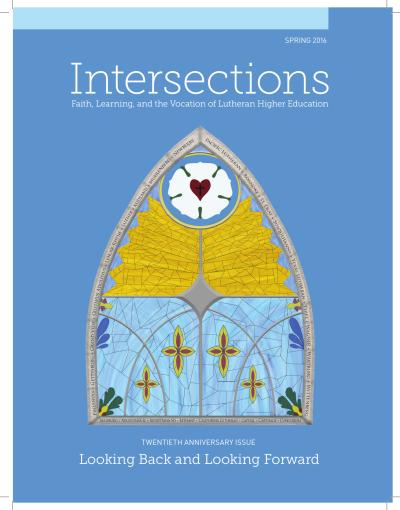
The Vocation of Intersections on its Twentieth Birthday
Jason A. Mahn, Robert D. Haak, Tom Christenson
No. 43 · Spring 2016
The three editors of Intersections — Bob Haak, Jason Mahn, and Tom Christenson (in spirit, following his death in 2013) — trace the twenty-year vocation of the journal itself: its 1996 birth at Capital University; its coming-of-age years of debate over institutional markers, two-kingdoms theology, and Lutheran identity; the ascendancy of “education for vocation” as the central marker of Lutheran higher education; and its ongoing identity in relation to a changing ELCA and to the broader cultural conversation about purpose, wholeness, and the vocation of higher education.
-
 Article
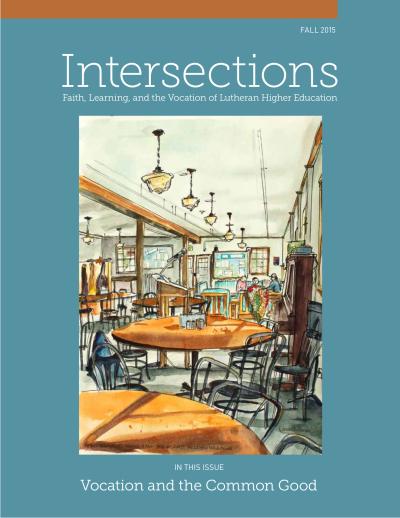
"Greed is an Unbelieving Scoundrel": The Common Good as Commitment to Social Justice
Samuel Torvend
No. 42 · Fall 2015
Torvend uses his Lutheran Heritage course at Pacific Lutheran University to ask what “the common good” might mean concretely — fresh air, clean water, food, shelter, healthcare — and traces the early Lutheran reform of literacy and social welfare to argue that the first gift of Lutheran education is the capacity to question the status quo and to push beyond charity into the pursuit of social justice.
-
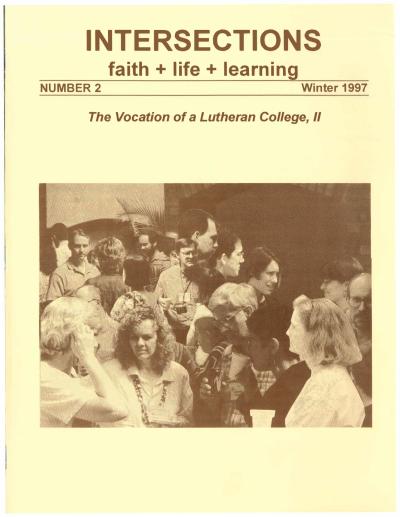 Article
Lutheran Tradition: Five Continuing Themes
Walter R. Bouman
No. 2 · Winter 1997
Bouman of Trinity Lutheran Seminary identifies five themes central to the Lutheran theological tradition (understood through Alasdair MacIntyre’s account of tradition as “an historically extended, socially embodied argument”): biblical (a non-oppressive authority for the Bible rooted in the gospel rather than in scholastic inerrancy, against the backdrop of Luther’s 1517 challenge to Tetzel and the post-Enlightenment marginalization of theology); catholic (continuity with the Book of Concord and the three ancient creeds, with Luther’s “Christology from below” recovering a Jewish rather than Hellenistic understanding of God, revived by Tillich, Pannenberg, Forde, and Jenson); evangelical (justification by faith as the answer to mortality’s radical question); sacramental (Word, Eucharist, and Baptism as Christ’s presence from the future of God’s consummated Reign); and world-affirming (creation as gift, vocation as God’s work in every calling, and stewardship of the ecological crisis).
-
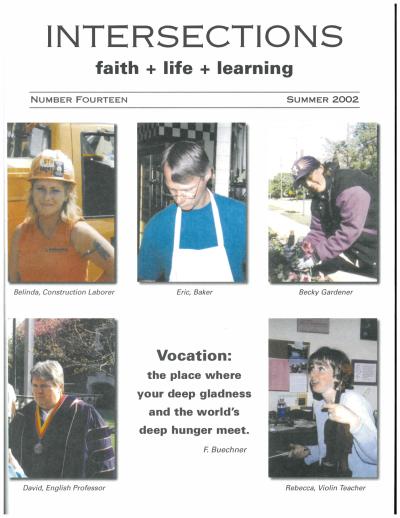 Book Review
Alister McGrath: Glimpsing the Divine: The Search for Meaning in the Universe
Don Braxton
No. 14 · Summer 2002
Braxton reviews Alister McGrath’s Glimpsing the Divine (Eerdmans, 2002), commending its twelve articulate, lavishly photographed meditations as a fine introduction to Western spirituality but criticizing its conservative neo-Barthian confessionalism, its Eurocentric treatment of non-Western traditions as “taillights” to Christianity’s “headlights,” its one-sided host-guest engagement with the natural sciences, and its metaphysical dualism. In a section added for ministerial readers, he contrasts McGrath’s self-contained confessionalism with H. Richard Niebuhr’s call to respond to all things as if to God’s actions upon us, and argues that in an era of rival fundamentalisms exclusivity must become a thing of the past.
-
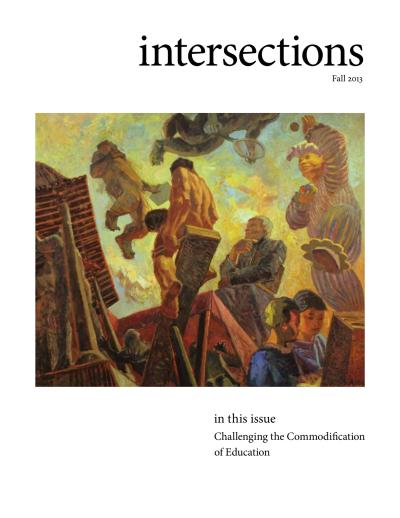 Article
Welfare of the City and Why Lutherans Care about Education
L. DeAne Lagerquist
No. 38 · Fall 2013
Lagerquist takes readers on a historical tour from sixteenth-century Saxony through the founding decades of Lutheran higher education in the United States to the present day, recovering Luther’s “gift economy” alongside Lewis Hyde and Oswald Bayer as a counter to the market logic that increasingly governs American higher education. She offers four propositions on vocation and commodification and proposes that Lutheran institutional vocation is to accept and pass along the gifts that come to our schools for the well-being of students, neighbors, and the world.