This issue includes papers presented at the Vocation of the Lutheran College conference held last year at Luther College in Decorah, IA. The theme of that conference was “Educating for Responsible Citizenship.” The papers in this issue clearly reflect that theme.
What is the relationship of Lutheran colleges and universities to the role of citizen? In some educational settings, educating for citizenship is the center of the declared mission. Other schools may have a more ambivalent attitude toward this role. The nature of the relationship between the church and the state (and the Christian and society) has been answered in differing ways throughout history. In some times, Christians have felt that their faith demanded that they retreat from society—either to isolation or to form an ideal society of their own. At other times, Christians have not only been involved in the social order, but have sought to define and control it. H. Richard Niebuhr’s classic Christ and Culture (New York: Harper Row, 1956) outlines some of the options.
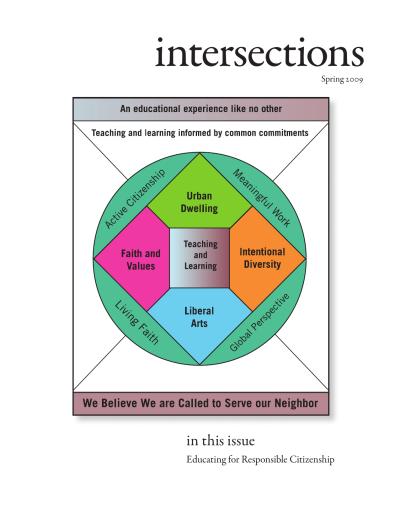
Luther (and Lutherans) had a complex understanding of the role of Christian as citizen of the state. The complex understanding of this relationship is illustrated in the diagram found on the cover (and more completely reproduced on p. 10). Paul Pribbenow, president of Augsburg College, presents the complexities (and the clear vision) of Augsburg’s relationship with their communities as a Lutheran college in an urban setting. “We believe… we are called… to serve our neighbor.” Each word and phrase powerful when taken seriously.
Jose Marichal brings into question the very concept of “community” in the twenty-first century. He asks the question (and poses some answers) to the idea that the very idea of community has changed in non-trivial ways with the existence of the web. What does it mean to be a “citizen” of a virtual community? Is there a context from which we as educators at Lutheran colleges and universities should be approaching the response to this question?
Wanda Deifelt returns to the teachings of Luther and the confessions for another way to offer a critique of the understandings of citizenship current in our culture. Citizenship is tied up with notions of the role of the individual and rights and responsibilities. Is there a distinctive “Lutheran” way of approaching these issues?
The Vocational of the Lutheran College conference marked the last “official” duty of Arne Selbyg who approaches the question of citizenship from an experiential and personal point of view. He observes how the concepts and practices of being a “citizen” vary from culture to culture and time to time. Norwegian Lutherans might have a different understanding of citizenship than Lutherans born and raised in America. As a lover of jazz, he offers a metaphor for social interactions in America that he feels is better than the traditional “melting pot.”
In a fitting farewell to the long-time organizer and visionary for the Vocation of the Lutheran College conference, Arne was ‘sung out’ of office by Mike Blair, chaplain at Luther College.
A Fine Norwegian—also known as “The Arne Selbyg Blues”
When Arne was young, he was such a prodigy,
He excelled in confirmation and sociology.
They said, “Faith and learning is just the thing for you.”
Arne replied, “This vocation is most certainly true!”Chorus:
You’re such a fine Norwegian-(echo) a fine Norwegian.
Oh, your gifts are legion-(echo) gifts are legion.
We’re here to express our appreciation.
For all you’ve done for Lutheran higher education—
such a fine Norwegian!A servant and leader, gifted with good cheer;
In life’s next chapter Arne has nothing to fear—
Except the pension reports that can make you less serene,
When you read the bottom line and wonder,
“What does this mean?“Chorus:
Whether coming or going, Arne’s always hip;
He travels with a case of dual citizenship.
The pathway of a scholar can lead from place to place;
Lutherans find their way by paradox and grace.Chorus:
—By Mike Blair
Vocation of a Lutheran College, 8/2/2008
On that note we will end. With thanks for all the participants at the conference… and especially to Arne Selbyg, who led us at the conference, and many others before—who has served us all in the colleges and universities with his wisdom and guidance for many years as Director of Colleges and Universities for the ELCA—and from whom I learned much when he was Dean of the Faculty at Augustana College in Rock Island.
This year’s Vocation of a Lutheran College conference will be held July 30th—August 1st at Augsburg College in Minneapolis, MN. The theme is “A Calling to Embrace Hope: Lutheran Higher Education in an Age of Anxiety.” The presentations of this conference will be printed in a future issue of Intersections.
-
 Editorial
From the Publisher
Mark Wilhelm
Wilhelm introduces essays from the 2008 Vocation of a Lutheran College Conference held at Luther College under the theme “Educating for Responsible Citizenship,” previewing contributions from Paul Pribbenow on dual citizenship at Augsburg, Wanda Deifelt on Luther College’s engagement with civic vocation, Jose Marichal on the promise and peril of digital citizenship, and Arne Selbyg on his three experiences of being educated for citizenship.
-
Article
Dual Citizenship: Reflections on Educating Citizens at Augsburg College
Paul C. Pribbenow
Pribbenow argues that the vocation of Augsburg College is to educate “dual citizens”—those able to live within the messiness of common work rather than resolve every tension once and for all. Drawing on John Courtney Murray on democracy as “the intersection of conspiracies,” Bill Moyers, Jean Bethke Elshtain, Stephen Carter, and the Augsburg vision statement “We believe we are called to serve our neighbor,” he names four common commitments and five principles of civic education that ground Augsburg’s incarnational mission in its city neighborhood.
-
Article
Students in the Cloud: Creating Digital Citizens
Jose Marichal
Marichal weighs the utopian and dystopian views of the “networked information economy,” drawing on Yochai Benkler, Manuel Castells, Henry Jenkins, Cass Sunstein, Robert Putnam, Nicholas Carr, and Andrew Keen to chart the promise and peril of life “in the cloud,” and proposes Aristotle’s intellectual virtue of phronesis—developed through Hubert Dreyfus’s five stages of skill acquisition—as the goal of digital citizenship for college faculty and their students.
-
Article
From Alien to Citizen
Arne Selbyg
Selbyg reflects on three experiences of being educated for citizenship—growing up in Norway under the legacy of Lutheran pastors and public school teachers who resisted the Nazi occupation, arriving in America as a resident alien, and becoming a naturalized American citizen—and proposes the jazz ensemble as a better metaphor for American society than the melting pot, one in which different citizens learn skills, study other instruments, and dialog with one another in service to the common music.
-
Article
Seeking the Common Good: Lutheran Contributions to Global Citizenship
Wanda Deifelt
Deifelt draws on Luther’s account of neighborly love in “The Freedom of a Christian” and on his Two Kingdoms theology to argue that a Lutheran ethics of care fosters a sense of responsibility, accountability, and compassion that broadens citizenship beyond rights and virtues. Engaging William Galston’s typology of civic virtues, Sylvia Walby on women’s citizenship, Serene Jones on communitarianism, and Manuel Castells on globalization, she proposes that Lutheran theology equips the church to educate for transformative participation in world affairs.
-
 Book Review
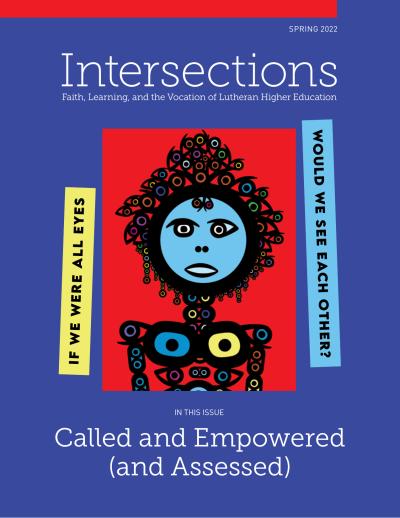
Assessing the Value of Liberal Arts: A Review of The Evidence Liberal Arts Needs, by Richard A. Detweiler
Robert D. Haak
No. 55 · Spring 2022
Haak reviews Richard A. Detweiler’s The Evidence Liberal Arts Needs, in which the former president of the Great Lakes Colleges Association analyzes 240 college mission statements and interviews more than 1,000 graduates to argue that liberal arts educational experiences have a measurable impact on adult lives of consequence, inquiry, and accomplishment — and invites NECU institutions into a further conversation about how Detweiler’s methodology applies to Lutheran higher education.
-
 Article
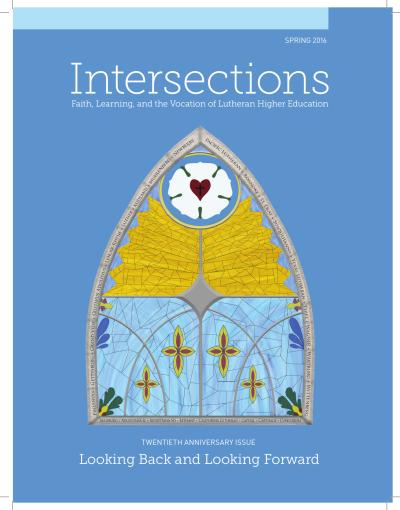
The Vocation of Intersections on its Twentieth Birthday
Jason A. Mahn, Robert D. Haak, Tom Christenson
No. 43 · Spring 2016
The three editors of Intersections — Bob Haak, Jason Mahn, and Tom Christenson (in spirit, following his death in 2013) — trace the twenty-year vocation of the journal itself: its 1996 birth at Capital University; its coming-of-age years of debate over institutional markers, two-kingdoms theology, and Lutheran identity; the ascendancy of “education for vocation” as the central marker of Lutheran higher education; and its ongoing identity in relation to a changing ELCA and to the broader cultural conversation about purpose, wholeness, and the vocation of higher education.
-
 Editorial
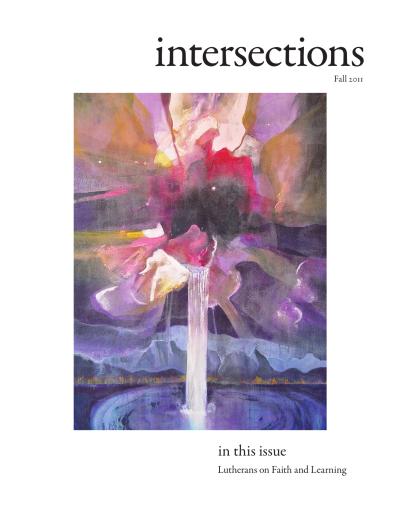
From the Outgoing and Incoming Editors
Jason A. Mahn, Robert D. Haak
No. 34 · Fall 2011
Outgoing editor Robert D. Haak reflects on a six-year run inheriting Intersections from founder Tom Christenson, the “powerful voices” that have driven the conversation (Dovre, Jodock, Christenson, Simmons, Morgan, Olsen, Wilhelm) and the newer ones now entering (Mahn, Bussie); incoming editor Jason A. Mahn, picked up from the airport in Bob’s pickup truck five years ago, names central issues that “Lutherans on Faith and Learning” engages and previews essays by Dovre, Jodock, McDonald, Hill, Turnbull, and Jodock again.
-
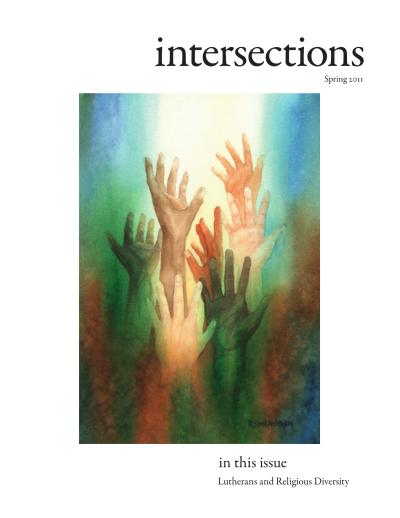 Editorial
From the Editor
Robert D. Haak
No. 33 · Spring 2011
Haak frames the issue by asking how Lutheran colleges and universities understand the changing landscape of religious identification on their campuses, and argues that Lutheran theological commitments — including the work of the Spirit and the Incarnation — call institutions to create places where the voice of “the other” is heard and valued.
-
 Article
Called to Serve
Robert D. Haak
No. 31 · Winter 2010
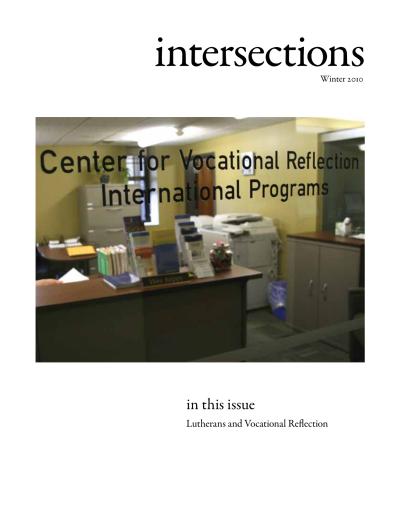
Haak describes Augustana’s Center for Vocational Reflection (CVR) and its threefold framework of skills/gifts/talents, passions/values, and needs of the community. He surveys the CVR’s Working with Faith group, seminary visits, spiritual companioning, Servant Leader Internships, international travel reflection, and the major Senior Inquiry curriculum revision—then reports the lessons learned at Augustana: that multiple exposures matter more than any single program, that the language of vocation works even for non-religious students, that student-initiated ideas (like Erin Blecha’s Athletes Giving Back) often succeed most, and that the CVR will soon merge into a new Community Engagement Center.
-
 Editorial
From the Editor
Robert D. Haak
No. 30 · Fall 2009
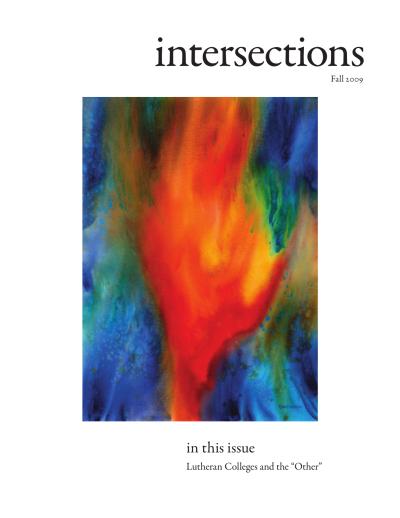
Haak frames the issue around the question of Lutheran college identity as formed in distinction from some “other,” introducing essays by Witherup on the Joint Declaration, Reuther on Holden Village, Afzaal on Christian-Muslim dialogue, Dovre on the history of Midwestern Lutheran colleges, Radecke on service-learning, and Ratke on Wilhelm Löhe — each making the claim that the “other” is an essential partner in conversation who helps us know who we are and shape who we will become.
-
 Article
Hope in the Face of Ecological Decline
Jason Peters
No. 32 · Spring 2010
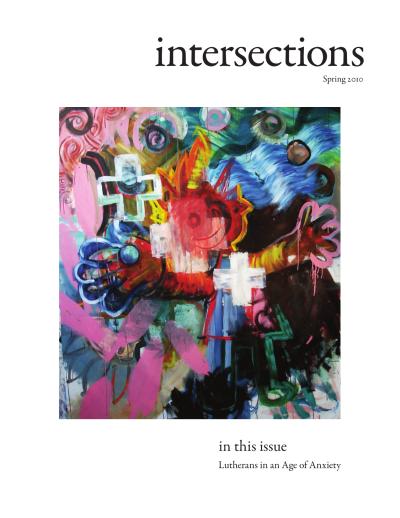
Peters reads our ecological crisis—a campus “Birth Control Tree,” feminized fish, population, climate, water, and soil—through Alexander Pope, William Blake, Søren Kierkegaard, and C. S. Lewis’s The Abolition of Man, and argues that the modern project of mastering nature has made despair (the unconscious form Kierkegaard named) our condition. He calls for three reorientations: practical (assigning value to domestic arts and place over disciplinary specialization), philosophical (dismantling the Baconian/Machiavellian/Cartesian project of control), and theological (recovering the Church’s rejection of Gnosticism so that grace comes to us by means of nature, not in contempt of it).
-
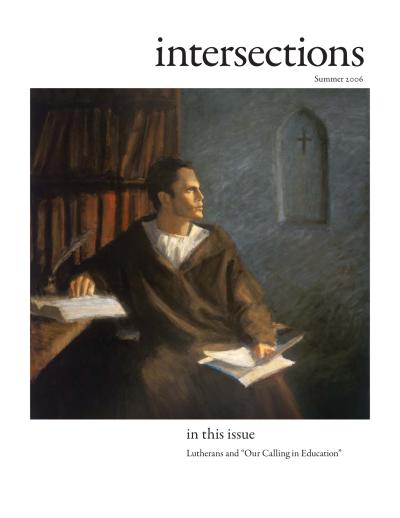 Editorial
From the Editor
Robert D. Haak
No. 23 · Summer 2006
Haak previews the issue’s four essays by Marcia Bunge, Paul Dovre, Samuel Torvend, and Cheryl Budlong — each engaging the ELCA Task Force on Education’s study document and first draft of the social statement on Lutheran education — and invites readers to bring their distinctive voices as professional educators at Lutheran institutions into the conversation before the October 15 deadline. He also invites submissions to Intersections and directs readers to LauraOMelia@augustana.edu to be added to the direct mailing list.
-
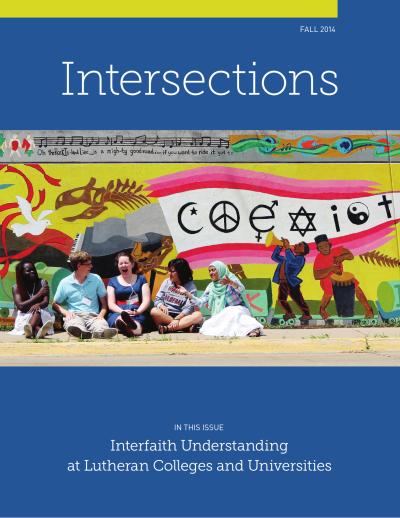 Editorial
From the Publisher
Mark Wilhelm
No. 40 · Fall 2014
Wilhelm draws a parallel between the rediscovery of vocation and the rediscovery of interfaith understanding in Lutheran higher education, arguing that previously under-emphasized aspects of the Lutheran tradition point us to interfaith work and that an authentic Lutheran college or university will make interfaith understanding a feature of its mission.
-
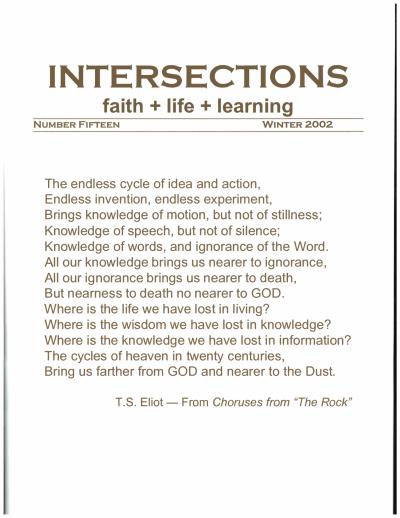 Article
The Marks of an ELCA College: One Bishop's Reflections
Stanley Olson
No. 15 · Winter 2002
Olson, speaking as a bishop and “Harness Boy” whose job is to keep the church’s connections working, replaces his original four-noun outline (fealty, ingenuity, insouciance, focus) with eight marks the ELCA should be able to observe in its colleges: intentional Lutheran identity, significant Lutheran presence, Christian faith at every table, freedom of inquiry, coaching toward vocation, gravity and grace, nurtured community, and excellence by its own standards. Drawing on his survey of all twenty-eight ELCA college mission statements (two tables) and on Darrell Jodock and Mark Edwards, he argues that the Lutheran connection must be made explicit in mission, marketing, and faculty searches, and closes with six reciprocal expectations the colleges should hold of the ELCA—commissioner, mature parent, supporter of adventurous teenagers, advocate, steward of graduates, and a church faithful to its own Lutheran mission.
-
 Response
Response to Robert Benne
Baird Tipson
No. 17 · Summer 2003
Tipson responds to Robert Benne’s comments in the previous issue about his review essay of The Future of Religious Colleges, affirming their fundamental agreement that the Enlightenment epistemology dominant in higher education poses the most serious threat to the vitality of Lutheran colleges. Using the example of lecturing on early Mormon history and the Book of Mormon, he concedes that the methodological “solvent” of Enlightenment historiography acts on Christian as well as Mormon faith claims, and concludes that while H. Richard Niebuhr’s “inner” and “outer” history and Walter Brueggemann’s approach in The Theology of the Old Testament are comforting to believers, they do not offer an epistemology that can stand alongside the Enlightenment model in evaluating truth claims in the academy.
-
 Reflection
Ecotones of Faith
Tracy Paschke-Johannes
No. 61 · Spring 2025
7 min audio
Paschke-Johannes draws on the ecological metaphor of the ecotone — the life-teeming transitional space between two ecosystems — to claim that we are not called to minister in the world of the past or one fifty years hence, but to nurture the kairos moments God is creating in the freshwater-to-saltwater present.