This question warrants a long list, but one thing belongs at the top: cultivating trustworthy communities. This is a patient and delicate process but the good news is, these communities can form anywhere—in a classroom, in a campus ministry, in a congregation, in a home, on a neighborhood block…. Anywhere there are people, there are opportunities for relationship. Wherever there is relationship, there is opportunity to cultivate trustworthy community. In turn, these trustworthy communities, made up of trustworthy relationships, equip us with the collective wisdom, care, and accountability needed to be the kind of people the world needs.
Trustworthy communities have always been needed, but perhaps part of the reason we are where we are is because too often our society has NOT invested in cultivating trustworthy communities. Instead choosing practices of exploitation and violence, eroding trust and convincing us that those around us are more likely a threat than a neighbor.
When I see many challenges around us, I fear that the world is ending. Maybe it is. Maybe (probably) parts of it should. This is scary and when we are scared it is easy to turn inward, to scapegoat our fears onto “others.” Ethical leadership when the world is changing—and perhaps ending—means resisting that impulse and instead doubling down on setting more tables, doing the slow relationship work, being bold and humble as we engage with people around us.
We need to be the kind of people and create the kinds of communities the world needs when it’s ending.
As a former youth ministry director, camp counselor and convener of congregations through my work at Augsburg with the Riverside Innovation Hub—my instinct as a leader has been to carry the bulk of the responsibility to build this kind of community and then invite others into it. But this is a lopsided approach.
Cultivating trustworthy community is a group effort. Leaders may take initiative, but the work isn’t to build for, but to set a table where something new can be nurtured—more accurately, to co-create trustworthy community.
My thinking about this has been particularly shaped through a recent book project I led. Hungry for Hope, Letters to the Church from Young Adults, released this summer, is the culmination of three years of stewarding a writing community of twenty-five people. Many of them are young adults who brought to the table their hopes, heartaches and imaginations of another way possible for the church and the world.
The process of co-creating this book mirrors the final product, which is an invitation to sit at the table together and wrestle with the questions of our time, ones that really matter to young adults (and folks of all ages!) Rev. Lamont Wells concluding remarks at this summer’s gathering landed home for me when he quoted Sharon Daloz Parks. Ethical leadership is “not about having the right answers, but about cultivating the courage to hold questions that matter and walk with others through them.” These are the first faithful steps towards co-creating trustworthy communities. These are the kinds of communities that not only are needed when worlds are ending, but are needed to seed what new worlds may begin to emerge.
For more information about the book, Hungry for Hope: Letters to the Church from Young Adults, visit the book’s website at www.hungryforhopebook.com.
-
 Editorial
From the Publisher
Lamont Anthony Wells
5 min audio
Wells frames the issue as a record of the 2025 VLHE Conference at Augsburg under the theme “Ethical Leadership in a Changing World,” arguing that vocation is never solitary but a collective, public witness of ethical formation, theology and care, flourishing and belonging, and leadership rooted in God’s grace.
-
Editorial
From the Editor
Colleen Windham-Hughes
5 min audio
Windham-Hughes plays on the shared Latin root of “education” and “seduction” (ducere, to lead) to warn against the No-saying seductions of giving up or condemnation, and to call educators to the riskier Yes of showing up to build third-space communities of truth-telling and hope.
-
Article
Wake Up Running! A Call to Ethical Leaders in Quest of Democratic Space
Walter Earl Fluker
44 min audio
Abridged from his VLHE keynote, Fluker draws on Habakkuk and Octavia Butler’s Parable of the Sower to call a new generation of ethical leaders to “wake up running” toward democratic futures, packing their runaway bags with love-filled-justice, grace-filled-empathy, and hope-filled-resiliency for the soul-filled work the moment requires.
-
Article
Building a Third Space in the Age of AI: A Conversation with Dr. Walter Earl Fluker
Elizabeth Kubek
11 min audio
Prompted by AI chatbots being marketed to students as a safer alternative to messy human relationships, Kubek interviews Fluker on how Howard Thurman’s vision of common consciousness, somaesthetics, and nature-rooted learning offers educators a “third space” alternative to AI’s hall of mirrors.
-
Article
Ethical Leadership: Rooted, Open, Generative, and Mindful
John Arthur Nunes
25 min audio
As he prepares to teach an Ethical Leadership First Year Seminar at California Lutheran, Nunes organizes his pedagogy around three mutually-reinforcing “turns” — inward, outward, and intellectual — grounded in Luther’s mandatum dei and larvae dei, Bonhoeffer’s estates, and Howard Thurman’s call to hear “the sound of the genuine” in oneself.
-
Article
Ethical Leadership for a Changing World: A Shared Calling from Cradle to Career
Cory Newman, Janelle Rozek Hooper
5 min audio
Hooper and Newman recount how an ELCA Barna survey on early childhood education sparked the realization at VLHE 2025 that ELCA colleges and the 1,200 Lutheran schools and early learning centers share identical challenges — and an untapped potential to form ethical leaders across the full educational continuum from cradle to career.
-
Article
What is Required of You?: Higher Education Leadership in a Moral Key
Paul C. Pribbenow
15 min audio
Drawing on Micah 6:8 and Stephen Carter’s “etiquette of democracy,” Pribbenow describes the three things Augsburg requires of every incoming student — show up, pay attention, and do the work — as a democratic social ethic that prepares students for engaged citizenship in a fractured public life.
-
Article
Fostering Moral Imagination and Inclusivity: The Role of Ethical Leadership in ELCA Colleges and Universities Amid Societal Challenges
Lamont Anthony Wells
12 min audio
Wells argues that “moral imagination” — the capacity to envision ethical alternatives, empathize across difference, and respond creatively to injustice — is the heart of ethical leadership in NECU institutions, and that anchoring leadership in this principle positions Lutheran higher education to cultivate socially responsible citizens.
-
Reflection
VLHE—Wednesday Morning Sacred Pause
Ann Rosendale
8 min audio
Rosendale draws on Esther 4:14 and the Lutheran practice of holding death and resurrection together — with “and” as the hardest word — to argue that the calling of Lutheran higher education for “just such a time as this” requires us to remember and name out loud that ours are places where God is at work.
-
 Article
Luther, the Catechisms, and Intellectual Disability
Courtney Wilder
No. 47 · Spring 2018
Wilder confronts Luther’s deeply troubling response to a child with disabilities at Dessau, then mines his Small and Large Catechisms for a Lutheran theology of inclusion — reading the Third Article of the Creed, the petitions of the Lord’s Prayer, and the sacrament of baptism as resources that affirm the full humanity of people with intellectual disabilities as faithful children of God.
-
 Editorial
From the Publisher
Arne Selbyg
No. 23 · Summer 2006
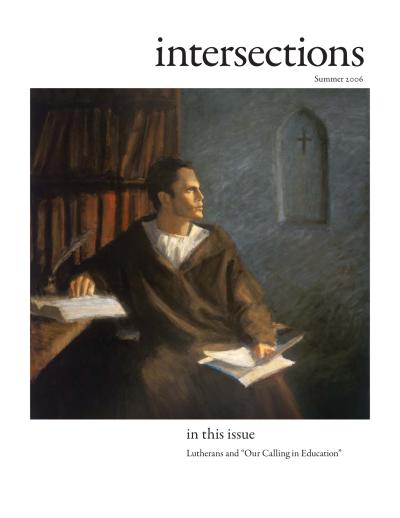
Selbyg features articles based on presentations at the 2005 Vocation of a Lutheran College conference focused on the upcoming ELCA Social Statement on Education, and urges members of the ELCA higher-education community to download the first draft (“Our Calling in Education”) from the ELCA website and submit feedback to the Task Force on Education before the October 15 deadline. He worries that the sexuality social statement on a 2009 timeline will draw more attention than the education statement, but reminds readers that, for Martin Luther and for those who work in Lutheran higher education, education is as important as sex.
-
 Article
Doing the Work One’s Soul Must Have
Beverly Wallace, Yolanda M. Norton
No. 56 · Fall 2022
Norton and Wallace describe the Womanist Experiential Learning Initiative — including the Beyoncé Mass, study-abroad partnerships in Portugal, Brazil, and Ghana, and the Black Girl Magic Academy for teenage girls — as a way of centering Black women’s voices in theological education and doing, as Katie Geneva Cannon put it, “the work…that one’s soul must have.”
-
 Article
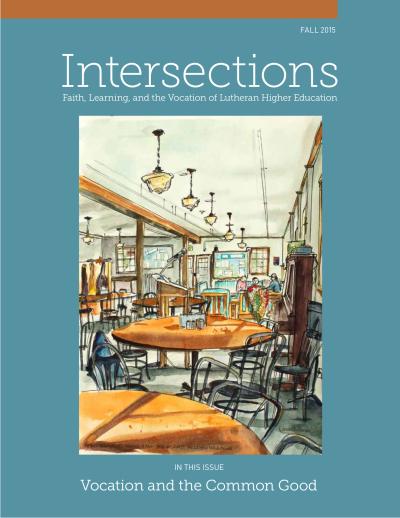
Women Presidents in Higher Education: How They Experience Their Calling
Aimee Goldschmidt, Gary McLean, Katherine A. Tunheim
No. 42 · Fall 2015
Drawing on in-depth interviews with fifteen women college presidents and a transformative-learning-theory framework, Tunheim, McLean, and Goldschmidt trace a three-stage journey — identifying, interpreting, and pursuing the call — and ask what the language of vocation contributes to the preparation and mentoring of women leaders in higher education.
-
 Article
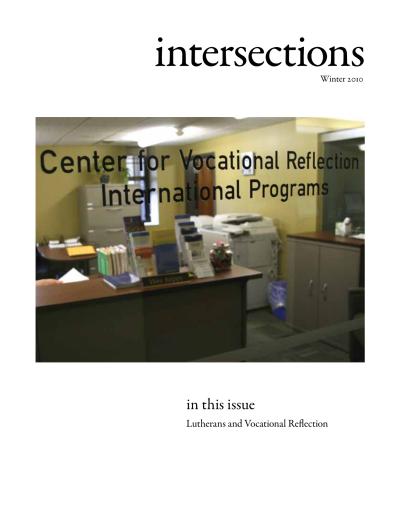
Called to Serve
Robert D. Haak
No. 31 · Winter 2010
Haak describes Augustana’s Center for Vocational Reflection (CVR) and its threefold framework of skills/gifts/talents, passions/values, and needs of the community. He surveys the CVR’s Working with Faith group, seminary visits, spiritual companioning, Servant Leader Internships, international travel reflection, and the major Senior Inquiry curriculum revision—then reports the lessons learned at Augustana: that multiple exposures matter more than any single program, that the language of vocation works even for non-religious students, that student-initiated ideas (like Erin Blecha’s Athletes Giving Back) often succeed most, and that the CVR will soon merge into a new Community Engagement Center.
-
Reflection
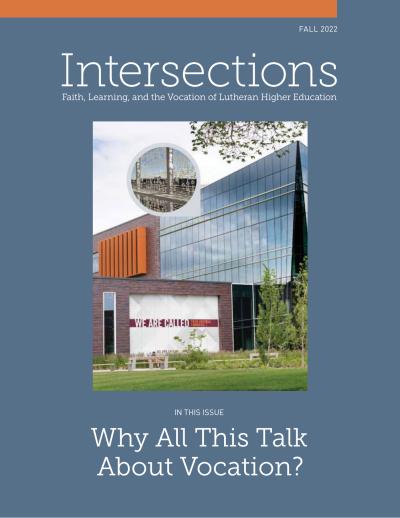
Why All This Talk About Vocation?
Madyson Ray
No. 56 · Fall 2022
Ray, a junior at Midland University and the only student attendee at the 2022 conference, reflects on four workshops — on teaching womanist thought, on supporting student-athletes, on resistance to the word “vocation,” and on vocational reflection — and brings home concrete ideas including a women’s-history scavenger hunt and semester-long vocational reflections.