Poetry: Rituals for an Uninvented Religion / On the Recently Discovered Mass Grave of Mice
Intersections No. 6 · Winter 1999
Rituals for an Uninvented Religion
I.
In June, when the earth is properly soft, it is customary
to unearth the dead and extract their lead fillings
These you melt down into a cup,
and when you drink the sacrificial wine,
you inherit their strange sense of humor.II.
Flowers are inappropriate to send to a dying man,
for, as we know, no one willingly courts death.
Instead, send him a mask carved with the face of evil man
already dead. His twin in hell will grow jealous
and order him to Heaven.III.
In August, you must eat two fish of exactly the same type
and weight, especially those which are bottom feeders.
In this way you learn humility. One fish is for the man
you are now, and the other is for the man you hoped you’d be.IV.
It is always inappropriate to carry coins in a sock
No one knows why. It just is.V.
When making a grave marker, you must mold it from wax
and stick a wick in the top. If you journey to the grave yard
at night and find a flame, you must make an offering
of reading material, for the literacy of the dead.VI.
If a child is born on leap day, he must be renamed
every four years, because technically he did not exist
for the previous three. Life is hard for the leap day child.VII.
On the day of judgment, no carnivals are allowed.
All animals must be freed to find their own heaven,
and leaders of all nations must provide alternative forms
of entertainment, preferably outdoors.
On the Recently Discovered Mass Grave of Mice
While tending their flocks, shepherds in New Zealand uncovered the skeletal remains of 300,000 mice.
Explanations live and die that way.
The nameless little ones decide
to die in places so rock-strewn
and desolate, you’d bet is was sheer boredom
that did it. They gather together
among clover and good grass for flocks
until one common denominator is found:
a million million bones,
each light as a child’s first questionOnce, the world answered our prayers
We had a name for shepherds
and the like who saved us, who
stumbled upon our souls’ last trace
and witnessed the dance that brought us
together, all fur and mammal heart,
our minds heavy with the unexplainable drive
toward the loneliest places.But like it or not, we are all part
of that good flock, mouse or lamb.
Our graveyard rush is so common
that to ask why mice die together,
according to their own time,
is a question as plain as your name in stone,
as whole towns of name and stone.
-
 Editorial
From the Publisher
Arne Selbyg
Selbyg reports on the work of the Division of Higher Education and Schools to focus what makes Lutheran colleges and universities distinctive, recaps the 1998 Vocation of a Lutheran College conference at Wittenberg, previews the 1999 Susquehanna conference on “Identity and Fragmentation: Can the Lutheran Center hold?” (inspired by Yeats’s vision of the Second Coming), commends Ernest Simmons’s Lutheran Higher Education: An Introduction for Faculty (Augsburg Fortress, 1998), and announces a new NEH/NSF-style initiative called “The Lutheran Academy of Scholars in Higher Education.”
-
Editorial
From the Editor
Tom Christenson
Christenson explains that three of the five papers from the 1998 Wittenberg Vocation of a Lutheran College conference appear here (with Robert Scholz and Cheryl Ney to follow in the next issue), passes on Andy Sheppard’s “Books for Belarus” appeal from Southwestern College, and reflects on Douglas John Hall’s The End of Christendom and the Future of Christianity—its claim that disengagement from cultural dominance is the prerequisite for faithful re-engagement, and its retrieval of Christ’s metaphors of “a little salt, a little yeast, a little light” as a possible session topic for a future VLC Conference.
-
Article
Learning and Teaching as an Exercise in Christian Freedom
Tom Christenson
Christenson, the 1998 Wittenberg keynote, argues that what makes our institutions Lutheran is not the percentage of Lutherans served or employed, ethnic celebration, or self-conscious difference, but a theologically informed vision of the educational task framed by the linked ideas of gift, freedom, and vocation. Drawing on Joe Sittler, Wendell Berry, David Orr, Harold Kushner, John Updike, Frederick Buechner, and Luther’s On the Freedom of a Christian, he reframes the liberal arts as four “liberating arts”—critical/deconstructive, embodying/connecting, melioristic/creative, and arts of enablement and change—and closes with his mother’s “end-of-the-month soup” as an image of vocation in a particular place.
-
Response
Of Imaginary Cows and a White Toy Sheep: The Freedom of a Christian College
Ryan La Hurd
La Hurd, president of Lenoir-Rhyne and a former Thiel English professor and Augsburg academic dean, responds to Christenson by insisting (with Robert Kegan’s story of Tommy’s imaginary cattle farm) that a college is composed of people but is not itself a person, and so cannot share in Luther’s freedom of the Christian. Drawing on Benedict Anderson’s Imagined Communities, Lewis Hyde’s The Gift, George Marsden, Mark Schwehn, Jacques Barzun, and the Pew Higher Education Roundtable, he distinguishes the “imagined college” (the gift-economy realm of teaching and the alma mater) from the “real college” (the commodity-economy realm of fund-raising, deferred maintenance, and federal aid reconciliation that does not have such freedom)—and ends with Pablo Neruda’s “Childhood and Poetry” and the marvelous white toy sheep offered through a hole in a fence.
-
Response
Finding the Words: The Trouble of Being California Lutheran University
Pamela M. Jolicouer
Jolicoeur, provost and vice president for academic affairs at California Lutheran, recounts the marketing problem of a university whose middle name is Lutheran in a Southern California religious landscape where the operative modifier is “Christian” (Pepperdine, Azusa Pacific) and tests Christenson’s three themes against her own “alumni magazine test”—the Jesuit standard set by Santa Clara. She concludes that freedom, gift, and vocation, though not uniquely Lutheran, are the words she can actually use: with prospective faculty, with the constituent church bodies who pressed for “Christian” in the new CLU mission statement (compromise: “rooted in the Lutheran tradition of Christian faith…”), and with the “C student” alumna headed for a Ph.D. in psychology whose consciousness of her own gifts had evaporated.
-
Reflection
Otherwise
David Wee
Wee’s September 3, 1997 St. Olaf Opening Convocation address takes its title from Jane Kenyon’s “Otherwise” and asks why we gather: to celebrate the gifts of life, place, companionship, and the work we love, and to become “otherwise”—wise about the others in our midst. He honors his own St. Olaf teachers (Ditmanson, Shaw, Stiehlow, Jordahl, Paulson, Meyer, Hove, Clausen, Larson, Jorstad) and the gruff Latvian stamp scholar Gus Eglas and Sherlock Holmes expert Randy Cox, draws Huck Finn’s “All right, then, I’ll go to hell” and Flannery O’Connor’s grandmother into a single argument, and closes on Tim Lull’s expectation that a Lutheran college campus should display contentment, courage, and cheerfulness as a family member faces day-six post-bone-marrow-transplant—“the first day of the rest of your life.”
-
 Poem
Poem
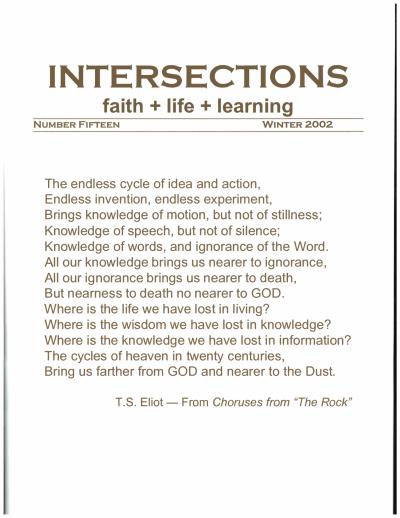
Drunks in a Midnight Choir
Kevin Griffith
No. 15 · Winter 2002
A pantoum-like Christmas-season poem in which red-robed choristers, flasks clinking and hands trembling, mangle the words of carols beneath “the midnight sky, your endless dark coat,” trusting that “it’s the season to forgive what’s vile” and that even wise men praise the humble and make glad.
-
Poem
The Etiology of Eschatology
Kevin Griffith
No. 15 · Winter 2002
A wry meditation on end-times and beginnings in which the last trumpet is only a prelude to the longest dawn, newly handmade animals grow fat waiting for caretakers to name them, dark-robed cryptologists fret over the end of everything, and once everyone has solved the great conundrum the big man simply hits rewind.
-
 Poem
Poem
Things That Renew Hope
Sig Royspern
No. 8 · Winter 2000
Inspired by Andrew Greeley’s Religion as Poetry, which defines religion as hope-renewing experiences and the stories, symbols, rituals, and images that preserve them, Rauspern offers a list-poem of small renewals of hope: lovers kissing in the street, the first snowfall of each year, compost and spring sprouts and Jewish humor, kids’ summer mischief, a mother nursing her baby on the bus, small jazz ensembles, two old men reconciling without remembering why, an unscheduled gift, the blues, a child taking him by the hand, and a gray-haired man who threw his cellular phone in the river.
-
 Article
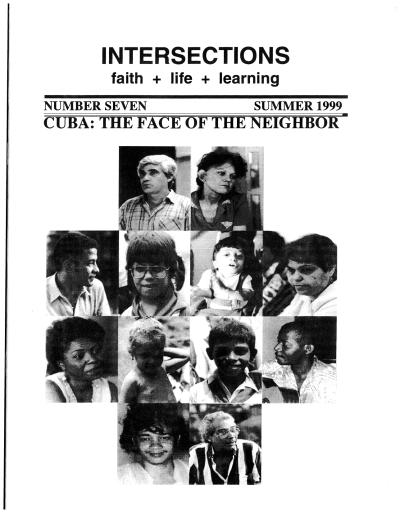
How Can We Keep From Singing?
Robert Scholz
No. 7 · Summer 1999
Scholz, professor of music at St. Olaf, responds to Tom Christenson’s “Freedom of a Christian” by walking through his own Nunc dimittis for the St. Olaf Christmas Festival, an Elderhostel choir of singers aged 60 to 95, and the four liberating arts (enablement and change, melioristic, embodying, and critical) as they shape conducting, composition, and music education. He defends the fine arts and folk traditions over “contemporary Christian” soft pop-rock and taped accompaniments, citing Luther’s preface to Georg Rhau’s Symphoniae iucundae and the family of God’s need to interact in song against the virtual community of TV evangelism and the Crystal Cathedrals of the air.
-
 Poem
Poem
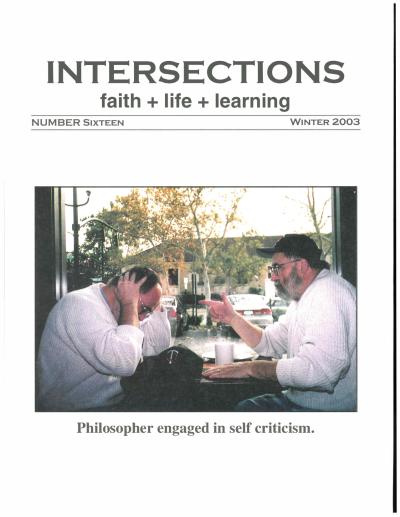
A Rainfall of Questions Collected in the Form of a Poem
Sig Royspern
No. 16 · Winter 2003
Royspern offers fourteen oracular questions on aging, addiction to possessions, water striders, magnolias, slippery fish, moths and the moon, priests and leaf-rakers, weeds and flowers, the price of education, abandoned groceries, spiritual pilgrimage, melons and oats, similes, and the impossibility of finding a store that sells a spring wind.
-
 Article
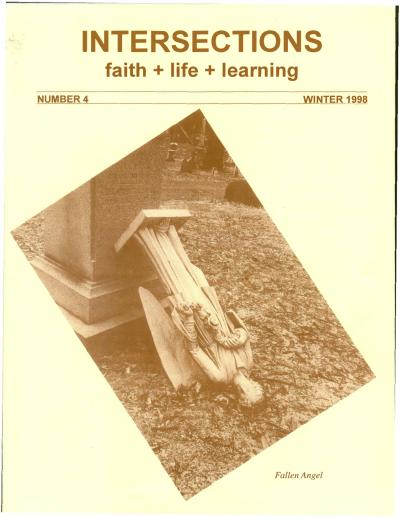
The Skeptical Theologian's Dictionary
Carl Skrade, Spencer Porter
No. 4 · Winter 1998
Porter and Skrade offer selections from a mock-lexicon of theological terms: answer, church, faith, God, grace, hope, justification, love, prayer, sin, soul, and theology, among others. Each entry begins with a standard definition and then unsettles it—answer reminds the reader that in theology and poetry the questions matter more than their answers; church alternates between “the mystical Body of Christ” and ordinary human gatherings whose machinery often obscures the gospel; God is the One whose name we are told not to take in vain and yet whose name we keep using; prayer is communion with God yet often degenerates into a list of demands. The form’s irony exposes the gap between the language of theology and its lived realities—a sober, witty corrective for Lutheran classrooms and chapels alike.
-
Poem
Drunks in a Midnight Choir
Kevin Griffith
No. 15 · Winter 2002
A pantoum-like Christmas-season poem in which red-robed choristers, flasks clinking and hands trembling, mangle the words of carols beneath “the midnight sky, your endless dark coat,” trusting that “it’s the season to forgive what’s vile” and that even wise men praise the humble and make glad.
-
 Reflection
Sweet on My Lips
Corin Wesner
No. 13 · Winter 2002
A passage from Wesner’s travel journal during the same South Africa workshop. Walking into a wood-and-tin shack church where raindrops fall on already-soaked carpet and the service is in Xhosa, she remembers her painted, carpeted home church and her adolescent argument with her mother about wearing a dress to worship, and finds herself engulfed in warmth as the few women sing—welcomed by a stranger’s smile and opened up.