Or vice-versa. What comes around goes around
and so it goes. Everyone knows that when
the last night’s bright trumpet sounds for the final time,such great darkness is only a prelude to the longest
dawn, a clock strike that begets a new round of blinding light,
of oceans stretching beyond the scope of the mind’s iris,gardens rich with trees so heavy with burst fruit
that all the newly handmade animals will grow fat
waiting for caretakers to slap a name on them.And then, when one lousy mistake gets made, as they
always do in their own passive-voiced way, the world
will begin its great downhill slide once again, and allthe dark-robed cryptologists who haven’t yet gone mad
with trying, will fret over the end of everything once again,
decoding the frail pages of books heavy with nothing morethan what they intended. Yes, once everyone has solved
the great conundrum of the world’s possible last song
and dance, time will have already smacked themwith its grand goodnight kiss, the stars will have given
their last call, the universe will have locked
the door on its way out, and the big man will hit rewind.
-
 Editorial
From the Publisher
Arne Selbyg
Selbyg announces that the 2001 ELCA Churchwide Assembly has commissioned a new social statement on education, placing it alongside the economy, the environment, abortion, sexuality, health, and peace, and invites Intersections readers to submit input on which topics within the field of education the statement should address.
-
Editorial
From the Editor
Tom Christenson
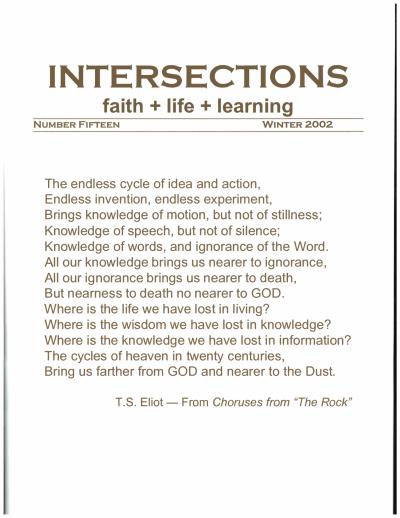
Christenson introduces an issue of varied voices—bishops and university presidents, philosophers and poets, students and their teachers—and defends the T. S. Eliot cover selection (“Where is the wisdom we have lost in knowledge?”) against the charge of being too depressing, arguing with cover artist Ida that Lutherans are realists about human accomplishments and that there is a huge difference between optimism and hope.
-
Article
The Marks of an ELCA College: One Bishop's Reflections
Stanley Olson
Olson, speaking as a bishop and “Harness Boy” whose job is to keep the church’s connections working, replaces his original four-noun outline (fealty, ingenuity, insouciance, focus) with eight marks the ELCA should be able to observe in its colleges: intentional Lutheran identity, significant Lutheran presence, Christian faith at every table, freedom of inquiry, coaching toward vocation, gravity and grace, nurtured community, and excellence by its own standards. Drawing on his survey of all twenty-eight ELCA college mission statements (two tables) and on Darrell Jodock and Mark Edwards, he argues that the Lutheran connection must be made explicit in mission, marketing, and faculty searches, and closes with six reciprocal expectations the colleges should hold of the ELCA—commissioner, mature parent, supporter of adventurous teenagers, advocate, steward of graduates, and a church faithful to its own Lutheran mission.
-
Article
Welcome Strangers
Gregg Muilenberg
Muilenberg, a non-Lutheran philosopher at Concordia, argues that self-consciously Lutheran colleges cannot make non-Lutheran faculty feel welcome through “institutional fit” rhetoric (he cites Concordia’s own hiring boilerplate) because identity must be sustained and developed, not preserved like a pickle. Drawing on Nikos Kazantzakis’s Report to Greco and the three marks of the “profoundly religious person”—commitment to the truth, to the power of the spirit, and to metousiosis through myth—he proposes that faith and reason are best understood as an unending struggle into which strangers must be invited as valuable and active participants, safeguarded by the strongest possible affirmation of academic freedom (citing Martha Nussbaum on Notre Dame and BYU).
-
Poem
Drunks in a Midnight Choir
Kevin Griffith
A pantoum-like Christmas-season poem in which red-robed choristers, flasks clinking and hands trembling, mangle the words of carols beneath “the midnight sky, your endless dark coat,” trusting that “it’s the season to forgive what’s vile” and that even wise men praise the humble and make glad.
-
Article
The Identity, Mission, Vision, and Goals of a Lutheran College vis a vis Bacon's "Of Studies" and Newman's "The Idea of a University"
Cora Lazor, Mary Theresa Hall
Hall, an Associate Professor of English at Thiel, and Lazor, a Thiel junior and 2002 ELCA Division for Higher Education summer intern, read Thiel College’s Statements of Identity, Mission, Vision, and Goals alongside Sir Francis Bacon’s “Of Studies” (1625) and John Henry Cardinal Newman’s The Idea of a University (engaging Azade Seyhan’s May 2002 PMLA essay along the way). They argue that Bacon’s “Read…to weigh and consider” and Newman’s defense of liberal over technical training underwrite Thiel’s new Writing-Intensive Course requirement, its ten institutional objectives, and its commitment to “service to society” in the Judeo-Christian tradition.
-
Article
Honesty of Mind: On the Uses and Abuses of Socratic Ignorance in Environmental Studies, Religion, and the Classroom
Don Braxton
Braxton, taking his cue from David James Duncan’s defense of ignorance as a fly-fisher’s most crucial tool and from Socrates’ midwife’s art in the Theaetetus, defends a doctrine of “honesty of mind” resting on four premises—knowledge is constructed, judgments are wagered amid imperfect knowledge, expertise can disable learning, and we are encumbered by other ways of knowing. He field-tests the disposition against three domains: the climate-change and creationism debates in environmental studies, the post-September 11 turn toward religious pluralism (engaging Union Seminary’s Joseph Hough and Hauer and Young’s “three-world” approach to the Bible), and the liberal arts classroom where students “become democrats of the mind” through Reinhold Niebuhr’s balance of conviction and contrition.
-
Book Review
Paul Dovre, ed.: The Future of Religious Colleges
Baird Tipson
Tipson, president of Wittenberg University, reviews Paul Dovre’s edited proceedings of the October 2000 Harvard Conference on the Future of Religious Colleges (Eerdmans, 2002), summarizing essays by Douglas Sloan on the failure of the “two-realm theory of truth,” George Marsden on faith-shaped scholarship, DeAne Lagerquist, Father David O’Connell, Mark Noll, Robert Benne, Mark Roche on Notre Dame, Joel Carpenter on neo-Calvinist Kuyperianism, and Mark Schwehn on a Lutheran “college-related church” and the centrality of vocation. Against Benne’s suggestion that only two or three robustly Lutheran colleges can be sustained, Tipson defends a less robust but still authentically Lutheran model embodied at places like Wittenberg, Gettysburg, and Roanoke, arguing for the enlightenment commitment to subjecting all truth claims to rigorous criticism and for hiring Marsden-style faith-shaped scholars rather than counting Lutheran heads.
-
 Article
Redemption Through Imperfection
Kyoko Mori
No. 5 · Summer 1998
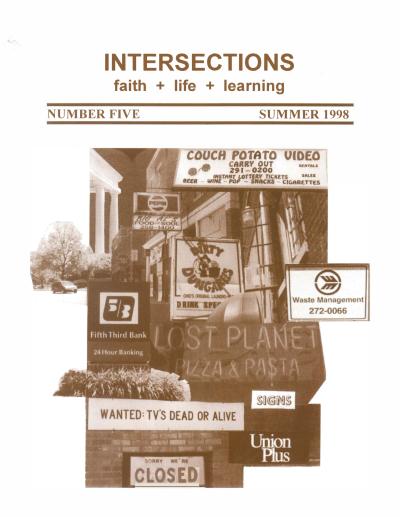
Mori, drawing on a visit to the Philadelphia Museum of Art with a friend, contrasts Marcel Duchamp’s Étant donnés—a peephole work whose mysterious motion sweeps every viewer into a shared, perpetual performance—with the static, glass-encased Liberty Bell as parody of spiritual experience. She extends the contrast into a meditation on rituals (comfort and consolation) versus art (truth, however painful), and on writing as a redemptive process that moves from orderly first drafts toward chaos and deeper, frightening truth—closing with master potters who skewed each finished vessel slightly so that art and decoration could be told apart. Parts are excerpted from Polite Lies (Holt 1997).
-
 Article
Valuing Poetry
Allison Wee
No. 37 · Spring 2013
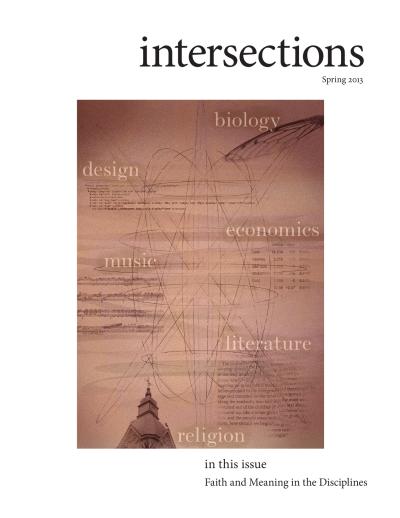
Writing from California Lutheran University as “value” in higher education collapses into “can it get you a job?”, Wee makes a case for poetry as a life-saving discipline. Drawing on William Carlos Williams, Shakespeare, the Psalms, Wordsworth, Pattiann Rogers, Mary Oliver, and her own Environmental Literature assignment that sends students outside for an hour of attentive stillness, she argues that the poet’s skill of translation cultivates the close attention, fresh perspective, and immaterial dimensions of life her students need most.
-
 Poem
Poem
Two Poems: The Dark Angels / Decorative Cooking
Gary Fincke
No. 3 · Summer 1997
Two poems by Gary Fincke of Susquehanna University: “The Dark Angels,” a return to the sidewalk in front of the father’s razed bakery in Etna, the soot-pocked windows, the Saturday trash fire, the last eclair on the work room’s folding chair; and “Decorative Cooking,” the mother’s story of St. Julitta, Betty Crocker’s “New Design for Happiness,” the Sunday dinners of shaped Jellos and anise Magi cookies, the visit of the former pastor returned to Pittsburgh to declaim the death of God, and the father who lays evergreen crosses by the mother’s headstone in the Garden of Dreams.
-
 Poem
Poem
A Rainfall of Questions Collected in the Form of a Poem
Sig Royspern
No. 16 · Winter 2003
Royspern offers fourteen oracular questions on aging, addiction to possessions, water striders, magnolias, slippery fish, moths and the moon, priests and leaf-rakers, weeds and flowers, the price of education, abandoned groceries, spiritual pilgrimage, melons and oats, similes, and the impossibility of finding a store that sells a spring wind.
-
 Poem
Poem
Sprigs of Mint
Caitlin McHugh
No. 21 · Summer 2005
McHugh meditates on three light green mint stalks dying in a plastic cup of water in her window frame’s shadow, drawing a parallel between the neglected mint, the “tainted papers” of her unread journals, and the time that both holds her back and drives her forward.
-
 Reflection
Meditation—Band Chapel Service, St. Olaf College
Erik Haaland
No. 7 · Summer 1999
Haaland, a St. Olaf senior, offers a brief Band Chapel meditation that defines art as “the expression of what is deeply human through the manipulation of the physical world” and defends worship—architecture, stained glass, music, eloquence—as an art form requiring our best and most sincere efforts. When the God we worship and the salvation we proclaim do not seem near, artful worship offers not propositions but something real and tangible to hold on to.