The flasks clink under our red silk robes.
Oh God, forgive us for the off-key notes,
the harmonies so far from kilter they punch holes
in the midnight sky, your endless dark coat.Oh, God, forgive us for the off-key notes.
It’s hard to fight the shakes, the bitter cold
in the midnight sky, your endless dark coat.
We should be sent packing, truth be told,but it’s hard to fight the shakes, the bitter cold.
We mangle the words: mudder and chile.
We should be sent packing, truth be told,
But it’s the season to forgive what’s vile.We mangle the words: mudder and chile.
The whisky dulls us. A grindstone gone bad.
But it’s the season to forgive what’s vile.
Even wise men praise the humble and make glad.And so, in spite of our breath, our trembling hands,
the harmonies so far from kilter they punch holes
in the night, we offer our songs. Our music stands.
And the flasks clink under our red silk robes.
-
 Editorial
From the Publisher
Arne Selbyg
Selbyg announces that the 2001 ELCA Churchwide Assembly has commissioned a new social statement on education, placing it alongside the economy, the environment, abortion, sexuality, health, and peace, and invites Intersections readers to submit input on which topics within the field of education the statement should address.
-
Editorial
From the Editor
Tom Christenson
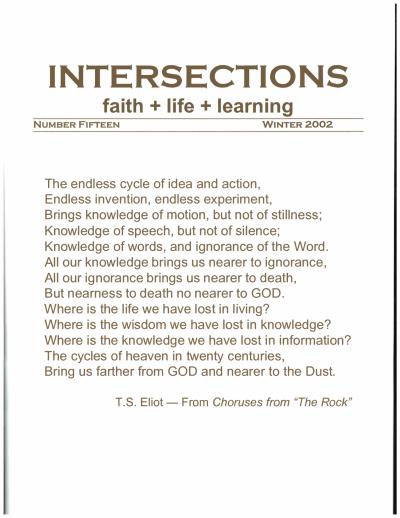
Christenson introduces an issue of varied voices—bishops and university presidents, philosophers and poets, students and their teachers—and defends the T. S. Eliot cover selection (“Where is the wisdom we have lost in knowledge?”) against the charge of being too depressing, arguing with cover artist Ida that Lutherans are realists about human accomplishments and that there is a huge difference between optimism and hope.
-
Article
The Marks of an ELCA College: One Bishop's Reflections
Stanley Olson
Olson, speaking as a bishop and “Harness Boy” whose job is to keep the church’s connections working, replaces his original four-noun outline (fealty, ingenuity, insouciance, focus) with eight marks the ELCA should be able to observe in its colleges: intentional Lutheran identity, significant Lutheran presence, Christian faith at every table, freedom of inquiry, coaching toward vocation, gravity and grace, nurtured community, and excellence by its own standards. Drawing on his survey of all twenty-eight ELCA college mission statements (two tables) and on Darrell Jodock and Mark Edwards, he argues that the Lutheran connection must be made explicit in mission, marketing, and faculty searches, and closes with six reciprocal expectations the colleges should hold of the ELCA—commissioner, mature parent, supporter of adventurous teenagers, advocate, steward of graduates, and a church faithful to its own Lutheran mission.
-
Article
Welcome Strangers
Gregg Muilenberg
Muilenberg, a non-Lutheran philosopher at Concordia, argues that self-consciously Lutheran colleges cannot make non-Lutheran faculty feel welcome through “institutional fit” rhetoric (he cites Concordia’s own hiring boilerplate) because identity must be sustained and developed, not preserved like a pickle. Drawing on Nikos Kazantzakis’s Report to Greco and the three marks of the “profoundly religious person”—commitment to the truth, to the power of the spirit, and to metousiosis through myth—he proposes that faith and reason are best understood as an unending struggle into which strangers must be invited as valuable and active participants, safeguarded by the strongest possible affirmation of academic freedom (citing Martha Nussbaum on Notre Dame and BYU).
-
Poem
The Etiology of Eschatology
Kevin Griffith
A wry meditation on end-times and beginnings in which the last trumpet is only a prelude to the longest dawn, newly handmade animals grow fat waiting for caretakers to name them, dark-robed cryptologists fret over the end of everything, and once everyone has solved the great conundrum the big man simply hits rewind.
-
Article
The Identity, Mission, Vision, and Goals of a Lutheran College vis a vis Bacon's "Of Studies" and Newman's "The Idea of a University"
Cora Lazor, Mary Theresa Hall
Hall, an Associate Professor of English at Thiel, and Lazor, a Thiel junior and 2002 ELCA Division for Higher Education summer intern, read Thiel College’s Statements of Identity, Mission, Vision, and Goals alongside Sir Francis Bacon’s “Of Studies” (1625) and John Henry Cardinal Newman’s The Idea of a University (engaging Azade Seyhan’s May 2002 PMLA essay along the way). They argue that Bacon’s “Read…to weigh and consider” and Newman’s defense of liberal over technical training underwrite Thiel’s new Writing-Intensive Course requirement, its ten institutional objectives, and its commitment to “service to society” in the Judeo-Christian tradition.
-
Article
Honesty of Mind: On the Uses and Abuses of Socratic Ignorance in Environmental Studies, Religion, and the Classroom
Don Braxton
Braxton, taking his cue from David James Duncan’s defense of ignorance as a fly-fisher’s most crucial tool and from Socrates’ midwife’s art in the Theaetetus, defends a doctrine of “honesty of mind” resting on four premises—knowledge is constructed, judgments are wagered amid imperfect knowledge, expertise can disable learning, and we are encumbered by other ways of knowing. He field-tests the disposition against three domains: the climate-change and creationism debates in environmental studies, the post-September 11 turn toward religious pluralism (engaging Union Seminary’s Joseph Hough and Hauer and Young’s “three-world” approach to the Bible), and the liberal arts classroom where students “become democrats of the mind” through Reinhold Niebuhr’s balance of conviction and contrition.
-
Book Review
Paul Dovre, ed.: The Future of Religious Colleges
Baird Tipson
Tipson, president of Wittenberg University, reviews Paul Dovre’s edited proceedings of the October 2000 Harvard Conference on the Future of Religious Colleges (Eerdmans, 2002), summarizing essays by Douglas Sloan on the failure of the “two-realm theory of truth,” George Marsden on faith-shaped scholarship, DeAne Lagerquist, Father David O’Connell, Mark Noll, Robert Benne, Mark Roche on Notre Dame, Joel Carpenter on neo-Calvinist Kuyperianism, and Mark Schwehn on a Lutheran “college-related church” and the centrality of vocation. Against Benne’s suggestion that only two or three robustly Lutheran colleges can be sustained, Tipson defends a less robust but still authentically Lutheran model embodied at places like Wittenberg, Gettysburg, and Roanoke, arguing for the enlightenment commitment to subjecting all truth claims to rigorous criticism and for hiring Marsden-style faith-shaped scholars rather than counting Lutheran heads.
-
 Institutional Focus
About the Cover and Artist
No. 49 · Spring 2019
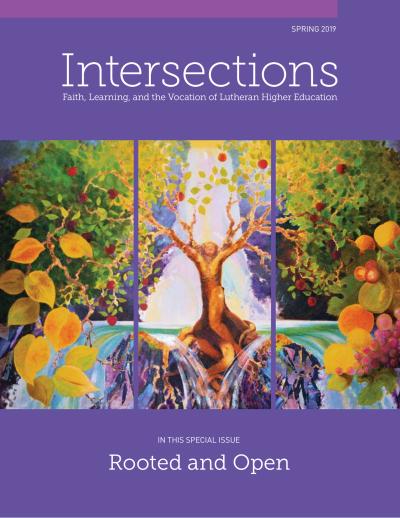
Kristen Gilje, a Bellingham, Washington artist who spent nine years as Artist in Residence at Holden Village, recounts the “Tree of Life” she painted for the Holden Village 1999 summer theme and the unexpected interpretation Lapidary Fred offered of Yggdrasol, Prometheus, the Druid Tree Spirit, and the crucifix all at once.
-
 Article
Honoring the Word: Lutherans and Creative Writing
Carol Gilbertson
No. 16 · Winter 2003
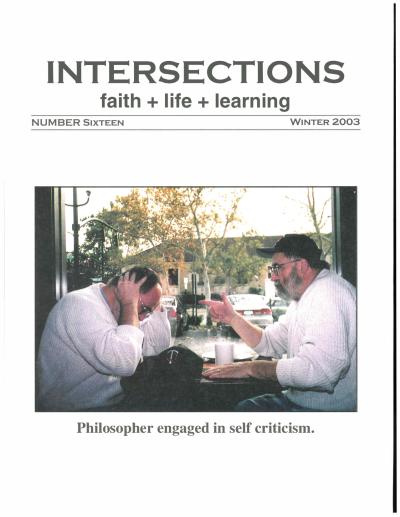
Gilbertson argues that “honoring the Word” in Lutheran colleges means cherishing the sacred power of human language as God’s gift across three sites—the chapel talk, the classroom of wonder, and the poem—and illustrates her argument by reading aloud her own poems: “The Refiner’s Fire and Leaping Calves,” “Late June,” “Early June,” “Sweet July,” “Good Friday,” “Pondering These Things,” “The Limbs of Words,” and “Night Rising,” drawing on Darrell Jodock, John Updike, Martha Nussbaum, George Steiner, and T. S. Eliot’s “The Dry Salvages” to claim writing as a Christian vocation that “incarnate[s] the unseen sacred.”
-
 Poem
Poem
Two Poems: The Dark Angels / Decorative Cooking
Gary Fincke
No. 3 · Summer 1997
Two poems by Gary Fincke of Susquehanna University: “The Dark Angels,” a return to the sidewalk in front of the father’s razed bakery in Etna, the soot-pocked windows, the Saturday trash fire, the last eclair on the work room’s folding chair; and “Decorative Cooking,” the mother’s story of St. Julitta, Betty Crocker’s “New Design for Happiness,” the Sunday dinners of shaped Jellos and anise Magi cookies, the visit of the former pastor returned to Pittsburgh to declaim the death of God, and the father who lays evergreen crosses by the mother’s headstone in the Garden of Dreams.
-
 Poem
Poem
Original Song Lyrics: "Just a Little"
Mike Blair
No. 48 · Fall 2018
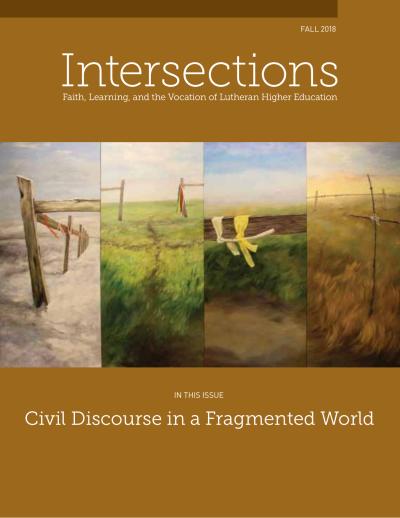
Lyrics for an original song inspired by biblical images and stories, by Emma Lazarus’ “The New Colossus,” and by the faith, hope, love, and courage of immigrant friends and neighbors — led as a devotion during the 2018 Vocation of a Lutheran College conference.
-
 Poem
Poem
Unpossible
Tim Knopp
No. 19 · Summer 2004
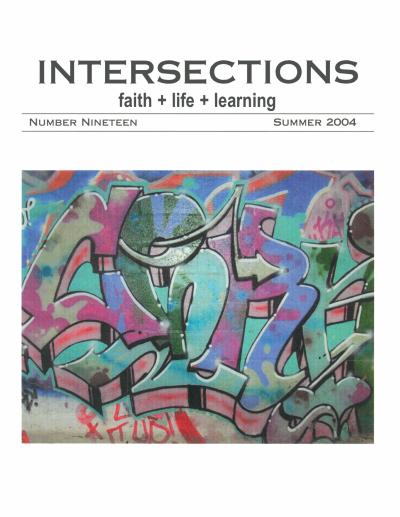
A new Capital University education graduate reflects on the bargain of trading childhood for “four years closer to some hidden knowledge, four years farther from what I once knew,” as the noon chimes call him out into a campus where professors and students teach one another along worn brick paths that “love is” should be “love can be.”
-
 Poem
Poem
Sprigs of Mint
Caitlin McHugh
No. 21 · Summer 2005
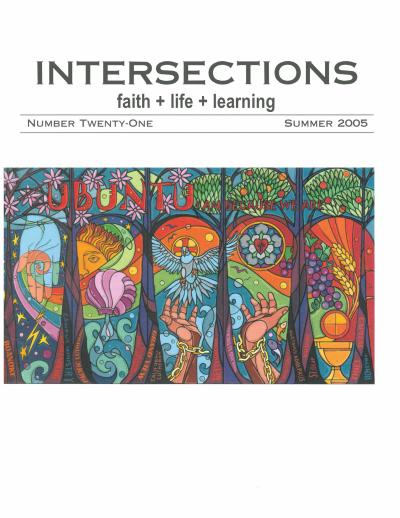
McHugh meditates on three light green mint stalks dying in a plastic cup of water in her window frame’s shadow, drawing a parallel between the neglected mint, the “tainted papers” of her unread journals, and the time that both holds her back and drives her forward.