So why all this talk about Vocation? It is to do the work the one’s soul must have. It is also a recognition that if we as a community are ever truly going to take seriously the work of racial reconciliation and deconstructing racism and patriarchy, the work can not only be focused on deconstructing systems of power. The work must also center on the flourishing of marginalized groups. This is the understanding of Dr. Kimberly Crenshaw who coined the world “Intersectionality” and is also the work of Womanist Scholars. We recognize in our vocational calling now is the time when Black women scholars and leaders of the church must come together to create initiatives that contribute to new generations of Black women leaders who can shift the way that people live in the world. This is what the Womanist Experiential Learning Initiative is all about.
“If we as a community are ever truly going to take seriously the work of racial reconciliation and deconstructing racism and patriarchy, the work can not only be focused on deconstructing systems of power. The work must also center on the flourishing of marginalized groups.”
The Womanist Experiential Learning Initiative, a collaborative work of Womanist Hebrew Bible Scholar Dr. Yolanda Norton and Pastoral Theologian Beverly Wallace, will provide students with the opportunity to explore a theological perspective engaged by many African American women theologians—one that takes serious and centers Black women’s voices and scholarship as a viable source and resource for theological education. A portion of this project, in concert with the work of the Office of Justice for Women in the Evangelical Lutheran Church in America will allow young women in high school, college, and seminaries “to step into their questions and reconsider their assumptions,” engaging in theological exploration viewed through the lens of race, class, and gender.
The Beyoncé Mass—a Christian womanist worship service that uses the music and life of Beyoncé as a tool to cultivate an empowering conversation about Black women—their lives, their bodies, and their voices. This mass introduces individuals to this womanist understanding. It is a space that encourages a practice of Christian faith that sees and acknowledges people where they are and for who they are. The Mass is a space story, Scripture, and song that calls for the liberation of all people by creating welcome, fostering healing, and engaging contemporary conversation and culture as a part of Christian identity and praxis. Additional “host” spaces are needed to share this experience.
The Womanist Experiential Learning Initiative is also working to provide Black female students at the undergraduate level the opportunity to study abroad in countries like Portugal, Brazil, and Ghana, where they can learn about global intersectionality and participate in service-learning opportunities with Black girls in these locations. We know that studying abroad expands the cultural horizons of students, but this intentional work is also intended to help Black girls who attend predominantly white institutions develop a social and learning network that can combat the isolation they often feel. In addition, this study abroad initiative will be tied to the Black Girl Magic Academy—a new program being launched by a new nonprofit—the Global Arts and Theology Experience—in conjunction with a range of church, academic and community partners.
In addition, the Womanist Experiential Learning Initiative, will pilot The Black Girl Magic Academy in three cities in the United States and two outside of North America. This program will focus on Black girls between the ages of 13 and 17 years old. The curriculum will be a year long experience and will allow them not participate in virtual learning opportunities with their peers around the world but also work with Black young adult women in their context to expand their learning beyond what traditional educational systems provide.
Already several seminary students have taken it upon themselves to engage in this women learning in our Lutheran Seminary. One student explored the use of a womanist pedagogy with women in prison. Another student is looking at how to engage the arts, specifically opera to share the story of a displaced African American community. And another student is learning about how to use a womanist way of knowing for spiritual direction with the LGBTQI+ community. As part of the reflection on her womanist reading, this same student wrote:
It was in bell hooks’ book, Sisters of the Yam, that I found language to describe the pain that I had seen within myself. The daunting reality of being a Black queer woman oftentimes feels like too much to bear, and in order to do so day to day, I had to shut down pieces of myself. I could not go through the day bearing all of myself, knowing that I am the very thing that the white cisgender, heteronormative capitalist society that I live in works so hard to diminish. In abandoning these parts of myself, I have become numb and stuck in survival mode. The grief of that is a lot. There have been countless times where I thought that it was not worth surviving, staying in this world. But it was trusted community that brought me back, and kept me here. Every day it has been their words, smiles, or even a touch that has given me enough strength to carry on to the next moment. Sisters of the Yam helped me to understand this part of my story. Through hooks’ writings, I was able to see that I am not alone, that my experiences are not odd, but rather a part of a legacy of surviving, and thriving, because of community. I am because we are.
And another 23 year-old student who was newly exposed to Womanism through her experience with the Beyoncé Mass said: “I’m going to get a concentration in Womanist Theology even if that concentration is not offered.”
The impact of this work is tremendous. To expand this work to colleges and universities, congregations and communities with learnings also in a global context, will assist Black women and persons who want to see the legacy of humanity through the lens of Black women will help inform the world. Our hope too is that this work will inspire, equip, connect and support Black women (and other students) divinely motivated to serve as change makers in their communities doing, as Dr. Katie Geneva Cannon often said, “the work—their vocational calling—that one’s soul must have.”
-
 Editorial
From the Editor: Why All This Talk About Vocation?
Colleen Windham-Hughes
Windham-Hughes introduces the Fall 2022 issue built around Mark Wilhelm’s keynote “Why all this talk about vocation?” and previews five panel responses, two first-time conference reflections, and companion pieces on Womanist theology — framing vocation as a call not to privilege but to constructive and corrective work that undoes unjust systems.
-
Article
Why All This Talk About Understanding the Mission of NECU Member Institutions as a Vocation?
Mark Wilhelm
In his valedictory keynote, retiring NECU Executive Director Mark Wilhelm argues that Lutheran higher education is, properly understood, vocation-based education — outlining four core practices recovered over the past fifty years and naming the constructive and corrective work still to be done, including a fuller embrace of DEIJ and of the diverse vocations of NECU’s 27 institutions.
-
Response
Response to Mark Wilhelm: Vocation, Mission and Privilege
Marit Trelstad
Trelstad affirms Wilhelm’s claim that vocation is the foundational shared mission of Lutheran higher education rather than one program among many, and presses the critique that calls to “vocational reflection” can mask privilege — arguing that an intersectional lens shows vocational discernment is in fact a matter of survival and flourishing for students from marginalized communities.
-
Response
Response to Mark Wilhelm: DEI, Great; DWS (Dismantling White Supremacy), Even Better
Vic Thasiah
Thasiah argues that if Lutheran colleges and universities want to live out their commitment to the flourishing of all, DEI is good but DWS — dismantling white supremacy — is even better, and offers three Lutheran sensibilities (suspicion of self-righteousness, the decolonial shockwave of the cross, and critical thinking that can still register awe) that can make DWS a core practice of higher education.
-
Response
Response to Mark Wilhelm: Distinguishing Between Identity and Vocation
Andrew Tucker
Tucker proposes that NECU’s next most faithful step is to faithfully and effectively differentiate vocations and identities — arguing that identity is who you are, vocation is what you do, and that recognizing the plurality of both helps Lutheran institutions name which work is theirs to take up and which is good work that belongs to someone else.
-
Response
Response to Mark Wilhelm: Vocation—Wide Perspective Questions
Mary-Paula Cancienne
Cancienne, drawing on Iain McGilchrist, asks whether higher education has prioritized micro lenses at the expense of the macro view, and invites educators to hold the drama of individual vocation stories within a wider plot that includes James Webb Telescope wonder, climate grief, the long shadow of enslavement, and the resilience of native populations.
-
Response
Response to Mark Wilhelm: Adopting the Framework of ‘Because’ and ‘Therefore’
Paul C. Pribbenow
Pribbenow describes how Augsburg University responded to its dramatic demographic transformation (from 18% to nearly 70% BIPOC entering students over sixteen years) by adopting an institutional vocational statement and a simple “because/therefore” framework for translating particular Lutheran theological convictions into institutional programs, policies, and practices.
-
Article
Work Works
Julius Crump
Crump argues that in an era of class-stratified careerism and the “ruins of neoliberalism,” commencement-speech rhetoric about heroic vocation will not resuscitate vocation — instead, professors embodying vulnerability, extemporaneity, and contemporaneity in the classroom can show students that consistent work, embodied as service to others, is itself worthy.
-
Reflection
Why All This Talk About Vocation?
Madyson Ray
Ray, a junior at Midland University and the only student attendee at the 2022 conference, reflects on four workshops — on teaching womanist thought, on supporting student-athletes, on resistance to the word “vocation,” and on vocational reflection — and brings home concrete ideas including a women’s-history scavenger hunt and semester-long vocational reflections.
-
Institutional Focus
LibGuide: Introduction to Womanist Theology
Elli Cucksey
Cucksey, the head librarian at Trinity Lutheran Seminary, recounts how Beverly Wallace’s Introduction to Womanist Theology class — the first offering of the ELCA Seminaries’ Womanist Theology Initiative — led her to build a publicly available LibGuide that amplifies Black women’s voices and gathers the resources of the course for future students.
-
 Response
Tat for Teat: Ratke Responds
David Ratke
No. 9 · Summer 2000
Ratke, agreeing with much of VonDohlen’s critique but contending that VonDohlen misreads both Luther and the two-realms doctrine, marshals Luther’s To the Christian Nobility, On the Freedom of a Christian, Temporal Authority, Whether Soldiers Too Can Be Saved, and the “Sermon on Keeping Children in School,” along with Walther von Loewenich, to argue that Luther was well aware of structurally differentiated society, made no claim to a monistic epistemology, and intended the two-realms doctrine to combat—not introduce—dualistic bifurcation between sacred and secular. Our identity is “not as either Christian or academic, but as Christian and scholar.”
-
 Article
Views on Flourishing After the Age of Roe
Caryn Riswold, Mary J. Streufert
No. 57 · Spring 2023
Riswold and Streufert reflect on the Radcliffe Institute’s January 2023 conference “The Age of Roe” and argue that the ELCA’s 1991 Social Statement on Abortion and its 2019 statement Faith, Sexism, and Justice offer Lutheran higher education a third way to approach reproductive justice grounded in serving the neighbor so that all may flourish.
-
 Article
Making Dry Bones Stand: Lutheran Higher Education at Century's End
Diane Scholl
No. 17 · Summer 2003
Scholl reads John Winthrop’s “A Model of Christian Charity,” the banishment of Anne Hutchinson, de Crevecoeur’s American farmer, Olaudah Equiano, Phyllis Wheatley, and Hawthorne’s The Scarlet Letter alongside Ezekiel’s vision of the dry bones to ask how a Lutheran college can be a community that holds difference and commonality together. Drawing on Ernest Simmons’s warning against collapsing into either dogmatic absolutism or thoroughgoing relativism and Bruce Reichenbach’s companion essay in this issue, she identifies five features of shared life at a Lutheran college—the liberal arts, political process, the arts, the community of caring, and the recognition of difference and the right to dissent—and argues that the necessary tension between individualism and corporate identity, framed by theological vision, is “our best legacy and our best hope for the future.”
-
 Article
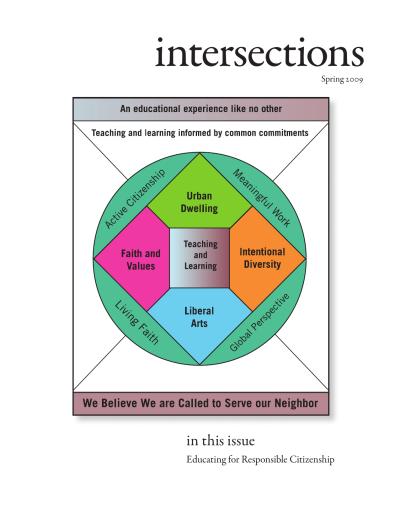
Students in the Cloud: Creating Digital Citizens
Jose Marichal
No. 29 · Spring 2009
Marichal weighs the utopian and dystopian views of the “networked information economy,” drawing on Yochai Benkler, Manuel Castells, Henry Jenkins, Cass Sunstein, Robert Putnam, Nicholas Carr, and Andrew Keen to chart the promise and peril of life “in the cloud,” and proposes Aristotle’s intellectual virtue of phronesis—developed through Hubert Dreyfus’s five stages of skill acquisition—as the goal of digital citizenship for college faculty and their students.
-
 Article
Access, Accessibility, & Change: A Call for Trustworthy Leadership in Higher Education
Emma Jones
No. 60 · Fall 2024
Jones surveys the converging pressures on higher education — cost, the enrollment cliff, shifting demographics, and declining public confidence — and uses Reichheld and Dunlap’s four factors of trust (transparency, capability, reliability, humanity) to call campus leaders to rebuild trustworthy leadership from the inside out.
-
 Article
Why Did the Chicken Cross the Road? A Homily on Liminality and Vocation
Lori Brandt Hale
No. 45 · Spring 2017
Drawing on Wes Moore’s The Other Wes Moore, Warren St. John’s Outcasts United, Victor Turner’s anthropology of liminality, and Dietrich Bonhoeffer’s poem “Who Am I?”, Hale considers how Hmong, Muslim, Latinx, LGBTQ+, non-traditional, and other students live in “double liminal” spaces — and asks whether liminality might itself be a place of transformation in conversations about vocation.