I have been asked to respond to Robert Funk’s essay. I do so with two caveats:
1. I have spoken and written much about Funk and about the Jesus Seminar that he represents. Most often, I find myself in the position of defending them from unfair assaults and calling attention to the significant contributions that they have made to the world of scholarship. Now, as a respondent, my role must be that of critic, at least it must be that if I want to avoid redundancy and be interesting, and I do. But I hope that what follows is taken within the context of essential support for Funk’s commitments and achievements as a respected colleague in scholarship.
2. I have probably been asked to respond in my capacity as a New Testament scholar, but I don’t care to do that, partly because—as just indicated—the disagreements then become somewhat pedantic. The arguments can be made: John Meier, who Funk cites as supporting his goal of building a reliable database, disagrees quite sharply with Funk as to what actually constitutes that database. Like many scholars (including me), Meier remains unconvinced that the Gospel of Thomas offers an independent or early witness to Jesus or that the reconstructed Q document offers substantially more reliable information than the Gospel of Mark. Likewise, Raymond Brown and many scholars (including me) remain unpersuaded by arguments that indicate the passion narratives were formed late, after the sayings tradition was well in place. But if such arguments can be made, they also have been made and there seems little point in rehearsing them here. Let us acknowledge, as Funk does, that many of the details of his work are still under debate—indeed, the very database from which he works and the methods and criteria through which it is both established and interpreted remain controversial subjects for scholars (including me) who are committed to the same basic goals that he pursues.
I prefer to respond to Funk’s paper as a Christian and as a pastor, hoping that this stance will offer comments that are more thought-provoking. In this capacity, I must say just a word about the concluding tone of the paper, which is really the only part of it that irks me. Funk says, “Jesus may prompt us to abandon the institutional church. Who would weep for its loss if its only function is to protect Christian privilege?” As an ordained minister of the Evangelical Lutheran Church in America, I can speak only for my little branch of the institutional church, but our 1998 Directory lists 28 colleges and universities, 213 primary schools, 1378 early childhood education centers, 233 general health care centers, and 2108 social service organizations. It lists numerous mental health facilities, recovery centers, adoption agencies, employment services, literacy programs, food pantries, counseling services, refugee centers, AIDs hospices, advocacy groups, retirement homes, women’s shelters, and other “institutional” agencies devoted to improving the physical, mental, emotional, sexual, social, psychological, political, ecological, and spiritual well-being of every creature on this planet. It does strike me, then, as a bit unfair to imply that this institution (or others like it) have as their “only function” the protection of Christian privilege.
But now that I’ve got that off my chest, let’s go on to matters more substantive to Funk’s proposal. I can organize the rest of my remarks as commentary on the following revealing remark: “Jesus, and not Peter, ought to have the primary say about the faith that posits him as its author.”
I wonder, first, to which “faith” Funk is referring. Christianity takes Jesus to be the object and content of its faith but does not necessarily claim him as its founder. When (as in Hebrews 12:2, KJV), he is called the “author of faith,” the reference is to the spiritual, risen Christ who creates faith (trust) in the hearts of believers. There is no indication that the historical person of Jesus bequeathed to his followers a catechism of Christian dogma. When I was twelve years old and studied catechism in Confirmation class, my pastors told me quite plainly that many of the church’s cherished beliefs were not found as such in the New Testament (much less in the words of the historical Jesus). I learned not only about how Peter and Paul shaped the faith now called Christianity but also about how Augustine and Luther and Bonhoeffer and countless others had continued to shape it. By the time I was confirmed I knew that “Justification by grace” came from Paul, that the doctrine of the Trinity came from Athanasius and the Nicene council, that the concept of the “real presence” of Christ in the Lord’s Supper came from Martin Luther, and so forth. At some level, I was keenly aware that if the Jesus of first-century Nazareth could be beamed up by the Starship Enterprise and deposited in the middle of one of our Sunday morning services he would be confused to say the least. I knew this, but it didn’t bother me. Why does it bother Funk?
Funk thinks that Jesus, not Peter, ought to be the one who defines “the faith.” Faith based on Peter is derivative faith, second-hand faith. This position strikes me as a bit like that of political conservatives who complain that certain policies of our government (e.g. social welfare programs) were not part of the original design for our nation as mapped out by those quintessential “founding fathers.” So what? Can’t ideas be judged on their own merit, regardless of origin? What’s wrong with a faith being “derivative,” that is, based on the accumulated insights and experiences of others? If, as Funk asserts, a fundamental quality of the faith movement Jesus began was “trust in other human beings,” then I would think such a faith would have to be derivative, indeed that it would celebrate this fact, point with pride to the numerous human sources from which it is derived. Or, if as Funk asserts, a fundamental quality of this faith is a rejection (or at least suspicion) of “brokers,” then I would think that such a faith would have to renounce any attempt to make the ideas of one person (the historical Jesus) the absolute authoritative norm for authentic doctrine.
The word that I do appreciate in the italicized sentence above is primary. Funk rightly notes that Christian theology has often neglected the insights of Jesus himself in favor of the insights of others concerning him. “Christianity,” Funk says, “has been preoccupied with the status of Jesus rather than with the kingdom of God.” The creeds leave a blank between “born of the virgin Mary” and “suffered under Pontius Pilate,” a blank where the life, ministry, and teaching of Jesus should come. Funk is not only correct in these observations but he is right to call Christianity to account for them. He is right to say that the recovery of the historical figure of Jesus may serve “as a catalyst” for new and profound developments in the Christian movement. But then, in the first paragraph under the section in which he describes this “new beginning for the Christian movement,” he indicates that “the recovery of the historical Jesus may prompt the creation of a twenty-first century version” of the early stage, that is, of the faith before Peter or Paul or countless others added their two-cents worth. Is that the only viable alternative to the neglect of the historical Jesus? A repudiation of everything that has happened since?
Funk seems to conceive of that period we call the ministry of Jesus as a magic moment in time, so pristine that any accretion must be evaluated negatively. Naturally every theological development must be critiqued. History progresses by fits and starts, with gains and losses. One may ask whether the development of Trinitarian theology or sacramental practices were gains or losses. In fact, theologians have always and will always debate these matters. But to assume that such developments must necessarily be losses simply because they are developments seems naive; indeed, it seems anti-historical, even anti-intellectual. It seems almost like an inverted fundamentalism: there is no need to argue the theological validity of a proposition if we can show that is derived. Only the presumably underived words and deeds of the historical Jesus are to be regarded as sacrosanct, as fundamental.
I go now to one example of how the rejection of what is derivative impoverishes faith. The example concerns what—since Bultmann—has been called myth. In the Jesus tradition, myth is by definition derivative. Jesus spoke in aphorisms and parables, but he did not tell myths, and from the historical perspective of the Jesus Seminar, all of the actions of Jesus reported in the language of myth must necessarily be deemed inauthentic. In other words, the language of myth so prevalent in our Gospels belongs to a later generation of the Jesus movement. Still, Bultmann himself viewed myth as a vehicle for expressing religious truth. If Funk’s paradigm of avoiding derivative faith holds, then myth will not simply be demythologized; it will have to be cast off altogether, as part of the baggage of second-hand religion. In my mind this impoverishes faith, with regard to theology, and even more profoundly, with regard to piety.
Ultimately, we must consider whether faith or religion can be based on data alone. Indeed, we may have to ask whether authentic faith can not only transcend data but stand in tension with it. We must consider whether authentic faith can include piety as well as theology, appeal to the heart as well as to the head. I think that piety is to theology what poetry is to prose. Like prose, theology is utilitarian, functional. When we really want to communicate unambiguously, prose works better than poetry. But poetry enriches life in other ways, and it works very well when what one wants to communicate is ambiguity. To expand this analogy (which of course does not work on every level), let us imagine that historical data is the “grammar” of faith. Ignore grammar and you get sloppy prose; ignore historical data, and you get sloppy theology. But poetry is not constrained by the accepted rules of grammar and piety is not constrained by the reliable data of historical research.
There is, of course, a lot of bad piety, just as there is a lot of bad poetry, but the evaluation of either as such is somewhat subjective and not wholly determined by the standards that would apply to other genres of thought or literature.
I could turn to Thomas Merton or Teresa of Avila and find compelling illustrations for this point, but that’s too easy. I deliberately choose an unsophisticated example instead. I just called our local Christian radio station and asked them what the Number One Christian rock song in Columbus is this week. It’s a tune by the group Audio Adrenaline that consists mainly of the following line sung over and over again: “If I keep my eyes on Jesus, I can walk on water.” The record has sold over a million copies to people who presumably find it quite inspiring. I doubt that very many of these consumers understand the lyrics in a literalistic sense. That is, I doubt that many think that if they literally see Jesus in some aqueous location and fix their gaze upon him they will be supernaturally empowered to walk across the water without sinking. They do not understand the song this way because it is poetry and they know that. What it expresses is not a theological proposition regarding an existential occurrence in space and time, that is, something historical, but piety, something that transcends history through metaphor.
The Jesus Seminar deals with data, the stuff of history. Funk does not think that the historical Jesus actually did walk on water, much less enable Peter or others who kept their eyes on him to do so. My guess is that this conclusion would be troubling to many Audio Adrenaline fans. Why? Can’t the piety expressed in the song be authentic even if the historical data that is loosely referenced by it is contestable? I think that it can, but does Funk think so? I don’t see how he can. Such an appeal to myth is clearly derivative.
Funk suggests three reasons why the Jesus Seminar has met with resistance: it exposes widely held views to public scrutiny; it destabilizes the canon; it exemplifies the demise of neo-orthodoxy. These may all be correct, but I suspect a basic resistance to the Seminar comes from a perception (right or wrong) that it offers a prosaic understanding of religion based on data alone. The Jesus Seminar is perceived (rightly or wrongly) as lacking any sense of spirituality, any appreciation for the inner yearnings that drive most people to religion in the first place.
Marcus Borg has been the most obvious exception to this caricature. A prominent member of the Seminar, he also speaks forthrightly of his current experience of “the post-Easter Jesus.” He speaks of “meeting Jesus again, for the first time,” language that recalls Ricoeur’s concept of “the second naivete.” But Borg exhibits a different attitude than Funk toward data that is deemed historically inauthentic. He does not discard such materials as “derivative” but maintains that they “are valuable and illuminating precisely because they enable us to hear the voice of the community” (See Jesus in Contemporary Scholarship [Philadelphia: TPI, 1994], p. 174). Even if Jesus himself did not say, “I am the light of the world” (John 8:32), the fact that early Christians attributed this designation to him reveals something about the vividness and intensity of their experience that remains significant for faith.
One can easily fall off the cliff on the opposite side. I think Schweitzer did so when, after deciding that the historical Jesus was too strange to meet modern demands of faith, he took to advising people simply to experience the spiritual Jesus who can be encountered rather uncritically in the Gospels. Historical Jesus studies can and should inform theology, and our theology can and should inform our piety. Again, this is where Funk is strongest. His study of Jesus reveals one who calls people to trust, to celebrate, to renounce privilege, to overcome barriers, and to eliminate brokers. All valid themes, seldom heard in Christian preaching. The data gathered through historical research bring such themes to the fore and thrust them into the limelight.
But ultimately the religious needs of many—most—go beyond what data can reveal. We do not need to pick which ditch we will fall into. What we need is a wholistic faith, one that holds piety and theology together, one that appeals to the heart and the mind, that includes history and myth, poetry and prose.
-
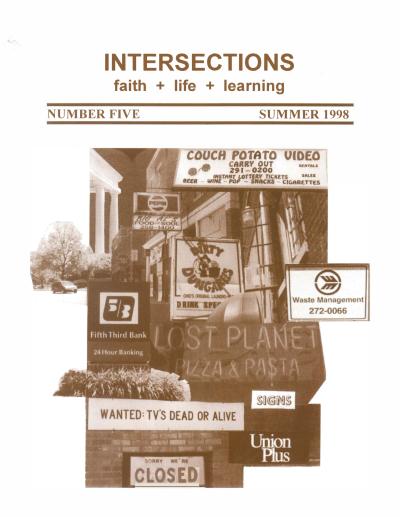 Editorial
From the Publisher
W. Robert Sorensen
Sorenson frames Intersections and the Vocation of a Lutheran College Conference as vehicles for widening the scope of inquiry that the separation of mind from spirit has curtailed, citing Ernest Boyer on probing “the deep places of the mind and the deep longings of the human spirit.” He previews an announcement at the 1998 conference of the Conrad Bergendoff Series—named for the late scholar and former Augustana College president—whose first volume, by Ernest Simmons of Concordia College, will support an Academy of Scholars in Lutheran Higher Education.
-
Editorial
From the Editor
Tom Christenson
Christenson introduces the issue as an illustration of the diversity of interests Intersections aims for, surveys the contents (Lagerquist on method, Mori on art and ritual, Baer on falling walls, Bergendoff as memorial, Funk and Powell in dialogue), urges readers to send in “your good stuff,” asks for distribution feedback, and closes with a sabbatical-year reading list—Kieran Egan, Robert Coles, Daniel Kemmis, David W. Gill, Sallie McFague, Roger Scruton, E.M. Adams, Freeman Dyson, Colamosca and Wolman, Gribbin and Goodwin, van Wyk, Wislawa Szymborska, and Flannery O’Connor.
-
Article
You Don't Seem Angry: Methodological Confessions Of A Lutheran Lay-Woman
L. DeAne Lagerquist
Lagerquist, opening from a colleague’s 1981 observation about her M.A. thesis on four female abolitionists, traces her path from feminist historian and battered women’s shelter advocate through the University of Chicago’s obsession with method to a more self-conscious account of her own. The method grows out of four Lutheran themes—original sin (caution and humility), the eighth commandment against bearing false witness (generosity and forgiveness), the neighbor as “little Christ” (cooperative interpretation), and vocation (interpretation as calling, located alongside feeding the hungry and visiting the lonely)—and shapes her ongoing work on a history of Lutherans in the United States with a plot about learning to live with diversity.
-
Article
Redemption Through Imperfection
Kyoko Mori
Mori, drawing on a visit to the Philadelphia Museum of Art with a friend, contrasts Marcel Duchamp’s Étant donnés—a peephole work whose mysterious motion sweeps every viewer into a shared, perpetual performance—with the static, glass-encased Liberty Bell as parody of spiritual experience. She extends the contrast into a meditation on rituals (comfort and consolation) versus art (truth, however painful), and on writing as a redemptive process that moves from orderly first drafts toward chaos and deeper, frightening truth—closing with master potters who skewed each finished vessel slightly so that art and decoration could be told apart. Parts are excerpted from Polite Lies (Holt 1997).
-
Reflection
A Community That Connects
Conrad Bergendoff
Excerpts from Conrad Bergendoff’s 1990 address at the opening of Augustana’s new library, prepared by David Crowe and published here as a memorial after Bergendoff’s death in December 1997. Bergendoff—Augustana class of 1915, president 1936–1962—recounts eighty years of Augustana memories, insists that “size is pretty much within you, not outside of you,” traces the institution’s bonds to Uppsala from 1860 (and the 1910 visit of the Rector Magnificat), and celebrates Augustana’s graduates “in practically every part of the world” as evidence that a small school can have a universal output.
-
Reflection
Walls: Talk At Gustavus Adolphus College
Elizabeth Baer
Baer’s September 11, 1997 Gustavus Adolphus chapel homily on Joshua 6 turns from the trumpets to the walls—Robert Frost’s “Mending Walls,” the walls of the Warsaw ghetto in Vladka Meed’s On Both Sides of the Wall and Margaret Zassenhaus’s Walls, the Berlin Wall coming down in 1989—and then to the autobiographical, intertextual discourse of Gustavus chapel itself as a place where misunderstandings come down. An author’s note added after the March 29 F3 tornado reports the closing line (“LET’S MAKE THOSE WALLS COME TUMBLING DOWN”) as eerily prescient: roofs, windows, and 90% of campus trees were lost, but the Chapel walls and the eternal flame in the red glass lantern stood firm.
-
Article
The Quest Of The Historical Jesus: Problem & Promise
Robert W. Funk
Funk, founder of the Jesus Seminar, frames the quest as the search for reliable data amid twenty-two ancient gospels and as a confrontation among three “parties”—the Jesus Party, the Apostolic Party, and the Bible Party. He surveys the Seminar’s 1985–1998 work (The Five Gospels, The Acts of Jesus, the color-coded reports), defends the synoptics over John, the priority of Mark, the Sayings Gospel Q and the Gospel of Thomas, and argues that a recovered Jesus—a teacher of a trust ethic, celebration, a kingdom without social barriers, a society without brokers, without cult rituals—may serve as catalyst for a sweeping third-millennium reformation that purges the “clogged arteries” of institutional Christianity.
-
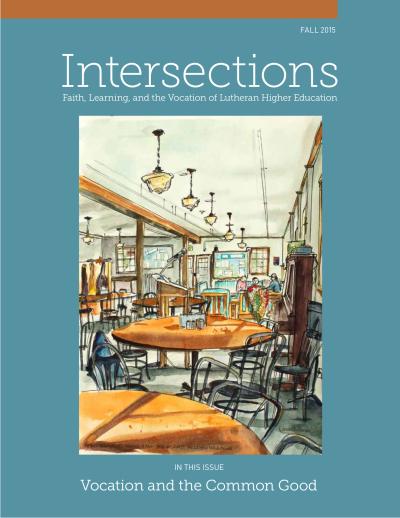 Article
Grinding for the Common Good and Getting Roasted
Rahuldeep Singh Gill
No. 42 · Fall 2015
Reading Starbucks’ ill-fated “Race Together” campaign as a parable for campus work on the common good, Gill argues that interfaith cooperation, vocational reflection, and the “re-storying” of our campuses require us to err boldly across lines of difference — not pretending that difference doesn’t matter, but inviting students to imagine and realize what the common good might mean to them.
-
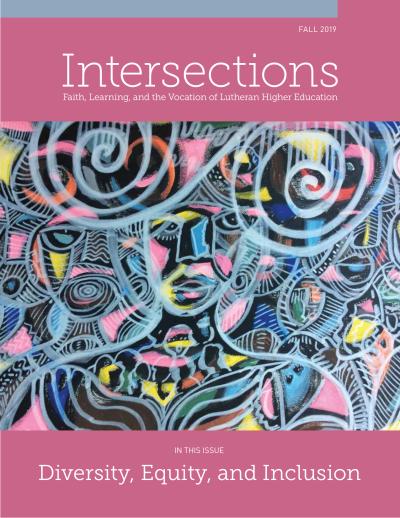 Reflection
Seeing in a New Way: A Meditation
Kara Baylor
No. 50 · Fall 2019
Baylor, the only Black campus pastor in the NECU, weaves Psalm 25, the parable of the Good Samaritan as re-read through Lenny Duncan, and the “crimson thread of divine justice” from Allen Dwight Callahan into a meditation that closes with the invitation she offered at the 2019 conference — to tie a crimson thread around the wrist as a symbol of collective commitment to moving beyond privilege toward inclusion and equity.
-
 Reflection
Currents
Jaime Schillinger
No. 25 · Spring 2007
Preached in St. Olaf chapel on March 29, 2005, Schillinger reads three “currents” pulling on her hearers—Minnesota spring, the academic year’s final stretch, and Holy Week’s passion and resurrection—against poetic voices from ee cummings, Gerard Manley Hopkins, and Edna St. Vincent Millay, before turning to the Song of Songs to suggest that this nexus calls students into the rhythms of love, awakened desire, and an elusive, unresolved promise that animates academic, spiritual, and vocational search alike.
-
 Response
“My Wife, We Have Not Come to the End of All Our Trials, but a Measureless Labor Yet”: The Lutheran Argument in Colleges
Steven Paulson
No. 2 · Winter 1997
Paulson of Concordia College responds to Bouman by invoking Penelope’s unreasonable patience for Odysseus and asking whether Bouman’s five “principles” deliver the “continuities of conflict” that MacIntyre’s account of a living tradition demands. He argues that the proper Lutheran “continuity of conflict” is the praxis of proclamation—Christ crucified as “a stumbling block to Jews and folly to Gentiles”—which is given outside the institution’s walls and which colleges and universities, as socially embodied arguments, “can’t like” because it places truth beyond their control. The Lutheran problem, he concludes, is not the Enlightenment or Post-Modernism but the “old Adam,” the Odysseus still unsure of his identity.
-
 Reflection
Tom Natalini
Tom Natalini
No. 40 · Fall 2014
Natalini, a Susquehanna University senior raised Lutheran, schooled Mennonite, and seasoned by a meditative encounter in India, reflects on his journey through churchgoing, philosophy, near-Jewish conversion, and Buddhist practice to a stance he calls patience — neither Christian, Jew, Buddhist, seeker, nor “none.”
-
 Article
One Life, Many Callings: Vocation Across the Lifespan
Katherine Turpin
No. 47 · Spring 2018
Turpin, drawing on the collaborative research behind Calling All Years Good, traces how vocational discernment shifts through adolescence, younger adulthood, middle adulthood, late adulthood, and older adulthood — arguing that focusing vocation on entry into the workforce limits the capacity of intergenerational college communities to wrestle with calling throughout life.