Vocation on Campus: Reading Mark Tranvik's Martin Luther and the Called Life at Pacific Lutheran University
Intersections No. 47 · Spring 2018
Most readers of Intersections need no introduction to Dr. Mark D. Tranvik, Professor of Religion at Augsburg University. Dr. Tranvik has long been associated with the topic of vocation in Lutheran higher education. He is both a senior fellow at Augsburg’s Christensen Center for Vocation, as well as a frequent contributor to conversations about Luther and Lutheranism. This review article examines Tranvik’s Martin Luther and the Called Life and reads the book against the backdrop of another Lutheran university’s reflection on vocation. The reviewers offer both a student and a faculty member’s perspective on vocation and its roots in the Lutheran tradition. We read Tranvik’s text in connection with a Fall 2017 course on Reformation History taught at Pacific Lutheran University (Tacoma, Washington), and then interviewed a selection of students and faculty about vocation at Pacific Lutheran University’s Wild Hope Center for Vocation. We found Called Life to be an excellent learning resource for faculty and students, with a compelling view of vocation that is well-suited to the evolving contexts of Lutheran higher education. The book also brought up some intriguing questions about best practices for introducing vocational reflection that we couldn’t definitively answer. We suspect that similar conversations are taking place at many ELCA-affiliated schools in North America.
Examining Martin Luther and the Called Life
Tranvik’s 174-page text introduces the Lutheran concept of vocation through the teaching and life experiences of Martin Luther (1483-1546), a German church reformer who held an assortment of roles in life including son, student, monk, professor, spouse, parent, and community leader. As the text explores these roles it serves as a short biography of Luther, highlighting the reformer’s major struggles and achievements. In Chapter 1, Tranvik begins by exploring early Christian concepts about being in the world, biblical passages related to vocation, and the Western monastic impulse that so strongly shaped religious life. As the medieval period ended, the people with the most conspicuous religious callings were the cloistered monks and nuns, who led lives “characterized by poverty, chastity, and obedience” (12). Through their vows and duties, they aimed to be closer to their Creator than ordinary members of society.
“Baptism not only anchors the Christian believer in Christ, but also offers a powerful model for understanding God’s gracious activity and daily call to love and service.”
In Chapter 2, Tranvik explores Luther’s life experience and theology, emphasizing the young monk’s search for meaning and his eventual decision to reject the monastery and explore new roles as a preacher, teacher, spouse, and citizen. As he progressed through these changes, Luther listened not to his own voice, but to a Word and call residing outside his experience—what Luther perceived to be a direct invitation from God. In Chapter 3, Tranvik summarizes Luther’s theology of baptism and the salutary role of this “forgotten sacrament.” Tranvik is at his best when discussing baptism, in part because he has analyzed the sacrament carefully in other writings. Tranvik emphasizes that baptism not only anchors the Christian believer in Christ, but also offers a powerful model for understanding God’s gracious activity and daily call to love and service (59). Baptism offers assurance in the face of life’s trials and temptations, and it draws the Christian believer outward, reconnecting the baptized to the present needs of the community, the neighbor, and the created world.
In Part II: The Called Life, Tranvik continues to use Luther as a model for vocational reflection, but he shifts to address more contemporary concerns. As he examines specific aspects of Luther’s world (his life, his relationships, his church, and his political setting), Tranvik argues that Luther continually found his grounding in Christ’s atoning sacrifice, and Christ’s summons for service and discipleship in the world. Tranvik rejects what he sees as the prevailing tendency among modern historians to “see Luther as the herald of modern individualism” (65). Such an understanding strips God’s influence from the believer, a divestment that seems preferable for many, but not theologians like Dietrich Bonhoeffer, who Tranvik understands as basing the Christian life on being “called to compassion and action… by the sufferings of their brothers and sisters, for whose sake Christ suffered” (119).
Tranvik continues the theme of social engagement in Chapter 6, encouraging readers to be active in the world and function politically when necessary. He is careful to recommend humility as Christians enter the public realm; however, just as “Luther was weary of identifying any political program as ‘Christian,’” so too must we ensure that we don’t use “the Bible to prescribe how people should live” (112, 123). In most respects, we ought to rely on human reason to order daily affairs.
Luther taught that Christians are justified by Christ through grace. As a result, they participate in Christ through an exchange of divine and human attributes. In response, Christians should not separate themselves from the world and strive for further holiness; rather, they should be flexible in the face of God’s call and meet Christ in the world, for God is found not among the comfortable, but among the suffering. Tranvik carefully explains the consequence of this theology: it expands the concept of vocation beyond our own notions of purpose and success, and in doing so it fights the temptation of equating vocation with occupation. On this point he writes: “Luther never conflated work with vocation. A person is always called, whether one has a job or not” (160). Our roles as spouses, children, parents, citizens, and peers are all held to one truth: “we are fallen creatures saved by grace and not our good works…we are commanded to love our neighbors, take care of creation, seek justice in society and keep a special eye out for the vulnerable, weak, and marginalized” (120).
“Christians should not separate themselves from the world and strive for further holiness; rather, they should be flexible in the face of God’s call and meet Christ in the world, for God is found not among the comfortable, but among the suffering.”
Vocation at Pacific Lutheran University
Mark Tranvik’s book makes a strong case for using Luther’s life and theology as a focal point for modern discussions about vocation, and he recovers the importance of community service for people who are active in Lutheran organizations. To examine the application of these ideas, the present authors ask: How has the language of vocation been used at Pacific Lutheran University, an ELCA-affiliated institution founded by Norwegian Lutheran pioneers and located in Parkland, a suburb of Tacoma?
Language addressing the Lutheran understanding of vocation was used in the founding documents of Pacific Lutheran Academy (later PLC and PLU) during the school’s establishment in 1890. The institution’s Lutheran identity was a regular topic of conversation in the following decades, and like many Lutheran-affiliated schools, the discussion reflected broader debates about higher education and religion in public life. In the 1970s and 1980s, two questions took center stage. First, was the institution essentially a “church” or a “college” (and what was the difference)? Second, what role should religion play in campus programming and in key documents like the mission statement? Something that seemed unique about PLU was its cultural setting in the Pacific Northwest, a region known for its conspicuous lack of organized religion. As PLU faculty member Patricia O’Connell Killen described in a volume entitled Religion and Public Life in the Pacific Northwest: The None Zone, the region is one of the least-churched areas of the country. This dynamic means that traditional Christian language is not well understood by our students, most of whom come to PLU from the surrounding area. To be a Lutheran university in this setting presents both opportunities and challenges. Among the difficulties is how to introduce theological language about topics such as vocation, justification by faith, and service to students who have little exposure to Lutheranism or organized religion. (Currently, Lutheran-identified students account for about 15 percent of PLU’s student body.)
In 2002, PLU applied for and received a Lilly Foundation grant to explore the topic of vocation and its relation to university life. Internally, the project became known as “Wild Hope,” and the grant strongly influenced conversations about what it means to be a “Lutheran” institution of higher education for students, faculty, and community members. The project’s core question for students emerged as: “What will you do with your one wild and precious life?” (The query is adapted from Mary Oliver’s poem, “The Summer Day”). Beneath this call to vocational reflection, the project added several follow-up questions, including “What are you called to be and to do?” and “How will you make a genuine contribution to the world?” A Center for Vocation was established on campus in the aftermath of the grant, and students now participate in off-campus retreats as well as on-campus events and programming that highlight vocational discernment.
“Guiding student and faculty reflection on vocation is not without its challenges.”
In the early 2000s, PLU revised its mission statement to further promote vocational reflection. The mission statement now reads, PLU seeks to educate students for lives of thoughtful inquiry, service, leadership and care—for other people, for their communities and for the Earth. The revision process had its detractors, including those who worried that removing specific references to “God,” “Jesus,” and other expressions of the Christian tradition might undermine the institution’s historic connection to Christianity and/or Lutheranism. However, after fifteen years of programming it seems that the effort to broaden the understanding of vocation while also accentuating its Lutheran elements has been successful. Guiding student and faculty reflection on vocation is not without its challenges, however. As one student wrote in 2006, “Wild Hope teaches students a language of asking these deep, heart-wrenching, mind-boggling questions. But beyond PLU’s borders, it’s usually a foreign language” (Nordquist 94).
Called to be a Student
According to PLU student Alex Lund, the challenge for Lutheran-affiliated universities today is to use language that resonates with all students. At PLU, undergraduates come from a variety of backgrounds, and the University is actively engaged in outreach to build a student body that is diverse in terms of age, financial background, ethnicity, and religious affiliation. To introduce students to the concept of vocation, newcomers are typically asked, “What will you do with your one wild and precious life?” This question, reinforced by PLU’s mission statement, often presents a challenge to new Lutes. We are asked to justify our goals and expectations about college—and our future life—relatively quickly. If you are among the many transfer students entering the university, the pace is even faster. However, although vocational reflection does not come easily for some, students are offered many examples of what service in the world means, and we frequently study challenging topics that relate to the wider world and its needs. To be honest, some students get a bit lost during this discernment, while others come through dramatically engaged. However, I have seen students find their calling and vocation at PLU—it happens all the time, and often through a process of reflection that Mark Tranvik describes in The Called Life.
“I have come to recognize that God’s ‘absence’ in public language is in itself a kind of welcome to the outsider.”
As a student with an ELCA background (one of the 15 percent), I am drawn to more Lutheran expressions of vocation than some, and I find it valuable to hear God-specific language in on-campus conversations. At first, I found it frustrating to see how this language was sometimes limited to certain times and places. For example, we rarely hear about “God” or “Jesus” in major speeches or events on campus. Likewise, it is rather unusual to hear readings from Jewish, Christian, or Muslim scriptures in public settings (though in classrooms, this is a regular occurrence when it relates to the subject at hand). However, I have come to recognize that God’s “absence” in public language is in itself a kind of welcome to the outsider. As a Christian, I believe that God is always present on our campus, whether God is specifically named or not. In addition, I am welcomed to attend chapel or our University Congregation, both of which are operated in inclusive ways.
I know that PLU has been called to be more than just an institution that educates Lutherans; PLU is called to educate individuals from diverse backgrounds, and to address inequality in our world. Numerous faith traditions operate on campus, and the place is richer for it.
A Faculty Perspective on Vocation
According to history faculty member Michael Halvorson, thinking about vocation is a little like thinking about what it means to be a Christian or a member of any religious tradition—you’ll probably get a different answer about what it is from whomever you ask. One of the important questions raised in this review is not whether vocational reflection is important, but how it is initially raised on campus, i.e. whether vocation should be discussed without direct reference to “God’s call” or other language that specifically connects to the Lutheran heritage. Should we use more inclusive speech to draw students into thinking about vocation? Even if that means we are changing or diluting our Lutheran approach?
In The Called Life, Tranvik suggests that many partners are necessary (and welcome) in discussions about vocation. However, he also cautions that leaders in Lutheran colleges run the risk of turning the conversation into “vocation lite” if they neglect the calling role that God plays in the invitation to service (9). Near the end of his book, Tranvik further emphasizes what he sees as the critical value of recognizing God’s presence in the world:
Our task is to equip people with the eyes to see God at work in their lives and in their world. God’s great Word of grace and freedom is meant for the world. And people need help to think about ways to resist a culture that would prefer religion to either go away or be a private matter. (168)
I recognize the power and significance of this statement. To implement this vision in a way that contemporary students will understand, however, I believe that it is best to use intentionally inclusive language and a historical perspective. A historical perspective allows students and faculty to see how vocational reflection has changed over time, and how a university like PLU continues to reflect on its core beliefs and values. One such belief is that God is continually at work in the world, a world that God loves and deems good. God’s love extends powerfully to human beings, and as an aspect of this love, God calls people to serve their neighbors and care for the earth. Following Luther and others, a Lutheran university may choose to describe this call as an invitation that powerfully shapes a person’s identity. It is a call to vocational reflection that deepens relationships with others and with the world, despite the world’s messiness and problems.
A hallmark of Lutheran education is that it draws students, faculty, and community members to a greater appreciation of life on this earth in all its diversity and complexity. In this dynamic world, some believe that God is truly present and active; others do not know or are not sure. Despite a variety of beliefs on the matter, students in a university are not called to escape the world of reflection and inquiry, but to engage with it using their distinctive aptitudes and skills. Mark Tranvik’s The Called Life invites us into this complex, messy world with its many roles, needs, and opportunities. The book offers important insights about Luther’s own life story, as well as how people in the contemporary world can engage church and society in meaningful ways.
Works Cited
Killen, Patricia O’Connell and Mark Silk, eds., Religion and Public Life in the Pacific Northwest: The None Zone. Walnut Creek, CA: AltaMira, 2004.
Nordquist, Philip A. Inquiry, Service, Leadership, and Care: Pacific Lutheran University 1988-2008. Tacoma, WA: PLU, 2008.
Tranvik, Mark D. Martin Luther and the Called Life. Minneapolis: Fortress, 2016.
-
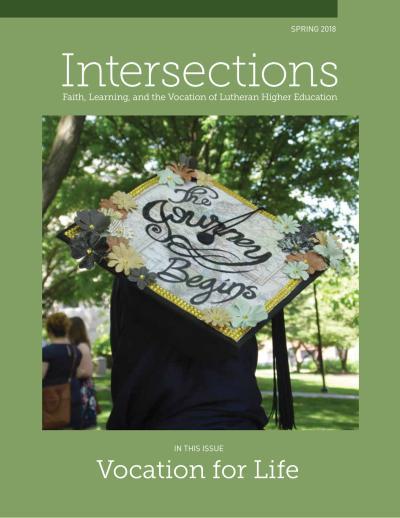 Editorial
From the Publisher
Mark Wilhelm
Wilhelm celebrates that NECU schools continue to educate for vocation but warns that the culture of Lutheran higher education is at risk — sustained largely by informal cadres of individuals — and introduces NECU’s Rooted and Open statement as a first institutional step toward reclaiming the 500-year-old Lutheran intellectual and educational tradition.
-
Editorial
Guest Editorial
Lynn Hunnicutt
Hunnicutt traces the etymology of vocation through its cognates — evoke, provoke, convocation — to argue that vocation presumes a relationship between caller and called, that callings are often grounded in ordinary words and humble lives, and that recognizing vocation as plural and lifelong relieves colleges of the pressure to help students find a single calling while on campus.
-
Article
One Life, Many Callings: Vocation Across the Lifespan
Katherine Turpin
Turpin, drawing on the collaborative research behind Calling All Years Good, traces how vocational discernment shifts through adolescence, younger adulthood, middle adulthood, late adulthood, and older adulthood — arguing that focusing vocation on entry into the workforce limits the capacity of intergenerational college communities to wrestle with calling throughout life.
-
Article
Vocation for Emerging Adulthood: Within and Beyond College
Adam Copeland
Copeland uses scenes from Master of None, David Brooks’ columns, Meg Jay’s The Defining Decade, and the stories of two ELCA college graduates to argue that emerging adulthood has fundamentally changed — and that Lutheran colleges should call out cultural lies about work, reframe vocation as meaning-making, and help graduates take small, wise steps into their twenties.
-
Article
Called to Compassion over the Course of a Life: A Buddhist Perspective
Florence D. Amamoto
Amamoto, an associate professor at Gustavus Adolphus shaped by Jodo Shin Shu Buddhism, argues that although Buddhism has no “caller” God, it has a strong sense of calling — we are called by the world to respond to the suffering around us with mindfulness, egolessness, and compassion — and that this lifelong journey is enriched by encounter with the Lutheran vocational tradition.
-
Article
Vocation and Dharma throughout Life's Stages: A Hindu Perspective
Vidya Thirumurthy
Thirumurthy traces her own attempt as a Hindu faculty member at Pacific Lutheran University to grasp the Lutheran concept of vocation, finding in the Bhagavad Gita’s teaching on dharma — duty fulfilled without expectation of reward — an equivalent that, like vocation, varies across the four stages of life and calls individuals to transform others through selfless service.
-
Article
Luther, the Catechisms, and Intellectual Disability
Courtney Wilder
Wilder confronts Luther’s deeply troubling response to a child with disabilities at Dessau, then mines his Small and Large Catechisms for a Lutheran theology of inclusion — reading the Third Article of the Creed, the petitions of the Lord’s Prayer, and the sacrament of baptism as resources that affirm the full humanity of people with intellectual disabilities as faithful children of God.
-
Article
Lutheran Higher Education in the Land of Anxiety
Jon Micheels Leiseth
Leiseth, returning to Concordia from work with the ELCA’s Young Adults in Global Mission in Southern Africa, draws on Bessel van der Kolk and Babette Rothschild to argue that pervasive student anxiety functions as low-grade trauma that hijacks the storytelling at the heart of vocational discernment — and explores embodied, breath-based practices that might help students reclaim their stories.
-
 Editorial
From the Publisher
Mark Wilhelm
No. 39 · Spring 2014
Wilhelm interrogates the widely used phrase “the model is broken,” arguing that it blames the victim, masks the demographic and public-funding pressures actually facing ELCA higher education, and distracts from the work of modifying—rather than discarding—a model of educating the whole person that has successfully adjusted across the centuries.
-
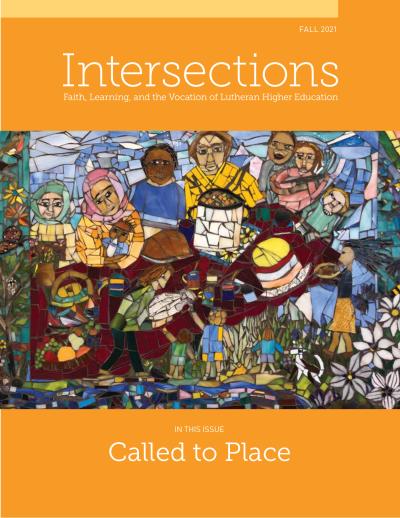 Reflection
Caught in a Place Between Caesar and God
Darrel D. Colson
No. 54 · Fall 2021
Colson reflects on his anguish, as Wartburg’s president, over an Iowa law that prevents him from requiring student COVID-19 vaccinations — reading Luther’s “Whether One May Flee From a Deadly Plague” alongside the conflict between obeying the law and serving neighbor.
-
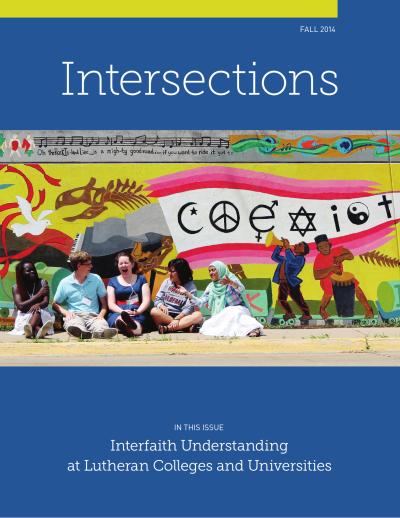 Article
What's in a Name?
Matthew J. Marohl
No. 40 · Fall 2014
St. Olaf College Pastor Matt Marohl tells the story of designing The Undercroft’s prayer and meditation room with a campus meditation group whose members began as “Matt” and ended — as their mutual respect grew — calling him “Pastor Matt,” a counterintuitive movement toward a more formal address that signals what intentional Lutheran-Christian hospitality looks like in practice.
-
 Article
Practicing Hope: The Charisms of Lutheran Higher Education
Martha E. Stortz
No. 32 · Spring 2010
Stortz names four charisms—theological gifts of identity rather than commodities—that Lutheran higher education brings to a culture of fear: semper reformanda as flexible, responsive institutions; the freedom of a Christian as simul justus et peccator critical inquiry that holds opposites in creative tension; regard for the other as “neighbor” rather than friend or alien; and the priesthood of all believers as a public, civic calling to know the poor. Drawing on Augustine, George Lindbeck, Patricia Killen, James Clifford, Earl Shorris, Carter Lindberg, and Augsburg’s Center for Global Education, she argues that immersion trips, neighbor-regard, and welfare reform witness that the gift Lutherans bring is hope grounded in Christ in you, the hope of glory.
-
 Editorial
From the Editor
Robert D. Haak
No. 25 · Spring 2007
Haak frames the issue around the question of what holds the twenty-eight ELCA colleges together amid their geographic, economic, and theological diversity, introducing Mark Hanson’s address to the assembled college presidents, Randall Balmer’s outsider perspective on the commonalities of Christian liberal arts, José Marichal and Pamela Brubaker on diversity rooted in community and globe, Storm Bailey’s argument that being Lutheran is precisely what makes us embrace diversity, and Jaime Schillinger’s St. Olaf chapel reflection on the formative power of worship and liturgy.
-
 Article
The Ought
Ned Wisnefske
No. 19 · Summer 2004
Wisnefske observes that students and faculty raise contradictory objections to moral education—that students are already morally formed, and that teachers must not form them—and argues that both share the same fear of “the Ought.” He proposes that the Ought is best encountered not in front of us but behind us, nudging us, as we exercise impartiality, sympathy, and free will and discover that the persons participating in moral inquiry deserve respect; the Ought can then reform our past formations and transform our wants, so that it is never too late, or a mistake, to be shaped by it.