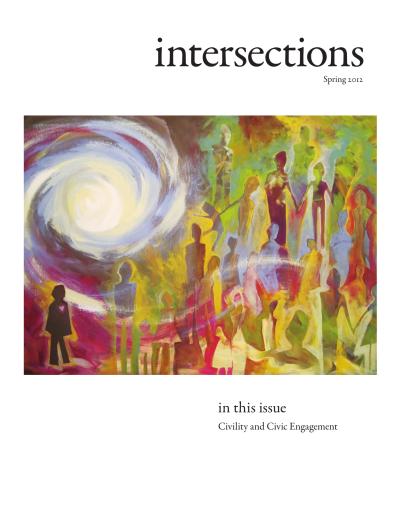
The authors first presented these essays as part of the 2011 Vocation of a Lutheran College Conference at Augsburg College. The annual vocation conference provides one of the four legs that sustain our conversation about the mission and identity of ELCA colleges and universities (see Mark Wilhelm’s comments above). All who have attended know just how thought-provoking the sessions can be, and just how illuminating and even prayerful our common conversations are. The conference and Intersections want to provide the kind of public arena where civil dialogue can happen. But Mark is right, too, to suggest that rich deliberation about our identity for the public good has to extend beyond the pages of a journal or the borders of a campus.
The first two essays here suggest why deliberations within our campuses must turn outward, and why this is so hard to come by. Samuel Torvend vividly describes how a long stretch of the Christian tradition demoted the importance of our public, bodily life to the salvation of individual “souls.” Luther turned this gnostic prejudice inside-out by recognizing God as deeply engaged in the civic realm—what Christians call the Incarnation. And yet Lutherans continue to miss the radicalness of a public Christ and the public reforms thereby engendered when they continue to privatize and spiritualize what “being saved” entails. Torvend insists that we must better follow Luther in linking the gospel with public engagement, especially among the hungry poor.
Per Anderson’s essay turns toward the pressing needs of the church for civil deliberation and to the ways liberal education can help. In light of difficult discussions about the reach of its social statements, the ELCA’s own civic engagement (or at least its understanding thereof) seems to be in holding pattern these days. Anderson notes how our colleges and universities are being called upon to help by forming citizens—not to mention churchgoers—with capacities for deliberation. Doing so would redirect our effort away from what we learn to how we talk with one another, although Anderson also notes that new moral quandaries also call us to ever-expanding bodies of knowledge.
Of course, our students see civil engagement modeled very infrequently. More and more American “consumers” (who used to be “citizens”) get their news from private, partisan sources (e.g. from internet feeds, suggested according to search “preferences”). Those who do look for multiple perspectives usually find them only in the form of televised talking heads talking past one another. Given this culture, small pedagogical acts can seem counter-cultural if not entirely subversive. For example, I sometimes make my students preface their own classroom comments by referencing a prior one (“I want to add to what Lisa said…”) so that we learn how to listen and talk with one another rather than develop and defend our “own positions”. Such strategies, of course, only start to cultivate the kind of community of moral deliberation that the church and world so desperately need.
The next two shorter essays were presented together at the vocation conference and here retain their oral style. Ann Svennungsen continues to discern why civility and civic engagement are so needful and absent in our dominant culture. She suggests that the civic realm itself is disappearing as citizens retreat to gated communities and niche markets. We thus must invest in the infrastructure for civic renewal. Some might assume that private colleges and universities would be the wrong place to look for such renewal, but—as Katherine Tunheim reminds us—much depends on whether we understand higher education as training for prosperity or for service. Our students’ most valuable lessons might very well happen while filling sand bags or studying the demographics of local teens.
Paul Pribbenow draws together a number of these themes in recounting the story of Augsburg College. The outward mission of Augsburg—like all of our Lutheran schools in different ways—was founded on the hospitality of the Incarnation, on the fact that the Word became flesh, on God’s own civic engagement. But, as Pribbenow reminds us, the world also did and does reject that Word, and so we need to go-out and pursue justice, and not only welcome-in outsiders. Doing so should lead us to recognize the education and liberation that happens “off the main road,” whether that be the side streets of the city or the community garden of a small town.
These essays are critical, discerning, and hopeful. May they begin conversations that are civil and engaging—both within our institutions and the communities they serve.
-
 Editorial
From the Publisher
Mark Wilhelm
Wilhelm describes the “four-legged stool” supporting ELCA higher education—the annual Vocation of a Lutheran College Conference, the Lutheran Academy of Scholars, the Thrivent Fellows program, and Intersections—and argues that the conversation about Lutheran mission and identity must now be extended beyond college and university personnel to the larger church and community before the gains of a generation are lost.
-
Article
Critical Engagement in Public Life: Listening to Luther's Troubling Questions
Samuel Torvend
Torvend narrates the medieval “spiritual/temporal” division and the neo-platonic devaluation of the body that shaped the world into which Luther was born, then traces the disruptive questions Paul’s letters provoked in Luther: about indulgences, the two estates, vocation, and the public reach of baptism. He argues that Luther’s reform — expressed in Kirchenordnungen, social welfare reform, public schools, and writings on lobbyists, usury, and monopolies — carries a “genetic encoding” of public engagement that Lutheran colleges should reclaim against the temptations of holy apathy and Christian nationalism.
-
Article
Cultivating Transformative Responsible Dialogue: Community of Moral Deliberation and Lutheran Higher Education
Per Anderson
Anderson proposes that ELCA colleges and universities embrace a project of “transformative responsible dialogue” that advances the ELCA’s commitment to be a “community of moral deliberation” and answers the LIFT Report’s call for a culture of faithful discernment. Drawing on Michael Meyer’s “liberal civility,” Martha Nussbaum, Hans Jonas’s responsibility ethic, Patrick Keifert’s ecclesiology of strangers, and Kathryn Tanner on culture, he argues that liberal education at our schools can form students whose dialogue knits together civility, responsibility, and Christian openness to the other.
-
Article
Why Lutheran Colleges Need to Engage Civil Society
Ann M. Svennungsen
Svennungsen makes the case that Lutheran colleges must engage the larger civil sphere, drawing on her work with The Presidents’ Pledge Against Global Poverty, Darrell Jodock’s seven fundamental experiences for vocational discernment, David Brooks on civility and modesty, and Michael Sandel’s argument that the affluent are seceding from public life. She urges Lutheran educators to invest in the infrastructure of civic renewal so that service-learning and civic engagement remain central to the Lutheran college curriculum.
-
Article
Practical Approaches for Lutheran Colleges to Engage Civil Society
Katherine A. Tunheim
Tunheim distinguishes a college’s mission from its vocation—a calling from the community—and offers four examples of Lutheran colleges “dancing with their neighbors”: Augsburg’s engagement with the Cedar Riverside Neighborhood, her Gustavus students’ work with the St. Peter Soccer Club, St. Olaf football players in the All-Star After-School Program in Northfield, and Concordia students filling sandbags during the 2009 Red River flood. She presses Lutheran educators to ask the troubling questions that prepare students to lead with ethics rather than merely with money.
-
Article
Hospitality is Not Enough: Claims of Justice in the Work of Colleges and Universities
Paul C. Pribbenow
Pribbenow argues that Augsburg’s incarnational motto — “And the Word became flesh” — grounds a calling beyond hospitality to justice. Drawing on Stephen Carter on civility, Letty Russell on just hospitality, Henri Nouwen, Parker Palmer, Michael Sandel, Bonhoeffer, Niebuhr, and Teresa of Avila, he describes four components of Augsburg’s practice: education “off the main road,” co-created common life, abundance over entitlement, and the anchor-institution model in which colleges become economic and civic partners with their neighborhoods.
-
 Article
Vocation at Full Stretch: Reflections on Follow Your Bliss and Other Lies about Calling and its Use among College Students
Jason A. Mahn
No. 61 · Spring 2025
43 min audio
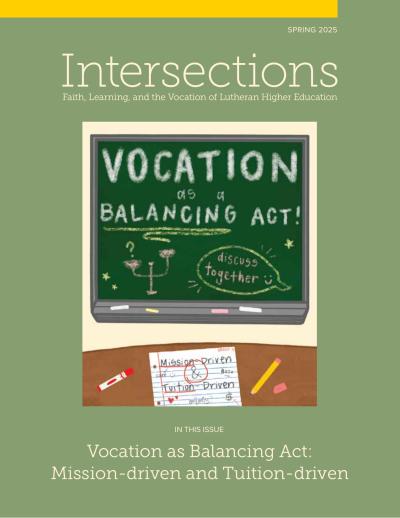
Mahn engages Bonnie Miller-McLemore’s Follow Your Bliss and Other Lies about Calling as required reading in a sophomore religion course, showing how her categories of missed, blocked, conflicted, fractured, unexpected, and relinquished callings empower young adults to perceive embodied, unplanned, and often painful dimensions of life as essential parts of vocation — and help close the gap between mission-driven and tuition-driven realities.
-
 Article
On Recruiting Diverse Students, Rooted in Mission
Eric Rowell, Jason A. Mahn
No. 59 · Spring 2024
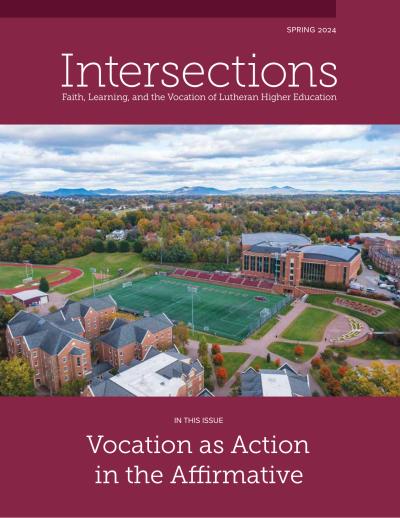
Jason Mahn interviews Eric Rowell, Assistant Director of Admissions and Diversity Outreach at Augustana College, about how recruiting students from a wide variety of backgrounds — rooted in Augustana’s Lutheran commitment to vocation and educating across difference — remains essentially unchanged in the wake of the Supreme Court’s 2023 decisions on affirmative action.
-
 Editorial
From the Outgoing Editor
Jason A. Mahn
No. 55 · Spring 2022
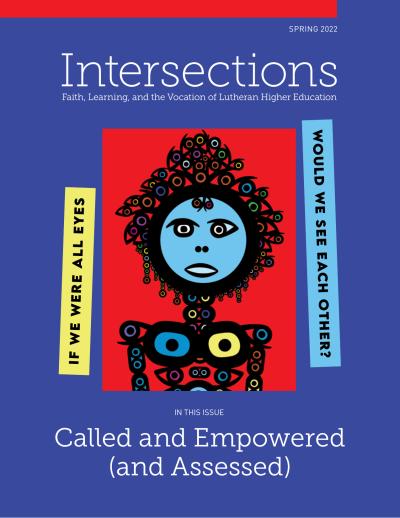
Mahn closes out a decade of editing Intersections, passes the duties to Colleen Windham-Hughes, gives thanks to Mark Wilhelm and Augustana College, and introduces an issue largely drawn from comments by Lutheran faculty, staff, and administrators at the 2022 NetVUE national gathering.
-
 Editorial
From the Editor
Jason A. Mahn
No. 54 · Fall 2021
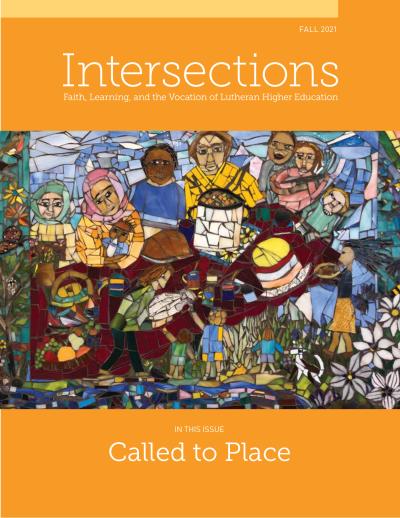
Mahn introduces the “Called to Place” theme of the 2021 VLHE Conference, arguing that Lutheran higher education’s emphasis on vocation must be grounded in particular geographies and embodied communities — for, as Wallace Stegner put it, “If you don’t know where you are, you don’t know who you are.”
-
 Reflection
Shelter in Place: Reflections from March 22, 2020
Jason A. Mahn
No. 53 · Spring 2021
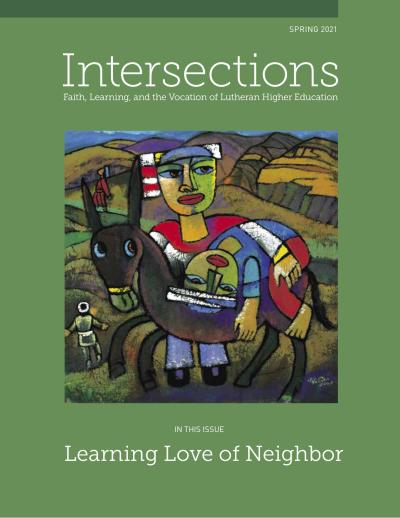
On the fourth Sunday of Lent in 2020, Mahn meditates on the etymology of “shelter” (from shield) and on an email from a former student in Boston whose mutual-aid organizing models a Lutheran understanding of vocation: the upending of ego by divine love that frees us, finally, to see and serve the neighbor.
-
 Editorial
From the Editor
Jason A. Mahn
No. 52 · Fall 2020
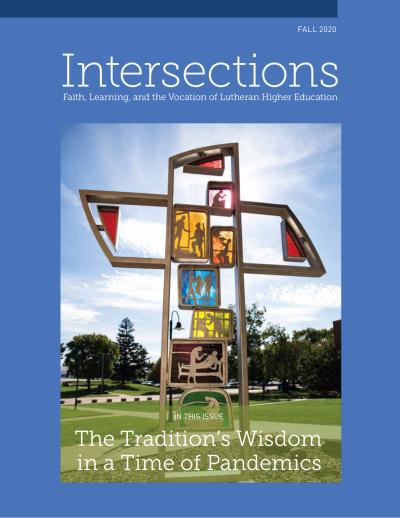
Mahn narrates a year of crisscrossing pandemics — Covid-19, economic collapse, partisan politics, and the long pandemic of white supremacy revealed anew by the murder of George Floyd — and argues that Lutheran liberal arts schools, by educating for vocation, are uniquely poised to help students respond with character and capable callings.
-
 Article
Seeking the Common Good: Lutheran Contributions to Global Citizenship
Wanda Deifelt
No. 29 · Spring 2009
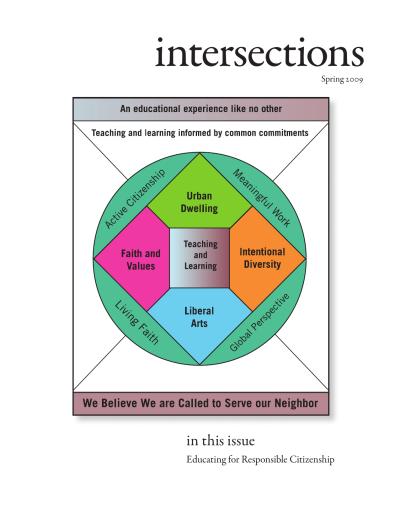
Deifelt draws on Luther’s account of neighborly love in “The Freedom of a Christian” and on his Two Kingdoms theology to argue that a Lutheran ethics of care fosters a sense of responsibility, accountability, and compassion that broadens citizenship beyond rights and virtues. Engaging William Galston’s typology of civic virtues, Sylvia Walby on women’s citizenship, Serene Jones on communitarianism, and Manuel Castells on globalization, she proposes that Lutheran theology equips the church to educate for transformative participation in world affairs.
-
 Article
Why All This Talk About Understanding the Mission of NECU Member Institutions as a Vocation?
Mark Wilhelm
No. 56 · Fall 2022
In his valedictory keynote, retiring NECU Executive Director Mark Wilhelm argues that Lutheran higher education is, properly understood, vocation-based education — outlining four core practices recovered over the past fifty years and naming the constructive and corrective work still to be done, including a fuller embrace of DEIJ and of the diverse vocations of NECU’s 27 institutions.
-
 Article
Women Presidents in Higher Education: How They Experience Their Calling
Aimee Goldschmidt, Gary McLean, Katherine A. Tunheim
No. 42 · Fall 2015
Drawing on in-depth interviews with fifteen women college presidents and a transformative-learning-theory framework, Tunheim, McLean, and Goldschmidt trace a three-stage journey — identifying, interpreting, and pursuing the call — and ask what the language of vocation contributes to the preparation and mentoring of women leaders in higher education.
-
 Editorial
Guest Editorial
Lynn Hunnicutt
No. 47 · Spring 2018
Hunnicutt traces the etymology of vocation through its cognates — evoke, provoke, convocation — to argue that vocation presumes a relationship between caller and called, that callings are often grounded in ordinary words and humble lives, and that recognizing vocation as plural and lifelong relieves colleges of the pressure to help students find a single calling while on campus.
-
 Article
Between Suspicion and Trust
Ahmed Afzaal
No. 30 · Fall 2009
Afzaal argues that scholars and educators have a unique vocation to shift Christian-Muslim relations from suspicion to trust, drawing on the 2007 Muslim open letter “A Common Word,” Robert Shedinger’s Was Jesus a Muslim?, and Muhammad Iqbal’s Reconstruction of Religious Thought in Islam to argue that Christianity and Islam converge in the insight that religion is a spiritual force for social justice and human liberation — an insight obscured by the modern Western discourse of sui generis religion.
-
Reflection
Why All This Talk About Vocation?
Madyson Ray
No. 56 · Fall 2022
Ray, a junior at Midland University and the only student attendee at the 2022 conference, reflects on four workshops — on teaching womanist thought, on supporting student-athletes, on resistance to the word “vocation,” and on vocational reflection — and brings home concrete ideas including a women’s-history scavenger hunt and semester-long vocational reflections.