The Impropriety of Jesus' Teaching: The Woman at the Well and The Vagina Monologues
Intersections No. 16 · Winter 2003
I dedicate my message to the women and men who worked against nearly insurmountable administrative resistance to put on the performance of Eve Ensler’s Vagina Monologues March 8th, and to those 800 students, faculty, and members of the community who came to the performance, half of whom had to be turned away, and to one young man, perhaps a student here, who in the discussion that followed the performance asked a probing question. He asked what resources in Christianity might be brought to the struggle to end violence against women and the silencing of their sexuality. Perhaps the story of the Samaritan woman at Jacob’s well gives us reason for hope.
Would that I had the courage of Socrates, the cunning of Odysseus and even the wrath of Achilles this morning as I address my friends and colleagues in defense of values central to our work as scholars, mentors, citizens, and Christians, the pursuit of truth and the protection and support of those whose voices would be silenced, whose suffering would be ignored and whose justice would be denied.
Perhaps my fondest wish today is for the “indecency” of Jesus of Nazareth whose impropriety was necessary to his ministry. Often it seems he took special care to offend against proper conduct. This was evident when he journeyed through Samaria, stopped at Jacob’s well and asked that shameful Samaritan woman to give him a drink. She was no stranger to impropriety. It was the only way she could survive. She suspected Jesus was a prophet because he knew her life story, her sexual history and her pain. She believed him when he said he was the source of living water and drank her fill. That is why she left her water jug behind when she went to the city to tell the people, “Come, see a man who told me all that I ever did. Can this be Christ?” (JN 4:29). “Many Samaritans from that city believed in him because of the woman’s testimony… And many more believed because of his word” (JN 4:39, 41).
For the woman at the well, the mark of Christ was the invitation to be known and the power to speak. She who had been shunned, ignored, and silenced; she who was unwelcome at the well during civilized hours; she who was no stranger to impropriety, was chosen to speak. Moreover, when she speaks, she tells everyone that he knows all about her. The people in the city who shun her and force her to the well in the heat of the day because they know the kind of woman she is, somehow listen to her now. This is miraculous. And still more amazing, they believe in Jesus on account of what she says and follow her back to the well. They go to see a Jew, Jesus. Being only half-Jews themselves and a people shunned by Jews, they must expect him to treat them as they treated the woman until now. They want to see how their own stories might be known and their lives recognized by Jesus. Jesus gave them the living water to drink and accepted their invitation to stay in Samaria for two days. Jesus’ solidarity with them, despite how Jews were supposed to treat Samaritans, was the sign to them that he was the Christ. The bonds of sexism and racism had held the woman at the well and the Samaritans in silence. Jesus undermined both forms of oppression in his visit to Samaria. His scandalous recognition of the woman and the people of her city showed his love for them and brought liberation.
Recently I heard several stories that reminded me of the woman at the well. One was a story of a Bosnian woman who had been raped with a rifle by a group of enemy soldiers. She was frightened that they would fire the rifle inside her. She was humiliated, brutalized, and shocked. After the assault, she was shunned by her community and forced to wall up her shame inside herself. Years later a woman named Eve Ensler asked to tell her story. I like to imagine that the woman raped in Bosnia felt relief and empowerment when Eve asked her to tell her story. I pray that like the woman at the well, she was liberated from her shame when she was invited to share her experiences. By retelling the stories of woman and girls of all ages, nationalities, races, and religions, who are silenced by custom, war, assault, the church, synagogue, and mosque, by their husbands, bosses, religious leaders, and others, Eve intends to bring healing and a confident voice to those who attend a performance of her play, the Vagina Monologues.
Eve Ensler allows her play to be performed on college campuses for free for one month each year. She is committed to ending violence against women by the year 2005 and needs the help of college students and others to get the word out. What a wonderful way for her to ask academic institutions to examine their commitment to the liberating power of liberal education. Sometimes, the academy whose stated goal is the free pursuit of truth, in its institutional structures and policies and in its struggle to maintain its place of privilege often times neglects this goal, for fear of offending against propriety and for fear of offending donors, parents, church officials, or perhaps even for fear of discomfiting itself. Eve and those who perform the Vagina Monologues wish to liberate women and their sexuality from the subtle and silent bonds that seal off women deep within themselves.
It is our mission as a college of the Church to defend and preserve academic freedom. Let us remind ourselves that it is also the mission of Christ to break the chains of oppression by means of inflicting discomfort on a person’s of power or privilege who despite a generalized friendly feeling in their hearts toward women, people of color, and gays and lesbians, remain complicit in that oppression by their taking up a position proper and pure by customary standards.
May God give us the courage to speak about sexuality, about our bodies, about sexual violence and rape. May God give a troubled conscience, a compassionate heart, and inspired deliberation to those who have the power to grant or deny requests for space and resources to perform the Vagina Monologues or bring The Laramie Project to campus. When we are in the presence of those who silence others by subtle and overt means, may God give us the wit, presence of mind, and the courage of to speak out and act out against them. When others have the courage to speak out, let us not leave them alone. Let us stand with them even at the risk of our social status, our popularity, our careers, our physical safety. Let us love one another as Jesus loved us - as he loved the woman at the well.
-
 Editorial
From the Publisher
Arne Selbyg
Selbyg reports that “vocation” is surely among the top three words in Intersections’s history and congratulates nine ELCA institutions—Augsburg, Augustana (Rock Island), Concordia (Moorhead), Gustavus Adolphus, Luther, Pacific Lutheran, St. Olaf, Valparaiso, and Wartburg—on receiving roughly two-million-dollar Lilly Endowment grants for the “Programs for the Theological Exploration of Vocation,” while reminding readers that for Lutherans the priesthood of all believers means callings to be accountants, nurses, police officers, and home makers count as fully as callings into ministry.
-
Editorial
From the Editor
Tom Christenson
Christenson previews this issue’s papers from the Vocation of a Lutheran College Conference—Curt Thompson on “the Lutheran knot,” Carol Gilbertson on the creative dimensions of language, Bruce Heggen on theological vocabulary in the state university, Susan Poppe on the boundaries of campus freedom, and Sig Royspern’s oracular gems—welcomes Robert Benne’s response to the previous issue as a sign that Intersections is becoming a locus of continuing conversation, and confesses his reluctant consent to appear on the cover.
-
Article
Do You Teach in a Different Manner at a Lutheran College? Unraveling the Lutheran Knot and Highlighting the Glory in the Theology of the Cross
Curtis L. Thompson
Thompson argues that being Lutheran means having a “knot in the stomach”—a dialectical “Yes and No” tension between law and gospel, two kingdoms, Word and world—and that this knot is held together by Luther’s theology of the cross supplemented by an under-appreciated theology of glory in which God shines through human beings and creation. He then traces how the Lutheran knot shapes his teaching at Thiel College in the Religion department, the first-year team-taught “History of Western Humanities,” the second-year “Science and Our Global Heritage,” and his work as Co-Director of Thiel’s Global Institute, concluding that only such “dialectical doublespeak” leaves him with the “at-once dreaded and delightful dis-ease of the Lutheran knot.”
-
Article
Honoring the Word: Lutherans and Creative Writing
Carol Gilbertson
Gilbertson argues that “honoring the Word” in Lutheran colleges means cherishing the sacred power of human language as God’s gift across three sites—the chapel talk, the classroom of wonder, and the poem—and illustrates her argument by reading aloud her own poems: “The Refiner’s Fire and Leaping Calves,” “Late June,” “Early June,” “Sweet July,” “Good Friday,” “Pondering These Things,” “The Limbs of Words,” and “Night Rising,” drawing on Darrell Jodock, John Updike, Martha Nussbaum, George Steiner, and T. S. Eliot’s “The Dry Salvages” to claim writing as a Christian vocation that “incarnate[s] the unseen sacred.”
-
Article
Writing Toward the Night Complete: Teaching and Working at the Public, Secular Institution
Bruce Allen Heggen
Heggen, Lutheran Campus Ministry pastor and adjunct English professor at the University of Delaware, builds on a freshman’s essay closing line—“All in all our night was complete”—to argue that even in the secular public university one can “teach hope” as a critical principle by drawing on Douglas John Hall’s Heideggerian distinction between calculative and meditative thought, the Frankfurt School’s instrumental versus substantialist reason, Luther’s theology of the cross, Parker Palmer’s “obedience to truth,” bell hooks, Lionel Basney, Shelley Shaver, and Donald Sheehan’s Frost Place “principle of compassion.” The classroom and Lutheran campus ministry together can become “communities of memory and hope” that, like the artist student’s Fourth of July, hold together danger, people getting together, explosions, and lots of fun.
-
Poem
A Rainfall of Questions Collected in the Form of a Poem
Sig Royspern
Royspern offers fourteen oracular questions on aging, addiction to possessions, water striders, magnolias, slippery fish, moths and the moon, priests and leaf-rakers, weeds and flowers, the price of education, abandoned groceries, spiritual pilgrimage, melons and oats, similes, and the impossibility of finding a store that sells a spring wind.
-
Response
Response to Bishop Olson and President Tipson
Robert Benne
Benne responds to two articles in the Winter 2002 Intersections: former Bishop Stanley Olson’s “The Marks of an ELCA College,” whose narrow reading of the two kingdoms cedes all epistemological claims to secular knowledge, and President Tipson’s engagement with The Future of Religious Colleges, whose “rather unchastened Enlightenment spirit” underestimates how loaded the social sciences and humanities are with their own philosophical and religious assumptions. Drawing on Reinhold Niebuhr, John Milbank, and William Buckley, Benne defends a “critical mass” of pervasively Lutheran colleges and calls on bishops and pastors to take the schools seriously lest they drift from their religious heritage.
-
 Reflection
Shelter in Place: Reflections from March 22, 2020
Jason A. Mahn
No. 53 · Spring 2021
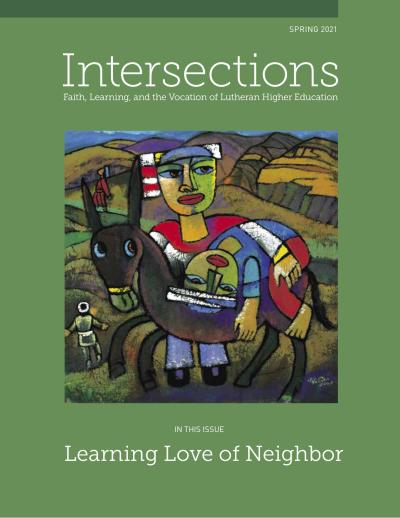
On the fourth Sunday of Lent in 2020, Mahn meditates on the etymology of “shelter” (from shield) and on an email from a former student in Boston whose mutual-aid organizing models a Lutheran understanding of vocation: the upending of ego by divine love that frees us, finally, to see and serve the neighbor.
-
 Article
"Faithful Nones" and the Importance of a Rooted and Open Pedagogy
John Eggen
No. 49 · Spring 2019
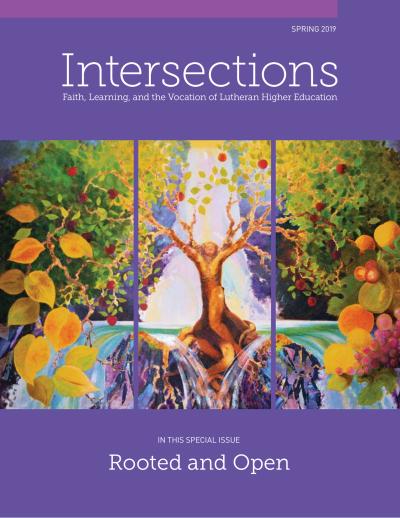
Drawing on a student survey from his D.Min. thesis at Midland University, Eggen identifies a distinctive subset of religious “nones” — the “faithful nones” — who reject institutional religion yet retain substantive beliefs and practices, and argues that the non-binary, third-path pedagogy commended by Rooted and Open is uniquely positioned to engage a generation that has disambiguated faith, religion, and spirituality.
-
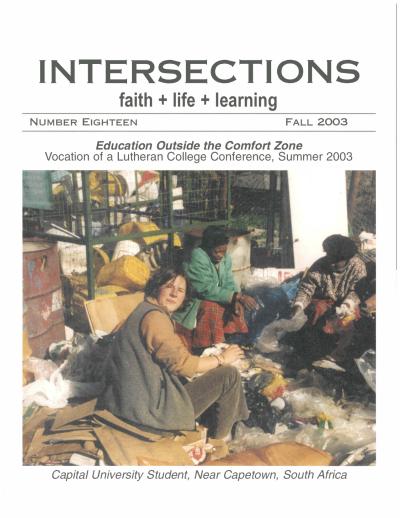 Article
The Search for a Just Peace in a Globalized World
Munib A. Younan
No. 18 · Fall 2003
Younan, Lutheran Bishop in Jerusalem, grounds Palestinian Christian identity in Incarnation theology and a Lutheran theology of grace and the cross, then surveys the Evangelical movement’s nineteenth-century legacy in the Middle East—the 1864 Arabic Bible, ELCJ schools, women’s ordination, and the Middle East Council of Churches. Engaging Edward Said’s critique of Samuel Huntington, he calls for international and local mutual-recognition agreements (including the Jerusalem Lutheran-Anglican agreement and a Lutheran-Reformed agreement in the Middle East), four marks of interfaith dialogue, and a sharp distinction between Lutheran “Evangelical” identity and the Dispensationalist evangelistic Right whose Israel-Palestine scenarios he names a heresy. He closes by proposing concrete scholarship, faculty exchange, and sabbatical partnerships between U.S. Lutheran colleges and the ELCJ’s churches, schools, and Dar al-Kalima Lutheran Academy.
-
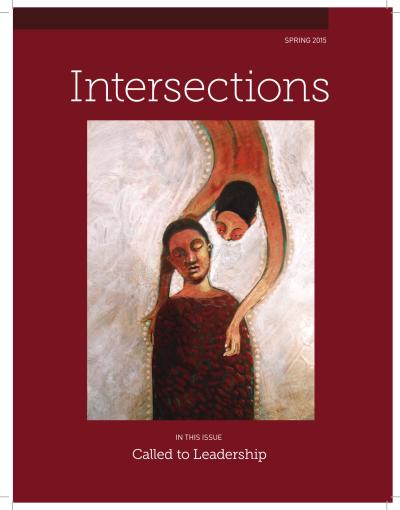 Article
Leading from Within: Peer-Learning Consultations to Explore Our Callings and Campus Capacities for Leadership
Chris Johnson
No. 41 · Spring 2015
Johnson reframes vocational leadership as “soul work” that calls for the deep mind as much as the conscious one, and offers two practices — deep listening and a modified Quaker clearness consultation — as ways for campus colleagues to listen one another into existence. Drawing on Sharon Daloz Parks, Marshall Ganz, Parker Palmer, and Mary Rose O’Reilley, he invites readers to map their stories of self, us, and now.
-
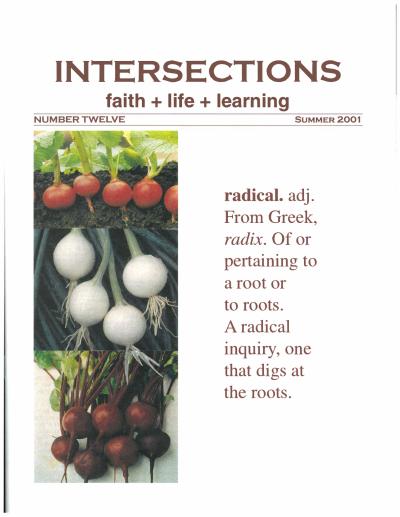 Editorial
From the Editor
Tom Christenson
No. 12 · Summer 2001
Christenson introduces three pieces from the summer 2000 Vocation of a Lutheran College Conference at Dana College—noting that Leonard Schulze was asked to keynote before becoming executive director of DHES—and recommends Peter C. Hodgson’s God’s Wisdom: Toward a Theology of Education and Douglas Sloan’s Faith and Knowledge: Mainline Protestantism and American Higher Education for their accounts of how faith and knowledge have been dissociated in modern higher education and what it might take to recover their connection.
-
 Reflection
Currents
Jaime Schillinger
No. 25 · Spring 2007
Preached in St. Olaf chapel on March 29, 2005, Schillinger reads three “currents” pulling on her hearers—Minnesota spring, the academic year’s final stretch, and Holy Week’s passion and resurrection—against poetic voices from ee cummings, Gerard Manley Hopkins, and Edna St. Vincent Millay, before turning to the Song of Songs to suggest that this nexus calls students into the rhythms of love, awakened desire, and an elusive, unresolved promise that animates academic, spiritual, and vocational search alike.