If someone did a word count of the articles that have been published in INTERSECTIONS from the very first issue until this one to see what this journal is all about, I feel confident that the word “vocation” would be among the top three. Vocation is a central concept for Lutherans, and this journal grew out of an effort to make it also a central concept at the colleges and universities that are related to the ELCA. Therefore, many leaders at those universities and colleges became excited when the Lilly Endowment, Inc. decided to start a major new initiative in the area of “Programs for the Theological Exploration of Vocation.” They invited church related colleges and universities in the United States to submit grant proposals for programs that would help students examine the relationship between their faith and vocational choices, provide more opportunities for young people to explore ministry as their life’s work, and enhance the college’s capacity to prepare a new generation of leaders for church and society. It seemed like an initiative that was tailor-made for our institutions.
And sure enough, in the first round of competition two Lutheran colleges and universities received implementation grants, the next year three more colleges were successful, and last fall four Lutheran colleges and universities were selected as recipients of these grants. We extend warm congratulations to Augsburg College, Minneapolis, Minnesota; Augustana College, Rock Island, Illinois; Concordia College, Moorhead, Minnesota; Gustavus Adolphus College, St. Peter, Minnesota; Luther College, Decorah, Iowa; Pacific Lutheran University, Tacoma, Washington; St. Olaf College, Northfield, Minnesota; Valparaiso University, Valparaiso, Indiana; and Wartburg College, Waverly, Iowa, for their successful development of plans to encourage vocational discernment among their students. These institutions will now receive grants from the Lilly Endowment of approximately two million dollars each over a five year period to accomplish the goals that they set out in their grant applications. An investment like that should have great benefits for the students from those colleges, and for the church.
These colleges already have an excellent track record of motivating their students to attend seminary and pursue church careers, maybe Lilly used that as a factor in their selection process. But it is important for institutions related to the ELCA to remember that we see just as much potential for callings to careers of vocational service if our students choose to become accountants, nurses, police officers or home makers. Since Lutherans believe in the “priesthood of all believers,” we can use our talents to serve God and his creation to the utmost of our ability in any setting, and be leaders of our church and of society in any career.
Arne Selbyg
Director, ELCA Colleges and Universities
-
 Editorial
From the Editor
Tom Christenson
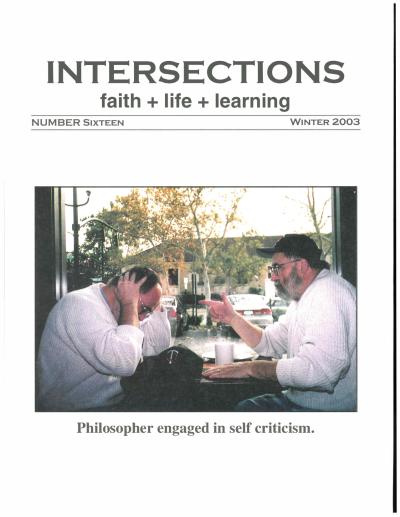
Christenson previews this issue’s papers from the Vocation of a Lutheran College Conference—Curt Thompson on “the Lutheran knot,” Carol Gilbertson on the creative dimensions of language, Bruce Heggen on theological vocabulary in the state university, Susan Poppe on the boundaries of campus freedom, and Sig Royspern’s oracular gems—welcomes Robert Benne’s response to the previous issue as a sign that Intersections is becoming a locus of continuing conversation, and confesses his reluctant consent to appear on the cover.
-
Article
Do You Teach in a Different Manner at a Lutheran College? Unraveling the Lutheran Knot and Highlighting the Glory in the Theology of the Cross
Curtis L. Thompson
Thompson argues that being Lutheran means having a “knot in the stomach”—a dialectical “Yes and No” tension between law and gospel, two kingdoms, Word and world—and that this knot is held together by Luther’s theology of the cross supplemented by an under-appreciated theology of glory in which God shines through human beings and creation. He then traces how the Lutheran knot shapes his teaching at Thiel College in the Religion department, the first-year team-taught “History of Western Humanities,” the second-year “Science and Our Global Heritage,” and his work as Co-Director of Thiel’s Global Institute, concluding that only such “dialectical doublespeak” leaves him with the “at-once dreaded and delightful dis-ease of the Lutheran knot.”
-
Article
Honoring the Word: Lutherans and Creative Writing
Carol Gilbertson
Gilbertson argues that “honoring the Word” in Lutheran colleges means cherishing the sacred power of human language as God’s gift across three sites—the chapel talk, the classroom of wonder, and the poem—and illustrates her argument by reading aloud her own poems: “The Refiner’s Fire and Leaping Calves,” “Late June,” “Early June,” “Sweet July,” “Good Friday,” “Pondering These Things,” “The Limbs of Words,” and “Night Rising,” drawing on Darrell Jodock, John Updike, Martha Nussbaum, George Steiner, and T. S. Eliot’s “The Dry Salvages” to claim writing as a Christian vocation that “incarnate[s] the unseen sacred.”
-
Article
Writing Toward the Night Complete: Teaching and Working at the Public, Secular Institution
Bruce Allen Heggen
Heggen, Lutheran Campus Ministry pastor and adjunct English professor at the University of Delaware, builds on a freshman’s essay closing line—“All in all our night was complete”—to argue that even in the secular public university one can “teach hope” as a critical principle by drawing on Douglas John Hall’s Heideggerian distinction between calculative and meditative thought, the Frankfurt School’s instrumental versus substantialist reason, Luther’s theology of the cross, Parker Palmer’s “obedience to truth,” bell hooks, Lionel Basney, Shelley Shaver, and Donald Sheehan’s Frost Place “principle of compassion.” The classroom and Lutheran campus ministry together can become “communities of memory and hope” that, like the artist student’s Fourth of July, hold together danger, people getting together, explosions, and lots of fun.
-
Article
The Impropriety of Jesus' Teaching: The Woman at the Well and The Vagina Monologues
Susan M. O'Shaughnessy
O’Shaughnessy Poppe dedicates her message to those who worked to put on Eve Ensler’s The Vagina Monologues against administrative resistance and reads the Samaritan woman at Jacob’s well alongside the testimony of a Bosnian rape survivor whose story Ensler asked to tell, arguing that the “impropriety” of Jesus—his scandalous recognition of those silenced by sexism, racism, war, custom, and the church—is the model for the mission of a college of the church to defend academic freedom and to break the chains of oppression by inflicting discomfort on the proper and pure.
-
Poem
A Rainfall of Questions Collected in the Form of a Poem
Sig Royspern
Royspern offers fourteen oracular questions on aging, addiction to possessions, water striders, magnolias, slippery fish, moths and the moon, priests and leaf-rakers, weeds and flowers, the price of education, abandoned groceries, spiritual pilgrimage, melons and oats, similes, and the impossibility of finding a store that sells a spring wind.
-
Response
Response to Bishop Olson and President Tipson
Robert Benne
Benne responds to two articles in the Winter 2002 Intersections: former Bishop Stanley Olson’s “The Marks of an ELCA College,” whose narrow reading of the two kingdoms cedes all epistemological claims to secular knowledge, and President Tipson’s engagement with The Future of Religious Colleges, whose “rather unchastened Enlightenment spirit” underestimates how loaded the social sciences and humanities are with their own philosophical and religious assumptions. Drawing on Reinhold Niebuhr, John Milbank, and William Buckley, Benne defends a “critical mass” of pervasively Lutheran colleges and calls on bishops and pastors to take the schools seriously lest they drift from their religious heritage.
-
 Article
From Alien to Citizen
Arne Selbyg
No. 29 · Spring 2009
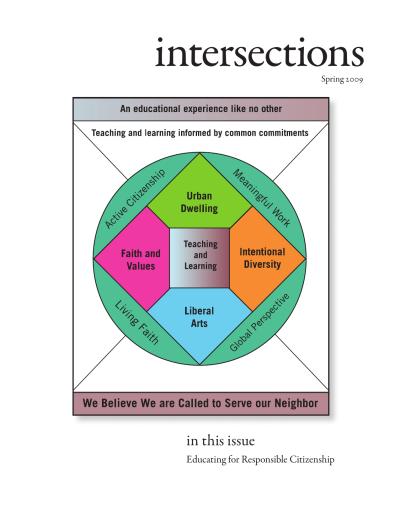
Selbyg reflects on three experiences of being educated for citizenship—growing up in Norway under the legacy of Lutheran pastors and public school teachers who resisted the Nazi occupation, arriving in America as a resident alien, and becoming a naturalized American citizen—and proposes the jazz ensemble as a better metaphor for American society than the melting pot, one in which different citizens learn skills, study other instruments, and dialog with one another in service to the common music.
-
 Editorial
From the Publisher
Arne Selbyg
No. 27 · Spring 2008
Selbyg, retiring this summer as Director for ELCA Colleges and Universities, reflects on his decade serving as spokesperson between the church and its twenty-eight colleges and universities, and argues that the link between the colleges and the church has grown stronger over the last ten years — sustained by supportive church leaders like Presiding Bishop Mark Hanson, the annual Vocation of a Lutheran College conference, and a Lutheran theology of higher education whose principles (questioning authority, returning to the sources, including the excluded, serving the neighbor) remain a strong basis for operating colleges and universities in the twenty-first century.
-
 Editorial
From the Publisher
Arne Selbyg
No. 26 · Fall 2007
Selbyg notes that, while a stated purpose of Intersections over its twelve years and twenty-six issues has been the intersection of faith, learning, and teaching, surprisingly few articles have addressed how Lutheran faculty teach and why — and credits the editor for assembling essays from authors whose teaching has benefited from the ELCA Wittenberg Center, on the eve of the City of Wittenberg’s “Luther Decade” leading up to the 2017 Reformation anniversary.
-
 Editorial
From the Publisher
Arne Selbyg
No. 25 · Spring 2007
Selbyg notes that most papers in this issue grew out of a pan-Lutheran conference organized by the Association of Lutheran College Faculties in fall 2006 rather than the annual Vocation of a Lutheran College conference, and argues that the ELCA’s ecumenical posture—truthful but open to learning from others—is a good foundation for institutions of higher education whose faculty likewise profess while remaining subject to change based on new research and insights.
-
 Editorial
From the Publisher
Arne Selbyg
No. 24 · Fall 2006
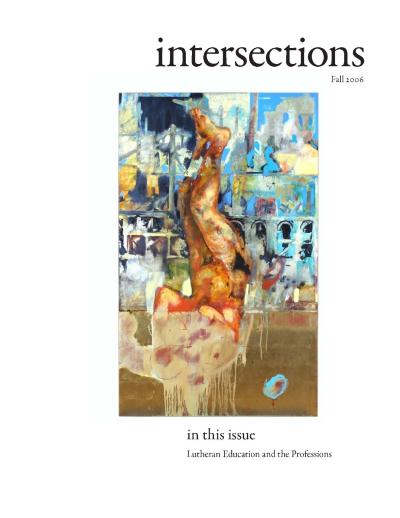
Selbyg situates this issue in the ongoing ELCA conversation about education that began with the 2005 conference and is feeding into the second draft of the ELCA Social Statement on Education, previews the 2007 conference (“The Vocation of a Lutheran College — Engaging the World”) at Augustana College, Rock Island, and lifts up Luther’s insistence that the church and its members contribute to their wider communities rather than retreat into self-centered enclaves.
-
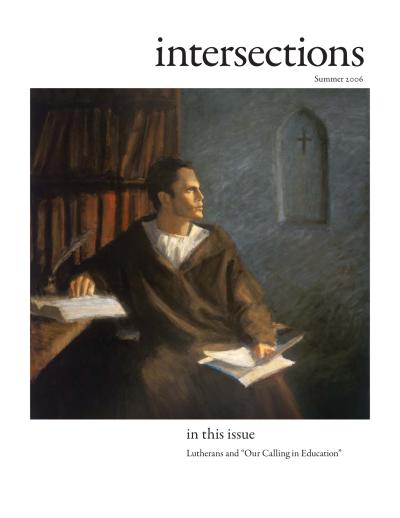 Editorial
From the Publisher
Arne Selbyg
No. 23 · Summer 2006
Selbyg features articles based on presentations at the 2005 Vocation of a Lutheran College conference focused on the upcoming ELCA Social Statement on Education, and urges members of the ELCA higher-education community to download the first draft (“Our Calling in Education”) from the ELCA website and submit feedback to the Task Force on Education before the October 15 deadline. He worries that the sexuality social statement on a 2009 timeline will draw more attention than the education statement, but reminds readers that, for Martin Luther and for those who work in Lutheran higher education, education is as important as sex.
-
 Editorial
From the Publisher
Arne Selbyg
No. 19 · Summer 2004
Selbyg notes that while the primary source of articles for Intersections is the annual Vocation of a Lutheran College Conference, this issue draws on participants in the Lutheran Academy of Scholars in Higher Education, whose Lutheran Brotherhood and Lilly Endowment grants have been exhausted but which has been continued through DHES, the colleges, and especially St. Olaf’s release of DeAne Lagerquist to direct it. He draws attention to editor Tom Christenson’s new book The Gift and Task of Lutheran Higher Education (Augsburg Fortress).
-
Article
Professional Education/Liberal Arts Education: Not a Case of Either-Or but Both-And
Gail Summer
No. 24 · Fall 2006
Summer, Dean of Academic Programs at Lenoir-Rhyne College, traces the historical interweaving of liberal arts and professional education in American higher education (using the rise of engineering as a case study) and argues that the standard “either-or” framing of liberal arts versus professional preparation misreads both. At Lutheran colleges, the “both-and” relationship is shaped by a Lutheran understanding of vocation in which professional programs are integral to, not in tension with, the liberal arts.
-
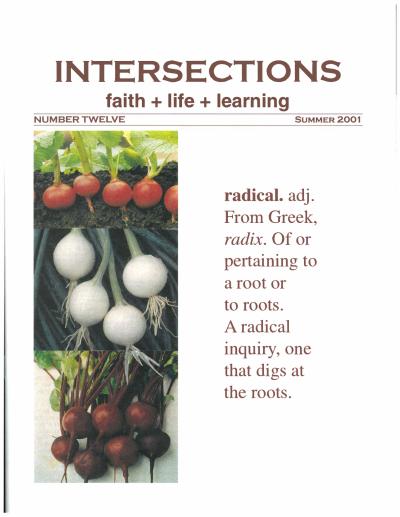 Article
Teaching as a Form of Servant Leadership
Leonard G. Schulze
No. 12 · Summer 2001
Schulze defines teaching as a paradoxical “servant leadership” rooted in the etymology of educare, e-ducere, Erziehung, and Bildung, surveys representative models of the teacher (Plato’s cave, the Theatetus midwife, Socrates of the Apology, and Freire’s Pedagogy of the Oppressed), and proposes a four-fold taxonomy of learning—information, critical thinking, praxis, and teleology—each requiring its own form of teacherly leadership. He closes with ten Wittenberg-style theses for teachers at Lutheran colleges, including that the Gospel liberates us from using knowledge as power, that disputatio is an expression of faith, and that we are called to lead students from the tyrannies of ignorance, rote knowledge, incompetence, and anomy to the freedoms of awareness, critical understanding, skillful action, and purposive lives in community.
-
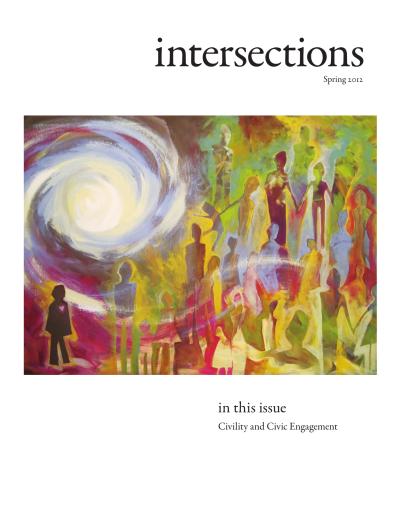 Article
Practical Approaches for Lutheran Colleges to Engage Civil Society
Katherine A. Tunheim
No. 35 · Spring 2012
Tunheim distinguishes a college’s mission from its vocation—a calling from the community—and offers four examples of Lutheran colleges “dancing with their neighbors”: Augsburg’s engagement with the Cedar Riverside Neighborhood, her Gustavus students’ work with the St. Peter Soccer Club, St. Olaf football players in the All-Star After-School Program in Northfield, and Concordia students filling sandbags during the 2009 Red River flood. She presses Lutheran educators to ask the troubling questions that prepare students to lead with ethics rather than merely with money.
-
 Editorial
From the Publisher
James M. Unglaube
No. 3 · Summer 1997
Unglaube opens the journal’s second year by previewing the 1997 Vocation of a Lutheran College conference at Carthage, which will examine the Lutheran tradition from outside (Richard Hughes of Pepperdine on the Lilly Endowment’s Models for Christian Higher Education; David Johnson, President of the University of Minnesota at Morris and Luther College graduate, on the tradition from the public sector) and inside (Ann Pederson of Augustana in Sioux Falls; Timothy Lull of Pacific Lutheran Theological Seminary), and previews Eric Eliason’s emerging proposal for an Academy of Scholars in Lutheran Higher Education modeled on NEH/NSF-style summer seminars.
-
Article
"Our Calling in Education": An Educator's Perspective
Cheryl Budlong
No. 23 · Summer 2006
Budlong, Professor of Education at Wartburg College, asks educators to reexamine their ‘mental models’ of what education itself means in light of the rapidly expanding literature on how young people learn. Drawing on Malcolm Gladwell, Eric Jensen, Ruby Payne, Judith Harris, Robert Slavin, and the AACTE’s Leading a Profession retrospective on the AACTE agenda 1980–2005, she calls on Lutheran educators to articulate vocation intentionally in their classrooms and to ground curricular and pedagogical reform in Wartburg’s focus on Discovering our Calling.