“O God, in whom we live and move and have our being: We humbly pray thee so to guide and govern us by thy Spirit, that in all the cares and occupations of our life we may not forget thee, but may remember that we are ever walking in thy sight.”1
My interpretation of the story of Pentecost is inspired by the work of Liz Spelman, Professor of Philosophy at Smith College and Maria Lugones, Associate Professor of Comparative Literature at SUNY Binghamton. They are both known for their work in critical race theory and feminist philosophy. In 1983, they published an essay together entitled: “Have We Got a Theory for You! Feminist Theory, Cultural Imperialism and the Demand for ‘the Woman’s Voice’.”2 At that time many feminists were trying to find their voices and make themselves heard. The trouble was that in a man’s world only the man’s voice was audible. Furthermore, the man’s voice was not identified as male. It called itself “the voice of reason, objectivity and sense.” And, because the man’s voice was the voice of reason, objectivity, and sense, all other voices uttered only unreason, subjectivity, and nonsense. Many feminists thought that the woman’s voice must finally be heard. She should be thought equally capable of uttering reasonable, objective and sensible claims for equality, human rights and freedom. She must be allowed to speak for herself.
While Lugones and Spelman agreed that the man’s voice (especially the voice of the white man of privilege) was the only one being heard, they worried that it was mainly white women of privilege who were allowed to shape the woman’s voice. White/Anglo women were speaking for others about whom they knew little or nothing. They were doing to women of color, immigrant women, uneducated women and others what had been done to them by white men of privilege, leaving them out of the discussion. Well-educated white/Anglo women acted as if they knew what all women wanted.
Spelman and Lugones point out that in fact, women of privilege know less about women of color than women of color know about them. They write:
...it is presumed to be the case that those who do the theory know more about those who are theorized than vice versa: hence it ought to be the case that if it is white/Anglo women who write for and about all other women, then white/Anglo women must know more about all other women than other women know about them. But in fact just in order to survive, brown and Black women have to know a lot more about white/Anglo women—not through the sustained contemplation theory requires, but through the sharp observation stark exigency demands.
Women of color have to know how to get along in the white/Anglo woman’s world, but white/Anglo women do not need to know how to get along in the worlds of women of color. Notice further, that immigrant women, like Lugones, must learn the dominant language in order to survive. Women of privilege in the United States do not need to speak Spanish, Swahili, Arabic or Portuguese. While some well-meaning white women of privilege may feel an obligation to speak on behalf of women of color, poor women, immigrant women, Lugones and Spelman insist that they stop speaking for others. Instead, they should find ways to listen to what other women have to say for themselves.
Let us turn now to the polyglot miracle of Pentecost. Acts 2:1-8 read as follows:
When the day of Pentecost had come, the disciples were all together in one place. And suddenly from heaven there came a sound like the rush of a violent wind, and it filled the entire house where they were sitting. Divided tongues, as of fire, appeared among them, and a tongue rested on each of them. All of them were filled with the Holy Spirit and began to speak in other languages, as the Spirit gave them ability. Now there were devout Jews from every nation under heaven living in Jerusalem. And at this sound the crowd gathered and was bewildered, because each one heard them speaking in the native language of each. Amazed and astonished, they asked, “Are not all these who are speaking Galileans? And how is it that we hear, each of us, in our own native language?” (RSV)
The first important thing to notice is that for these immigrant Jews who speak other languages, the bewilderment comes, not from the sound from heaven which is “like the rush of a violent wind,” nor from the “divided tongues, as of fire” resting on the disciples, but from Galileans speaking in their native languages. I don’t know about you, but the rush of a violent wind from heaven and tongues as of fire on peoples’ heads would surely astonish me! But, instead, it is the polyglot miracle that astonishes Jews from other nations. They are “amazed and perplexed” to hear Galileans speaking to them in their own languages. They wonder what this means.
The second thing to notice is that the response of the men of Judea and of the native inhabitants of Jerusalem is very different from the response of the Jews from other nations. The men of Judea and the native inhabitants of Jerusalem think that the apostles are “filled with new wine.” (Acts 2:13) They do not even recognize that other languages are being spoken. They think the apostles must be babbling drunken gibberish. In fact, Peter feels compelled to defend himself and his fellow apostles by claiming that it is too early in the day for their strange utterances to be debauched nonsense. Peter insists that what is happening is the fulfillment of the prophesy of Joel that “young men shall see visions, and old men shall dream dreams.” (Acts 2:17)
The third thing to notice, and what inspires me, is that even Peter does not understand what is happening. He knows it is a miracle, but he does not know that he and his friends are saying things that make perfect sense in other languages. The immigrant Jews are the ones who know what God said. They know what the miracle of Pentecost is and are astonished.
Now, I want to ask another question: Why did the writer of Acts fail to tell us what God said? How am I supposed to know what God said at Pentecost, if the author of Acts doesn’t bother to mention it? We are told only that the Jews heard the apostles speaking about God’s deeds of power. Why not be more specific? Isn’t the message from God more important than the messenger or the means of delivery?
I want to suggest that the fact that the apostles and the readers of this text do not know what God said at Pentecost, and the fact that other people, the devout Jews from other nations, do know what God said, forces us to reinterpret what it means to listen to God. In fact, it forces us to re-think discipleship. We had thought that the disciples were sent out to tell others the good news. We had thought that tongues as of fire over the disciples’ heads marked them as vestibules of God’s wisdom which they were to pass on to all nations. But if we take Pentecost seriously, we learn that we are like Peter. We mean well, but we need to listen to what others know about God instead of thinking ourselves fit to speak on their behalf. Pentecost makes us re-examine why the disciples must go out to all nations—they must go there to learn from the Jews of other nations what God said to them. Pentecost makes us re-examine how we must love one another. Rather than speak on behalf of others, we must let them speak for themselves. We must learn another’s language so that we can understand her when she tells us what God said to her in her language. And Pentecost makes us re-examine our conviction that we have privileged access to the message of the Holy Spirit. Disciples of old and disciples of today must set aside their self-righteousness in order that they might listen to God and to the message God gave to others.
This miracle of Pentecost reminds us that people of privilege know less than the foreigner, the immigrant, the oppressed, the woman, the child. If we want to know the good news, we must learn to listen in new languages to new voices. We must lift up the neglected miracle of Pentecost. We must attempt to understand one another, indeed, to love one another, in this way. A way that defeats cultural imperialism. A way that subverts our dominance and calls into question our righteousness. The only proper motivation for learning about the experiences of others is friendship, which requires trust and care. It requires wishing to know another’s heart and allowing her to speak for herself.
When I travel I must try to learn the languages and customs of the people I visit. I ought also to learn the languages of the immigrants, foreigners, and oppressed in my community. When I read a novel, a work of philosophy, a scientific treatise, scripture, or a letter from a friend, I must listen openly, allow them to guide me; to surprise, delight, challenge, and intrigue me. Further, I must be in dialogue with others in order to discover what is divine in my own experience, traditions, and customs. I must explore, question, examine myself. This is also what it means to listen. Only when I do this can I listen to God.
I cannot learn directly God’s language. Nor can I acquaint myself directly with God’s customs, for I am a human being. I am not Divine. The message of Pentecost, especially if I am a Galilean, is that I must learn the languages of all nations, so that when God speaks through my mouth to the Jews of other nations, I too might understand what God says. I must allow myself to be questioned in the intimacy of friendship. I must expect that others know better what God has said. The message of Pentecost is to listen to God by truly listening to and loving one another.
End Notes
1. “Daily Morning Prayer.” The 1979 U.S. Book of Common Prayer. 30 August 2008. The Society of Archbishop Justus. 6 October 2008 <http://justus.anglican.org/resources/bcp/mp1.pdf>.
2. Maria C. Lugones and Elizabeth V. Spelman. “Have We Got a Theory for You! Feminist Theory, Cultural Imperialism and the Demand for ‘the Woman’s Voice’.” Women’s Studies International Forum 6.2 (1983): 573-81.
-
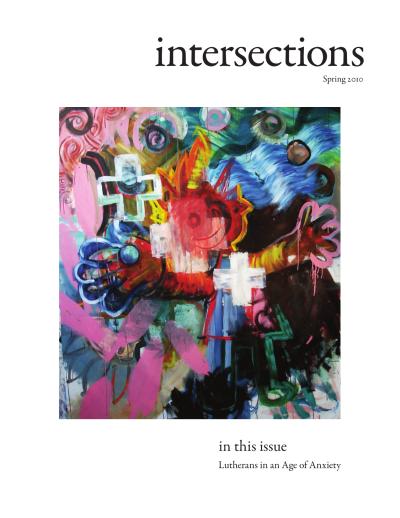 Editorial
From the Publisher
Mark Wilhelm
Wilhelm invites readers to enjoy or revisit the presentations from the 2009 Vocation of a Lutheran College Conference, then reflects on the Higher Learning Commission’s denial of Dana College’s request to transfer accreditation to a for-profit purchaser—an event that effectively ended Dana’s sale and prompted ELCA colleges and universities to welcome Dana students and faculty—and argues that the irreversible entry of for-profit operators into liberal arts education gives the Lutheran community further reason to continue the conversation about the vocation of a Lutheran college.
-
Article
Living at the Intersection of Fear and Hope
Mark S. Hanson
Hanson draws on his January 2009 ELCA/ELCIC visit to Jordan, Israel, and Palestine—a Hebron Quran that did not burn, fifth graders dancing at the Hope School, a conversation with King Abdullah II—to frame the vocation of Lutheran higher education at the intersection of fear and hope. Engaging Brueggemann, Sittler, Buechner, Auden, Strandjord, Douglas John Hall, W. Robert Connor, Lewis Mudge, and Cynthia Moe-Lobeda, he argues that Lutheran colleges are called to critical inquiry that does not collapse into a hermeneutic of suspicion, to a “thinking faith” that resists religious fundamentalism, and to communities of discernment that work for the common good.
-
Article
Practicing Hope: The Charisms of Lutheran Higher Education
Martha E. Stortz
Stortz names four charisms—theological gifts of identity rather than commodities—that Lutheran higher education brings to a culture of fear: semper reformanda as flexible, responsive institutions; the freedom of a Christian as simul justus et peccator critical inquiry that holds opposites in creative tension; regard for the other as “neighbor” rather than friend or alien; and the priesthood of all believers as a public, civic calling to know the poor. Drawing on Augustine, George Lindbeck, Patricia Killen, James Clifford, Earl Shorris, Carter Lindberg, and Augsburg’s Center for Global Education, she argues that immersion trips, neighbor-regard, and welfare reform witness that the gift Lutherans bring is hope grounded in Christ in you, the hope of glory.
-
Article
Hope in the Face of Ecological Decline
Jason Peters
Peters reads our ecological crisis—a campus “Birth Control Tree,” feminized fish, population, climate, water, and soil—through Alexander Pope, William Blake, Søren Kierkegaard, and C. S. Lewis’s The Abolition of Man, and argues that the modern project of mastering nature has made despair (the unconscious form Kierkegaard named) our condition. He calls for three reorientations: practical (assigning value to domestic arts and place over disciplinary specialization), philosophical (dismantling the Baconian/Machiavellian/Cartesian project of control), and theological (recovering the Church’s rejection of Gnosticism so that grace comes to us by means of nature, not in contempt of it).
-
Article
Hope in a Period of Economic Decline
Rebecca Judge
Judge reads the 2008-2009 recession against the panic-free 1982 downturn and argues that this panic comes from the genuine surprise of a generation that had been told—by George Will and others—that business cycles had been tamed by deregulation, globalization, and Greenspan. Drawing on Luther’s “Trade and Usury” and Large Catechism, Paul Tillich, Stephen Marglin, Karl Polanyi, and Larry Summers, she critiques the “crude utilitarianism” of Homo economicus and benefit-cost analysis, finding hope in the possibility that this recession will renew a national conversation about moral obligation to neighbor in a market whose “raging bull” has broken out of its squeeze chute.
-
Article
An Apostolate of Hope
David L. Tiede
Tiede argues that the vocation of a Lutheran college is to be “an apostolate of hope” oriented by three metrics of our time: 12,000 (the Dow), 350 (parts per million of CO2), and $1.25 (the daily income of 1.4 billion people in extreme poverty). Drawing on Darrell Jodock’s “third path” for church-related colleges, Larry Rasmussen’s Batalden lectures, Mark Tranvik, Douglas John Hall, Bill McKibben, Stephen Privett, Peter Singer, and Augsburg’s Center for Global Education, he proposes that justification by faith, critical pluralism, stewardship of God’s earth, and love and justice for our students together prepare wise leaders to renew the future.
-
Article
"Annoying the Student With Her Rights:" Human Life Coram Hominibus; Reflections on Vocation, Hope, and Politics
Caryn Riswold
Riswold takes a student’s course-evaluation complaint that she had been “annoyed with her rights” about voting as the entry point for reflection on fear of change, mistrust of difference, and right-wing extremist violence—Poplawski, Von Brunn, Roeder, and the Sotomayor hearings. Drawing on Gerhard Ebeling’s reading of Luther’s fourfold relationality (coram Deo, mundo, meipso, hominibus), Brian Gerrish, Alister McGrath, Gustaf Wingren, Philip Hefner, Mary Rose O’Reilley, and bell hooks, she argues that the vocation of the Lutheran college is precisely to “annoy students with their rights” by forming them for socially responsible voice grounded in faith active in love.
-
 Article
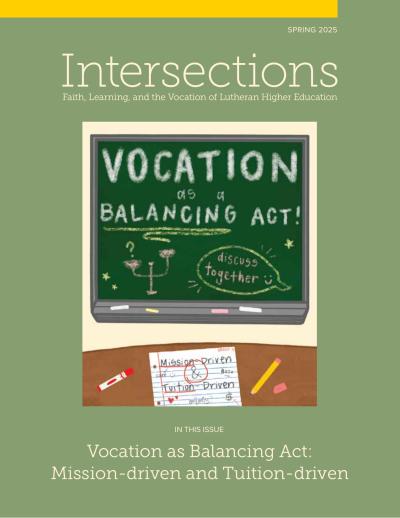
Finding the Miracle in the Intersection of Mission and Limitations: Lessons from Latin America
Kat Peters
No. 61 · Spring 2025
14 min audio
Peters draws on her time interning with Lutheran World Relief and leading a study abroad program in Central America — including a Costa Rican women’s farm cooperative whose ecotourism project was “unprofitable” but life-giving — to argue that the intersection of God’s preference for struggle and God’s desire for abundant life is itself the miracle higher education can claim amid scarcity.
-
 Editorial
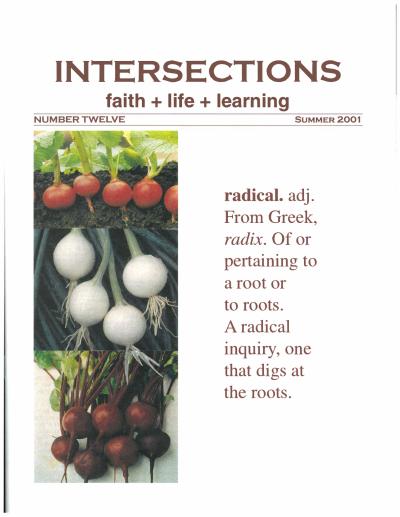
From the Editor
Tom Christenson
No. 12 · Summer 2001
Christenson introduces three pieces from the summer 2000 Vocation of a Lutheran College Conference at Dana College—noting that Leonard Schulze was asked to keynote before becoming executive director of DHES—and recommends Peter C. Hodgson’s God’s Wisdom: Toward a Theology of Education and Douglas Sloan’s Faith and Knowledge: Mainline Protestantism and American Higher Education for their accounts of how faith and knowledge have been dissociated in modern higher education and what it might take to recover their connection.
-
 Article
Both Priest and Beggar: Luther among the Poor
Martha E. Stortz
No. 46 · Fall 2017
Reading Luther’s deathbed remark “We are all beggars” against his “priesthood of all believers,” Stortz argues that priest and beggar are two sides of a human reality — one that locates civic responsibility for the poor at the heart of the Reformation legacy and that pushes beyond paternalistic service toward the systemic question of justice.
-
 Article
The University in the City of God: Beyond Dialectics and Rhetoric
Gregory A. Clark
No. 4 · Winter 1998
Clark, drawing on Alasdair MacIntyre’s Three Rival Versions of Moral Enquiry, distinguishes the preliberal, liberal, and postliberal university and argues that the liberal university’s pretense of dialectical neutrality has masked a particular rhetoric of its own. Following John Milbank’s Theology and Social Theory, he holds that every philosophy and institution is finally a rhetoric and that the church’s task is not to win on the secular university’s terms but to proclaim and embody an alternative city. The Christian college, then, should give up the apologetic pose of meeting secular reason halfway and instead practice the rhetoric of the gospel: a proclamation of Jesus, an enactment of Christian friendship and peace, and a willingness to be vulnerable to the violence of the world as Jesus was vulnerable to his own. Clark commends this stance to colleges related to the church.
-
 Article
Resistance in the Age of Trump: An Interview with Ivonne Wallace Fuentes
Jason A. Mahn, M. Ivonne Wallace Fuentes
No. 45 · Spring 2017
In conversation with Jason Mahn, Roanoke College historian Ivonne Wallace Fuentes describes how she launched a local chapter of Indivisible after the 2016 election, how the skills of teaching and historical research carry over into grassroots advocacy, and how her sense of vocation (vocare) has become intertwined with the work of advocacy (advocare).
-
 Article
Calling Economists
Lynn Hunnicutt
No. 37 · Spring 2013
Reading Luther’s Whether Soldiers, Too, Can Be Saved alongside Adam Smith’s Theory of Moral Sentiments and Wealth of Nations, Hunnicutt asks whether economists, too, can be saved—and whether economics can host a serious conversation about vocation. She traces her own move from Utah State to Pacific Lutheran University and its Wild Hope Center for Vocation, and turns to Deirdre McCloskey and George DeMartino as economists whose work makes room for vocation and the common good within the discipline.