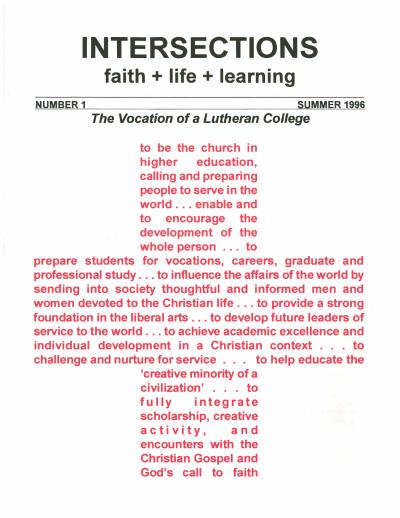
It is good to have the first issue of INTERSECTIONS become a reality. It represents a great deal of labor, primarily by Editor Tom Christenson. We appreciate his labor of love and Capital University’s willingness to be the locus for this publication.
The Vocation of a Lutheran College lives, yes, in the words of institutional mission statements. But it comes to life when the academic community becomes engaged in conversations about these intersections of faith, life and learning. We have now put in place an annual Vocation of a Lutheran College Conference where campus representatives come together to engage these topics. The publication of INTERSECTIONS will enhance these conferences. More important, it will enhance the continuing dialogue which we hope will take place on each of the campuses. Our future as colleges and universities in partnership with the church depends on it.
We are thrilled that the Lilly Endowment has made a sizable grant to support the 1996 Conference, to encourage campus dialogues, and to assist in birthing INTERSECTIONS. Our appreciation to Lilly for this commitment.
James M. Unglaube
Director, Colleges and Universities
ELCA Division for Higher Education and Schools
-
 Editorial
From the Editor
Tom Christenson
Christenson, feeling like a proud parent, welcomes readers to the inaugural issue and acknowledges three people without whom the publication would still be just an idea: Naomi Linnel of the ELCA office for Higher Education and Schools, publisher Jim Unglaube, and Capital University president Josiah Blackmore. He invites readers’ reactions, suggestions, and active involvement as editors, reviewers, authors, artists, and critics in shaping the dialogue across the ELCA college and university family.
-
Article
The Future of Lutheran Higher Education
Mark Schwehn
Schwehn’s keynote, framed against Otto Paul Kretzmann’s October 1940 inaugural at Valparaiso, organizes itself around four topics: the idea of a Christian University (Lutheran schools as a tributary of the Christian intellectual tradition, voices in a conversation in the spirit of H. Richard Niebuhr and Alasdair MacIntyre rather than phases of James Burtchaell’s devolutionary scheme); the pursuit of truth (against Foucauldian reduction of truth to power, with Hilary Putnam, toward a cruciform discipleship that discovers truth ambulando); the critique of knowledge (developing Christian theories of knowing in conversation with Benne, Lotz, Wolterstorff, LeClerc, and Augustine); and Christianity and liberal learning (objectivity refurbished as Thomas Haskell’s ascetic self-discipline, and the recovery of texts that have claims upon us).
-
Response
"Whose Future?" or "Social Justice and the Lutheran Academy?"
Marsha Heck
Heck argues that the future of Lutheran higher education lies less in defining Lutheran distinctiveness than in moral action grounded in face-to-face relationships with others. Drawing on David Lotz’s two-kingdoms theology of citizenship, Ernest Simmons’s relational reading of Luther, Arthur Preisinger’s indictment of the German Lutheran misreading of two kingdoms during the Third Reich, Starla Stensaas of Dana College, and Paulo Freire’s dialectic of empowerment, she calls Lutheran colleges to integrate moral reflection with moral action—to move students’ muscles against what is not true as well as to feel truths in their bones.
-
Response
Knowing and a Tradition to be Known
Kurt Keljo
Keljo, University Pastor at Capital, embraces Schwehn’s vocational call but challenges his epistemological framing. We are called to bear witness to the Truth more than to pursue it; truth and power need not be dissociated when power is understood cruciform-ly as love and service; alongside objectivity, a case can be made from the tradition for connected knowing (image of God, idolatry, repentance, Incarnation). Christians offer not a particular epistemology but a foundation for epistemology—a tradition to be known. He closes with James Fowler’s four marks of the “public church”: particularly Christian, prepared for pluralism, balancing intimacy with public engagement, and unafraid of ideological pluralism in confident, nondefensive civility.
-
Response
Lutheran Colleges: The Context for the Conversation
Thomas Templeton Taylor
Taylor of Wittenberg engages Schwehn’s first argument by sketching the institutional predicament of Lutheran colleges through three converging forces: the collapse of differences among old-line Protestant groups in the wake of ELCA-era ecumenism (with Robert Wuthnow); the secularization of American higher education described by George Marsden; and the post-war decline of liberal arts colleges under pressure to professionalize. The result is an “in-between stage” in which Lutheran colleges retain rhetoric without substance. Following Richard John Neuhaus’s “Eleven Theses,” he argues that, for a time at least, Lutheran colleges’ institutional affiliations must remain actively Lutheran if they are to remain in any sense Christian.
-
Response
Renewing Our Journey: Some Thoughts on Pursuing the Truth
John Rehl
Rehl, a Capital University graduate pursuing doctorates in theology at Chicago and in economics at Wisconsin, takes up Schwehn’s invitation to think again on the nature of truth. He sets aside truth as information, as object, and as mere words; recasts the church-related college’s task as a renewed emphasis on classroom teaching (Kierkegaard’s teacher as midwife) and on brave, articulate professors. He calls for moral education in courage, discipline, patience, and love, illustrates the costs of the fact-value split with examples from economics, and argues that we honor Lutheran heritage not by preserving it as a museum piece but by testing it—Luther’s theology of the cross over a theology of glory—and by preparing students for a world of Untruth, strengthened (with Julian of Norwich) by the promise that they will not be overwhelmed.
-
Institutional Focus
Diversity and Dialogue: Gustavus Adolphus College
Florence D. Amamoto
Amamoto, a third-generation Japanese-American Buddhist who teaches American literature at Gustavus Adolphus and regularly attends daily chapel, writes as an “inside outsider.” Engaging Schwehn’s closing call to refurbish the Lutheran college, she argues that church-related colleges are vitally important to society, that “refurbishing” must take up diversity, and describes how Lutheranism is manifest at Gustavus: Christ Chapel as the highest point on campus, the ecumenical chapel program led for thirty years by Chaplain Richard Elvee, the Nobel Conferences that pair scientists with philosophers and theologians, the First-term Seminar and Tuesday Conversations, the India study-abroad program organized by Deane Curtin, and the Sponberg Chair in Ethics. She names the pressures of money, secularization, and the publications-driven push for “excellence” that threaten this creative tension.
-
Institutional Focus
Continuing the Dialogue: Augustana College
Sandra C. Looney
Looney describes Augustana College, Sioux Falls, debating and renaming its values—Christian, Liberal Arts, Community, Excellence, Service—under the leadership of religion professor Dr. Arthur Olsen and the T’N’T (“Through Thick and Thin”) committee, in the wake of ELCA Region III’s “What Does It Mean to be a College of the Church?” conversations. She describes Augustana’s 56% Lutheran student body, daily 10 a.m. chapel, dual Christmas Vespers in Our Savior’s Lutheran Church and St. Joseph’s Cathedral, the Capstone classes on moral and aesthetic issues, and the ongoing work of enlarging Augustana’s conversation to include Native American, Jewish, and Islamic voices.
-
 Editorial
The Vocation of a Lutheran College: Some Transitional Thoughts
James M. Unglaube
No. 4 · Winter 1998
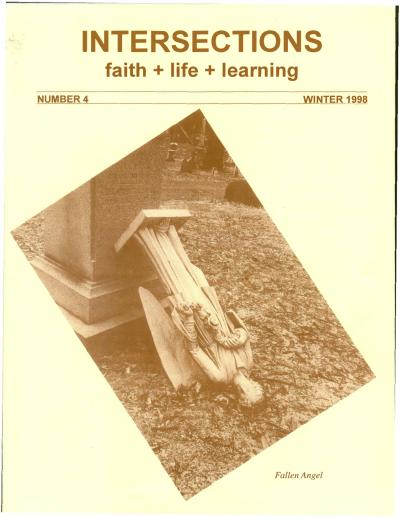
Unglaube offers final reflections on thirty years in Lutheran higher education as he leaves the ELCA Division for Higher Education and Schools to join Carthage College, his alma mater. He recalls colleague Richard Solberg’s influence, the closing of Upsala College in 1995, the Higher Education and Namibia program shared with Naomi Linnell, the growth of endowments from $70 million to $1 billion in 25 years, and the Vocation of a Lutheran College project he credits Paul Dovre with inspiring. He likens the twenty-eight ELCA colleges to flowers on a rose bush—same Lutheran tradition, each blossom different—requiring constant nurture if the partnership between church and college is to thrive.
-
 Editorial
From the Publisher
James M. Unglaube
No. 3 · Summer 1997
Unglaube opens the journal’s second year by previewing the 1997 Vocation of a Lutheran College conference at Carthage, which will examine the Lutheran tradition from outside (Richard Hughes of Pepperdine on the Lilly Endowment’s Models for Christian Higher Education; David Johnson, President of the University of Minnesota at Morris and Luther College graduate, on the tradition from the public sector) and inside (Ann Pederson of Augustana in Sioux Falls; Timothy Lull of Pacific Lutheran Theological Seminary), and previews Eric Eliason’s emerging proposal for an Academy of Scholars in Lutheran Higher Education modeled on NEH/NSF-style summer seminars.
-
 Editorial
From the Publisher
James M. Unglaube
No. 2 · Winter 1997
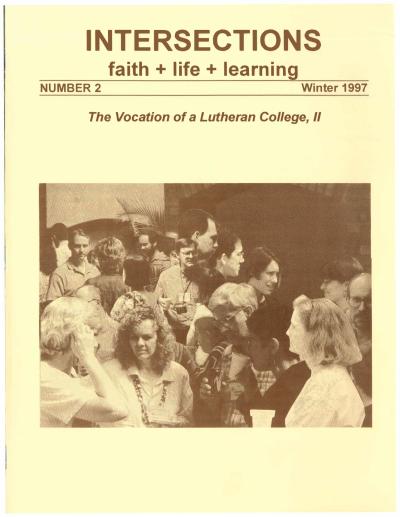
Unglaube reports on the second annual Vocation of a Lutheran College conference of August 1996, where Walter Bouman of Trinity Lutheran Seminary addressed “What is Lutheran; What is the Lutheran Tradition” (biblical, catholic, evangelical, sacramental, world-affirming—the world “received, enjoyed, served as God’s Gift”). He previews presentations by Wendy McCredie of Texas Lutheran and Baird Tipson of Wittenberg on how the Lutheran tradition is embodied in its colleges, and Bob Vogel’s challenge in “Coherence—And Now what?” that the tradition comes to life in how faculty give expression to their beliefs and values in the classroom and with colleagues.
-
 Editorial
From the Publisher
Mark Wilhelm
No. 31 · Winter 2010
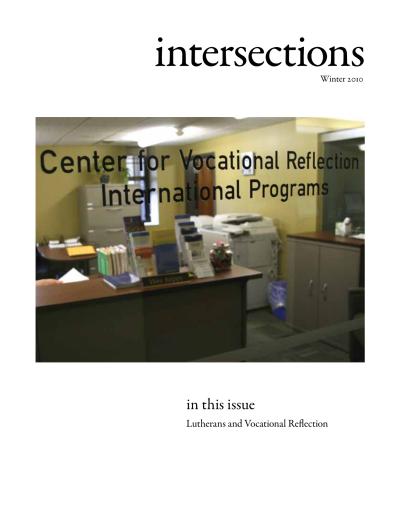
Wilhelm traces his decades-long enthusiasm for the Lutheran doctrine of vocation from his St. Olaf days reading Luther’s Open Letter to the German Nobility, notes Parker Palmer’s lecture-circuit ministry and Mark C. Taylor’s reflections on calling, and argues that ELCA colleges should claim vocation as the defining mark of Lutheran higher education—yet warns that vocation risks becoming “the program du jour” rather than a permanent hallmark.
-
 Article
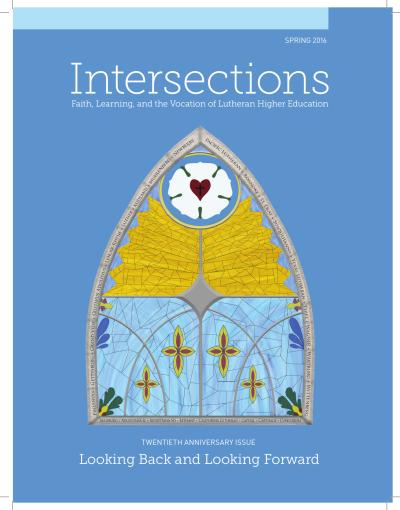
Distinctive Lutheran Contributions to the Conversation about Vocation
Kathryn A. Kleinhans
No. 43 · Spring 2016
Kleinhans surveys the recent resurgence of vocation talk in American higher education — from Frederick Buechner’s widely quoted definition to Lilly Endowment’s PTEV grants and the CIC’s NetVUE Scholarly Resources Project — and uses her chapter in At This Time and In This Place: Vocation and Higher Education to highlight distinctively Lutheran emphases: vocation grounded in creation rather than redemption, the given-ness of multiple simultaneous callings, and a frank acknowledgment of the constraints and “dark side” of vocation.
-
 Response
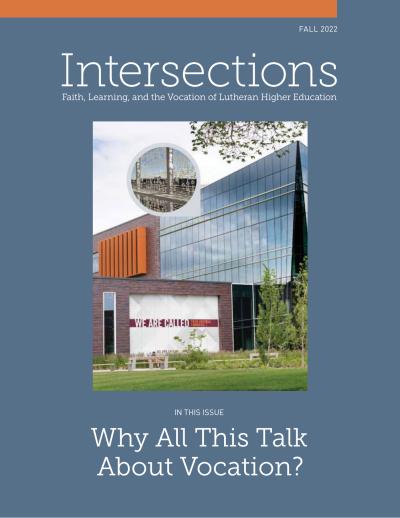
Response to Mark Wilhelm: Vocation, Mission and Privilege
Marit Trelstad
No. 56 · Fall 2022
Trelstad affirms Wilhelm’s claim that vocation is the foundational shared mission of Lutheran higher education rather than one program among many, and presses the critique that calls to “vocational reflection” can mask privilege — arguing that an intersectional lens shows vocational discernment is in fact a matter of survival and flourishing for students from marginalized communities.
-
 Article
Lutheran Identity, Academic Integrity, and Religious Diversity
Storm Bailey
No. 25 · Spring 2007
Bailey argues that one might rightly say of a college “that’s a pretty good school because it’s religious,” defending the proposition under three headings: academic and curricular virtues, free inquiry, and religious diversity. Drawing on Mark Schwehn’s Exiles from Eden, Richard Hughes on the Lutheran tradition’s “most potent theological resources” for the life of the mind, Parker Palmer, Lendol Calder, Mill’s On Liberty, Newman’s Idea of a University, and the AAUP’s 1940 Statement, he proposes a “critical mass” alternative in which the Lutheran commitment to truth-seeking and self-critique itself requires—rather than tolerates—a religiously diverse faculty whose opposing voices are needed for the mission to flourish.
-
 Editorial
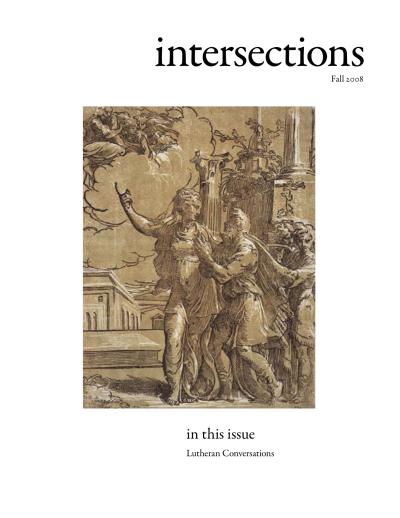
From the Publisher
Mark Wilhelm
No. 28 · Fall 2008
Wilhelm introduces himself as the new Director for Colleges and Universities and publisher of Intersections, thanks his predecessor Arne Selbyg, and previews an issue devoted to the aims and purposes of Lutheran higher education—reflections from Presiding Bishop Mark Hanson, two pieces from Wartburg College’s fall 2008 campus conversation about being a college of the church (his own essay and the Benne/Christenson dialogue), and a sermon by Lake Lambert III preached in the Castle Church in Wittenberg.
-
 Article
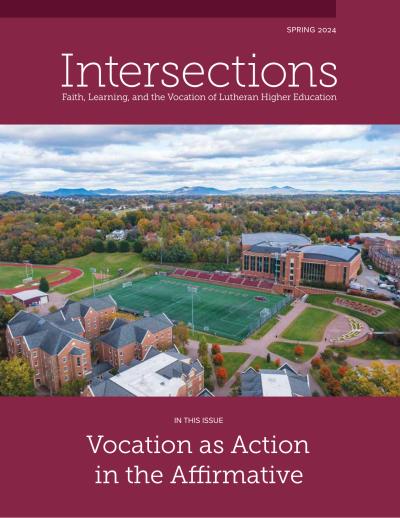
Forming the Division for Access, Equity & Belonging at Susquehanna University
Amy Davis, Dena Salerno, María L. O. Muñoz, Nina Mandel, Scott Kershner
No. 59 · Spring 2024
Five Susquehanna University colleagues trace the institution’s 166-year arc from a Missionary Institute founded to remove barriers to education through the formation of a new Division for Access, Equity & Belonging in 2023, arguing that access rooted in Lutheran origins must continue to drive policy revision, infrastructure, and belonging for minoritized communities today.