I would be pleased to discover that my approach to the question of “Lutheran Identity and Academic Integrity” is shaped by an outdated concern. I am concerned about the assumption that religious commitment in general—and Christian commitment in particular—threatens purely academic aspirations. If this is no longer the dominant view in American higher education, that fact is very good news. Even so, some—perhaps some few—continue to suppose that, when it comes to religious identity and academic integrity, the only real question is which one will give way to the other. I want to say that neither has to give way to the other. In fact, I want to say more than that. If we are past the point where people say “that can’t be a good school because it’s religious,” another sentiment may still be common: “that’s a pretty good school in spite of being religious.” I propose to emphasize ways in which Lutheran identity might promote our academic aspirations; that is to say, I want to suggest the possibility that someone might say “that’s a pretty good school because it’s religious.”
In suggesting this possibility, I’ll mention three kinds of considerations: academic virtues, institutional or curricular virtues, and the matter of academic freedom. In spite of the fact that religious (or Christian, or Lutheran) colleges and universities have not always exhibited excellence in these areas, not only can they do so, but they can do so for emphatically religious (or Christian, or Lutheran) reasons. I will try to make this case fairly quickly, because even if it is persuasive, questions should remain about the third aspect of my professed topic (and the emphasis of this conference): diversity. I will focus on religious diversity because it may seem most out of line with the argument so far proposed. After all, if whatever we are up to is a substantively Lutheran mission, doesn’t it stand to reason that we need Lutherans to pull it off, and that Lutherans are the ones who will enjoy the fruits of it? I don’t think so. Actually, what I think is that we don’t need only Lutherans. I will argue in the concluding discussion of religious diversity that the people who can say “that’s a pretty good school because it’s Lutheran or Christian” don’t have to be Lutheran or Christian to say it—if it’s true.
Academic Integrity: Academic and Curricular Virtues
Recent critiques of Enlightenment ideals such as individualism, objectivity and certainty have carried over to academic practices and institutions which bear the stamp of those ideals, and I should confess at the outset that I do not side wholeheartedly with critics of the Enlightenment academy. Nevertheless, even if one is enamored of individualism, the communal nature of learning and the pursuit of knowledge is undeniable. Further, no matter how significant the ideals of objectivity and certainty may be, it must be regarded as folly to ignore the limits of finite (and interested) reason—bound by perspective even if reality is not. Since this is the case, the academic enterprise—learning, research, teaching—requires communities in which the virtues of humility, hospitality and charity (to name but a few) are deeply ingrained. Christian communities are not the only ones in which these virtues ought to flourish, but they should be exemplary ones.
Others have articulated this more elegantly and in more detail than I can pretend here, and I’ll refer to just a couple of familiar examples. Almost fifteen years ago, Mark Schwehn described how spiritual virtues are indispensable to academic inquiry and emphasized the role of Christian communities of learning in Exiles from Eden: Religion and the Academic Vocation in America. More recently, Richard Hughes has elaborated how Christian faith can sustain the life of the mind in his book of that title. Hughes claims that “a scholar’s Christian faith can express itself in the highest and finest kind of scholarship—a scholarship committed to search for truth, to engage a variety of conversation partners, to critique all perspectives, even one’s own, and to nurture creative imagination” (11). When (appropriately for our present discussion) he focuses on the Lutheran tradition as a whole, Hughes has this to say:
The truth is, the Lutheran tradition possesses some of the most potent theological resources for sustaining the life of the mind that one can imagine. It encourages dialogue between the Christian faith and the world of ideas, fosters intellectual humility, engenders a healthy suspicion of absolutes, and helps create a conversation in which all partners are taken seriously (93).
On the subject of teaching and pedagogy, I need only mention the familiar work of Parker Palmer. Though much of this work is not explicitly Christian or religious, I agree with both Schwehn and Hughes that all of it is deeply and substantively rooted in Palmer’s Quaker heritage. A more explicit illustration from a colleague at a Lutheran college is Lendol Calder’s “For Teachers to Live, Professors Must Die” presented at Baylor University’s Christianity and the Soul of the University conference in 2004. Calder powerfully applies to classrooms the claim from the Gospel of John that “unless a grain of wheat falls into the ground and dies, it remains alone; but if it dies it bears much fruit.”
But it isn’t the case that just telling people how to live Christianity (or religion) tells people how to teach. The very act of asking what religion has to do with what goes on in our schools can move us to analysis of our pedagogical aspirations and methods. The most substantive and illuminating public discussion of teaching I have ever been in at Luther College was just a month or so ago, and it wasn’t in a workshop on pedagogy. It occurred among a group of second-year faculty from a wide range of disciplines and religious perspectives, convened for a workshop on the mission of the college and on what we tend to call “the dialogue between faith and learning.” Talking about the interactions of persons with widely varying fundamental commitments in our institution led us directly—and repeatedly—to the central questions of what we seek to accomplish in our classrooms, and what means and methods will make it happen. This is a specific way in which our institutional commitment to questions of religious identity invigorates and enhances our academic work and aspirations.
“Institutional commitment to questions of religious identity invigorates and enhances our academic work and aspirations.”
The example of Luther College’s faith and learning discussions (with the reader’s indulgence) will also serve to introduce one way in which religious identity can enhance what I’ve labeled institutional or curricular virtues. In the course of our wide-ranging discussion about the meaning and implications of the Lutheran academic tradition, contributions by workshop members were often prefaced by phrases like “As a biologist I…” or “In Social Work we…” or “historians sometimes…” The idea here is that the nature of the conversation not only elicited varying disciplinary perspectives on a common idea, but also required the articulation of what that disciplinary perspective consists of and how, to some extent, it works internally. The fact that such articulation is necessary even among faculty and that opportunity for conversation that requires it is increasingly rare reflects increasing fragmentation along disciplinary lines in higher education. In their Devil’s Dictionary for Higher Education, Cary Nelson and Stephen Watt have labeled the extremes of this trend as “entrepreneurial disciplinarity,” a circumstance which despairs of identifying any common mission even within disciplines. Of the many ways in which liberal arts colleges might emulate the habits of faculty-producing research universities, surely this is one of the more pernicious.
The discussion in our faculty workshop on faith and learning illustrates a more general principle. Institutional religious commitment or identity serves the academic goals of learning communities by inviting—or provoking—conversation across disciplines, and providing a framework for integrating disciplinary pursuits and perspectives. Insofar as the core claims of the institution’s religious tradition cut across disciplinary lines, and insofar as those claims are taken seriously, they provide a set of questions serving as integration or contact points for the various elements of an academic course of study. (These core claims or questions serve this academic function for all members of the academic community—whether individually within the affiliated religious tradition or not.)
Note that, if the religious commitment of the institution is just lip-service, if the core questions are seen as imposed on some by others, or if those questions are widely considered irrelevant to subjects of substantive academic inquiry, then this particular academic benefit is very unlikely to result. It seems in this case, then, that the more substantive the religious commitment, the greater the academic benefit. Substantive religious commitment in an institution means, in part, a faculty and administration which take the core questions of the tradition seriously. Note also that respect for these questions and attention to them do not imply an imposed consensus about their answers. In fact, the goal of integrating a course of academic study around key common questions would seem to be served by the broadest possible range of perspectives on the questions. This is a key consideration in the matter of religious diversity, to which I will return below. Before ending the discussion of religious identity and academic integrity, however, the crucial issue of academic freedom must be addressed.
Academic Integrity: Free Inquiry
I won’t beat around the bush about this. One of the reasons why we have to talk about academic freedom in this context (and one of the reasons why apprehension about religion and the academy may be well-founded) is a very real history of abuse of this principle by religiously-affiliated colleges and universities—in the name of their religious identity. It is by no means the case that only religious institutions, or that all religious institutions, have violated this principle. Nor is it true, in my view, that every religious restriction is an unjustified or abusive violation of academic freedom. It is nevertheless the case that religiously-based violations of academic freedom too often occur. Some think that, for this reason alone, religious commitment must be considered a threat to the academic integrity of educational institutions. I don’t think that’s true, and I’ll say why in terms of (at least one version of) Christian commitment.
The preeminent banner under which academic freedom is promoted in the United States is the American Association of University Professors’ 1940 Statement of Principles on Academic Freedom and Tenure. Justification for policies urged in the document is offered, in part, as follows:
Institutions of higher education are conducted for the common good and not to further the interest of either the individual teacher or the institution as a whole. The common good depends upon the free search for truth and its free exposition.
Academic freedom is essential to these purposes and applies to both teaching and research. Freedom in research is fundamental to the advancement of truth. Academic freedom in its teaching aspect is fundamental for the protection of the rights of the teacher in teaching and of the student to freedom in learning.
The 1940 Statement advocates academic freedom on grounds that the principle is crucial to the search for truth. I want to make it clear that this line of justification for free inquiry does not put it at odds with Christian commitment. Insofar as principles of free inquiry aid the pursuit of truth, scholars and institutions committed to the Christian tradition should be vigorous advocates for academic freedom—given the importance of truth-seeking to that tradition.
For the sake of brevity, I will not make even a cursory attempt to survey or explain the role of truth-seeking in the Christian tradition. Allow me simply to represent this long-standing (even if recently underemphasized) aspect of the tradition with Cardinal Newman’s claim from The Idea of A University that “Truth…is the main object of Religion.” (Discourse II.5) This will suffice because the phrase not only represents Christian truth-seeking but is also likely to incite just the sort of suspicion that we are undertaking to address. Why is it that academically-inclined people get nervous when Christians start talking about truth?
One reason (and here we might go all the way back to the notorious—even if abused—example of Galileo) is that authoritative professions to have the truth can be taken as grounds to stop looking for it, or asking questions, or listening to others. Since this attitude has too commonly accompanied strong religious commitment (both in- and outside the academy) it has undoubtedly encouraged widespread resistance to the notion of truth being “the main object of religion,” and a corresponding lack of appreciation for Christianity’s conceptual capacity to undergird principles and policies of academic freedom.
Nevertheless, an attitude which impedes the search for truth because truth has already been found fails to take sufficient account of uncertainty. Mill makes this point in his classic argument for free expression: “All silencing of discussion,” he writes in On Liberty, “is an assumption of infallibility” (17). To shut off questioning or the airing of alternative views on grounds that the truth is known is—given the assumption that the truth is important—implicitly to claim certainty. (Mill points out that even the practical considerations which may require an end of discussion are served by prior open inquiry.) Certainty is, of course, a vanishingly rare commodity if taken to refer to the impossibility of being mistaken rather than to mere strength of conviction, and thus the consideration is a compelling one.
The necessity to acknowledge uncertainty, however, should not be considered an external restraint on the Christian religious tradition as personally or institutionally expressed. The notion of human weakness—including epistemic weakness—is as central to Christianity as any idea. Allow me to return to Richard Hughes for an eloquent expression of this academic implication of the doctrine of human finitude:
This position means that every scholar must always confess that he or she could be wrong. Apart from this confession, there can be no serious life of the mind, for only when we confess that we might be wrong can we engage in the kind of conversation that takes seriously other voices. And only when we confess that we might be wrong are we empowered to assess in critical ways our own theories, our own judgments, and our own understandings (86-7).
It is especially pertinent for the present discussion that Hughes cites this doctrine and its implications as a particular contribution of the Lutheran tradition to the life of the mind. Since the possibility of being mistaken is an important motive to free inquiry in the pursuit of truth, such inquiry ought to be a hallmark of the Lutheran tradition, and to its institutions of learning.
Thus the Christian tradition, and by extension associated learning institutions, have internal reasons for allowing free discussion and questioning—even of their own basic truth-claims. But this is not the only motive for actively encouraging open inquiry. It is not merely to the extent that one might be mistaken that one ought to welcome questioning, but also to the extent that one is confident of the truth of one’s commitments. This point also reiterates Mill, who held that the highest intellectual ideal is not just to hold true beliefs, but to hold them in a certain way. His summary of the argument in On Liberty is this:
Even if the received opinion be…the whole truth; unless it be suffered to be, and actually is, vigorously and earnestly contested, it will…be held in the manner of a prejudice, with little comprehension or feeling of its rational grounds. And not only this, but…the meaning of the doctrine itself will be lost or enfeebled, and deprived of its vital effect on the character and conduct (50).
Free inquiry serves the truth, then, regardless of the status of the received opinion or tradition. Truth is served by the questioning of false received opinion for obvious reasons. Truth is served by free questioning of partially correct received opinion because the true is thereby winnowed from the false. And, finally, even wholly true opinions benefit from rigorous questioning since the vitality of our understanding and use of the truth is enhanced.
The familiar argument for absolute freedom of inquiry and expression in the second chapter of On Liberty seems to be an elaboration of the claims implicit in the AAUP’s Statement on academic freedom, since Mill’s argument depends crucially upon truth-seeking. To the extent, therefore, that Christian religious commitment is genuinely characterized by truth-seeking, it is wholly congenial to promoting rigorous free discussion and inquiry, both as advocated by a key founder of the modern liberal tradition, and as defended by the primary American academic organization for promoting and protecting free inquiry. If Christian scholars or Christian institutions are perceived as being at odds with that tradition or the goals of that organization, they should respond by vigorously emphasizing—in profession and in practice—the common commitment to truth.
“The possibility of being mistaken is an important motive to free inquiry.”
Here I would like to acknowledge again that not all institutions with strong Christian commitment put this theory into practice (hence the preceding exhortation). But I would also like to say that this theoretical account is more than an apologetic exercise—a way of reconciling Christian commitment and academic freedom. To a greater degree than some may realize, the philosophical foundations for the AAUP’s paradigmatic defense of academic freedom have been challenged, and in some circles abandoned. Commitment to those academic standards may depend far more upon social convention in the academy than upon theoretical foundations. People defend academic freedom because that’s just the way we do things. Philosopher Richard Rorty has argued that this reliance upon convention is sufficient support for academic freedom. I disagree. I’m not sure that convention and tradition is a strong enough foundation, and unlike Rorty I think that theoretical justification is possible. This is part—an instance really—of a larger debate in contemporary political theory about the viability of classical liberalism (Mill being a key figure in this tradition). The details of that argument are better left for another occasion. I will observe, however, that if Christian commitment can be a theoretical foundation for principles of academic freedom, and if those principles do turn out to be in need of theoretical support, then the considerations above may show again that our institutions can exhibit their academic integrity because of—not merely in spite of—religious identity.
Religious Diversity
I conclude as promised, by turning to the question of religious diversity in colleges and universities. To focus the present discussion, I will set aside several very important questions and issues. First, I focus here on religious diversity rather than on other issues of diversity. At my college, for example, the question of racial diversity is a pressing matter of ongoing concern and attention. From the point of view of Lutheran (or Christian) identity, it seems to me that the theoretical reasons for valuing and pursuing such diversity are evident; the hard part (for isolated colleges in the land of Norwegians) is strategy for achieving and preserving it. Religious diversity, on the other hand, is easy to achieve (maybe too easy), but its theoretical support, or its compatibility with robust and particular religious identity may be less clear.
Next, in focusing on a religiously diverse faculty, I set aside for now the religious composition of the student body and of administrative boards, etc. I hope that the applicability of ideas expressed so far to wider constituencies will be plain, but to the extent that it is not—or that different considerations are relevant—I leave that work for another occasion.
Finally, I want to acknowledge that some schools very clearly and narrowly define the range of faculty religious diversity which is compatible with their religious identity and academic mission. Here I have in mind those schools whose faculty positions are open only to members of the founding denomination, or to scholars who hold a specified range of theological views. In articulating a model for a wider range of faculty diversity, I want to be clear in saying that I don’t intend to imply that more restrictive models are less consistent or desirable. I myself am a graduate of Wheaton College, and I consider Wheaton (and Calvin, so as not to appear entirely self-serving) to be an example of religious and academic integrity, and of exemplary academic excellence. Others disagree, of course, (see Kenneth Wagner’s “Faith Statements Do Restrict Academic Freedom” in Academe, January-February 2006, and responses in that themed issue) but that too is an argument for another day. For now, I only want to resist that notion that colleges and universities must choose between adopting the Wheaton/Calvin model or abandoning substantive Christian identity. There are strands of that way of thinking on my own campus—proponents of the opposing choices all being dubious (at best) that we can long maintain a strong Lutheran identity and a religiously diverse faculty. I am arguing that there is more than one model for a strong and thoroughgoing Lutheran or Christian institutional identity in church-related colleges and universities, including models with religiously diverse faculties.
I hope that at least some elements of the model I propose will be evident already. Lutherans and many other brands of Christians may—because of their religious commitments—be inclined to academic virtues, and if those commitments inform the ethos of the school, the institution will encourage good pedagogy, interdisciplinary engagement, and academic freedom. So it’s great to have plenty of Lutherans (or relevant other brands) around. But the question of religious diversity is, what about having others around?
One sort of response to the question goes by the name of “critical mass” theory. The idea is that if you have enough Lutherans (etc.) around to keep the ethos and identity strong, you can have some others and the benefits they bring without bringing the house down. I guess it is obvious that Lutheran identity is going to require having Lutherans (or suitable substitutes) around, but I’m a little uneasy about tendencies of some versions of critical mass theories. To be specific, I’m uneasy because they focus more on the mass than on the rest of the faculty. The problem is that faculty with other religious commitments, in some sort of free-rider status, may be at best indifferent and at worst threatened by the mission and identity of the school. In practice, younger colleagues in this situation duck and run when talk about mission and identity comes up, and others may gather resources and allies to resist or subvert such talk and its object. I don’t know if that’s the kind of fun you want to have in promoting or preserving institutional identity, but it’s not the only option.
“Lutherans’ commitment to search for truth, to critique all perspectives (even their own), and to nurture creative imagination is served by the presence and active engagement of opposing ideas.”
Here I’ll suggest that the resources of the Lutheran tradition for promoting our highest academic aspirations are of central importance in conceiving of a vibrant, mission-oriented, and religiously diverse faculty. First of all, why might those principles promote a diverse faculty? Because Lutherans’ commitment to search for truth, to critique all perspectives (even their own), and to nurture creative imagination is served by the presence and active engagement of opposing ideas, presented by smart and articulate people who themselves are committed to the mission. Fine, but how can others be committed to the mission if, for example, they are not Lutheran or Christian? Well, they have their own reasons for being committed to the academic and pedagogical virtues (if they don’t have reasons or don’t have those commitments would you hire them even if you didn’t care about religious identity?). Chances are, nobody told them in grad school that those academic virtues might be robustly supported by Lutherans—for Lutheran reasons. So tell them. Now, instead of seeing that, well, Lutheran identity won’t bother them much if they stay out of sight until tenure, they might see that Lutheran commitments promote their academic aspirations, maintain circumstances that allow those aspirations to flourish, and require their own authentic voice in order to keep doing this job in a vital way.
It is true that this requirement entails that all faculty engage—in our example—Lutheran questions. I don’t want to slide over the fact that my approach privileges the religious tradition of the college. But since the very idea of having an identity seems to involve privileging the identifying elements, I’m not inclined to apologize for that—not as long as those essential elements create the conditions for communities where our highest academic aspirations can flourish. Substantive Lutheran, or Christian, identity can and should do this in our colleges. This will make them academically better institutions for everyone involved.
Works Cited
American Association of University Professors. 1940 Statement of Principles on Academic Freedom and Tenure. <http://www.aaup.org/AAUP/pubsres/policydocs/1940statement.html>.
Calder, Lendol. “For Teachers to Live, Professors Must Die.” Christianity and the Soul of the University Conf. Baylor University, 25 Mar. 2004.
Hughes, Richard T. How Christian Faith Can Sustain the Life of the Mind. Grand Rapids, MI: Eerdmans, 2001.
Mill, John Stuart. On Liberty. Indianapolis, IN: Hackett, 1978.
Nelson, Cary and Stephen Watt. Academic Keywords: A Devil’s Dictionary for Higher Education. New York: Routledge, 1999.
Newman, John Henry Cardinal. The Idea of A University. New York: Longmans Green, 1921.
Rorty, Richard. “Does Academic Freedom Have Philosophical Presuppositions?” Academe (Nov-Dec 1994): 52-63.
Schwehn, Mark R. Exiles from Eden: Religion and the Academic Vocation in America. New York: Oxford UP, 1993.
Wagner, Kenneth. “Faith Statements Do Restrict Academic Freedom.” Academe (Jan-Feb 2006) <http://www.aaup.org/publications/Academe/2006/06jf/06jfwagn.htm>.
-
 Editorial
From the Publisher
Arne Selbyg
Selbyg notes that most papers in this issue grew out of a pan-Lutheran conference organized by the Association of Lutheran College Faculties in fall 2006 rather than the annual Vocation of a Lutheran College conference, and argues that the ELCA’s ecumenical posture—truthful but open to learning from others—is a good foundation for institutions of higher education whose faculty likewise profess while remaining subject to change based on new research and insights.
-
Editorial
From the Editor
Robert D. Haak
Haak frames the issue around the question of what holds the twenty-eight ELCA colleges together amid their geographic, economic, and theological diversity, introducing Mark Hanson’s address to the assembled college presidents, Randall Balmer’s outsider perspective on the commonalities of Christian liberal arts, José Marichal and Pamela Brubaker on diversity rooted in community and globe, Storm Bailey’s argument that being Lutheran is precisely what makes us embrace diversity, and Jaime Schillinger’s St. Olaf chapel reflection on the formative power of worship and liturgy.
-
Article
Reflections on Our Shared Commitments
Mark S. Hanson
Originally delivered to the Lutheran Educational Conference of North America in March 2007, Hanson’s address describes the ELCA as “an ecology of interdependent ecosystems” and locates the church’s relationship to its twenty-eight colleges and universities in a shared mission rather than in older anxieties about church-relatedness. Drawing on Wittenberg’s Lutheran Identity Study, Augustana’s “Five Faith Commitments,” Pamela Jolicoeur’s Concordia address, W. Robert Connor on “big questions,” Joseph Sittler on grace, Walter Brueggemann on fear, Jonathan Strandjord on being “other-wise,” and Cynthia Moe-Lobeda’s Public Church for the Life of the World, he names four marks of shared mission: communities of free inquiry, encouragement of religious expression in a diverse society, education for the common good, and the formation of leaders for church and religious communities worldwide.
-
Reflection
Currents
Jaime Schillinger
Preached in St. Olaf chapel on March 29, 2005, Schillinger reads three “currents” pulling on her hearers—Minnesota spring, the academic year’s final stretch, and Holy Week’s passion and resurrection—against poetic voices from ee cummings, Gerard Manley Hopkins, and Edna St. Vincent Millay, before turning to the Song of Songs to suggest that this nexus calls students into the rhythms of love, awakened desire, and an elusive, unresolved promise that animates academic, spiritual, and vocational search alike.
-
Editorial
Guest Editor
Madeleine Forell Marshall
Marshall introduces the four papers in this issue from the 70th annual meeting of the Association of Lutheran College Faculties, held at California Lutheran University in October 2006 on the theme “Identity and Diversity in the Lutheran College.” She notes a geographic pattern—the two East Coast contributors (Balmer and Bailey) defend Christian liberal arts against perceived suspicion, while the two Westerners (Marichal and Brubaker) treat Lutheran identity as advantage and diversity as a Lutheran given—and announces the 2007 ALCF meeting at Newberry College on “Beyond ‘Whatever’: Values Based Learning in Lutheran Higher Education.”
-
Article
Sojourners in a Pluralistic Land: The Promise and Peril of Christian Higher Education
Randall Balmer
Balmer, a Barnard scholar of American evangelicalism reared in evangelical parsonages and formed at Trinity College in the Chicago suburbs, defends public education even as he champions Christian higher education as a “halfway house” for students moving from religious subculture into a pluralistic world. Drawing on his own undergraduate experience, his books Mine Eyes Have Seen the Glory and Thy Kingdom Come, and a chastening visit to Patrick Henry College, he names three perils of Christian higher education—the Scylla of secularism (intellectual arrogance allergic to piety), the Charybdis of sectarianism (intellectual dishonesty as exemplified by intelligent design’s special pleading), and insularity—and prescribes mentors, primary sources, internships outside the subculture, and a broader, intergenerational pluralism on campus.
-
Article
Why Diversity and Civic Engagement Don't Talk to Each Other on College Campuses: The Need for Public Work
Jose Marichal
Marichal opens with Thurgood Marshall’s line from Milliken v. Bradley and traces the “decoupling” of campus diversity and civic engagement initiatives back to their shared grounding in Benjamin Barber’s “thin” or pluralist democracy. Reviewing CIRCLE data on youth political disengagement, the limits of mandatory volunteerism, and persistent residential segregation, and drawing on Mary Ann Glendon, Lani Guinier, Caryn McTighe Musil, and Richard Rorty, he argues that only Harry Boyte’s notion of “public work” can bind diversity and civic engagement together—and contends that Lutheran colleges, with their understanding of vocation as call into the world, are uniquely positioned to build that infrastructure.
-
Article
Rich and Poor in an Era of Globalized Religion and Economies: Challenges to Lutheran Colleges
Pamela K. Brubaker
Brubaker opens with two World Council of Churches communion stories—a generous Aymara potato meal in Bolivia and a gated invitation-only lunch at a prosperous immigrant German Lutheran church in Brazil—to frame the question of which stance Lutheran colleges will adopt toward diversity. Drawing on Richard Hughes and Ernest Simmons on Lutheran “ecumenical confessionalism,” Linell Cady, Ulrich Beck, Held and McGrew, the World Bank’s 2006 Equity and Development report, Mark Juergensmeyer’s Global Religions, Harvey Cox on the Market as God, the WCC’s “economy of life” / AGAPE document, and Larry Rasmussen on universal human rights, she argues that part of the academic work of Lutheran colleges is to educate for critical citizenship by questioning neo-liberal assumptions and equipping students to claim social, economic, cultural, civil, and political rights for the whole human family.
-
 Article
Uneasy Partners? Religion and Academics
Storm Bailey
No. 11 · Spring 2001
Bailey, a philosopher at Luther College, takes up the reflex of describing church-related colleges as “pretty good in spite of the religion” and argues instead that religious commitment serves academic goals on three fronts: service as central academic purpose (Richard Hughes on Mennonite colleges in Models of Christian Higher Education), educational community (Plato’s dialogues, Parker Palmer, and Mark Schwehn’s Exiles from Eden), and integration of knowledge across disciplines against Nelson and Watt’s “entrepreneurial disciplinarity.” He then defends academic freedom on Christian grounds by drawing on Mill’s On Liberty argument from fallibilism, the centrality of epistemic weakness in the Christian tradition, and Wolterstorff’s claim that to infringe academic freedom is to desecrate an image of God—making personal and institutional religious commitment a foundation, not a foe, of the liberal academic ideal.
-
 Article
Dual Citizenship in Athens and Jerusalem: Ricoeur's Hermeneutics and the Promise of Lutheran Higher Education
Mark C. Mattes
No. 19 · Summer 2004
Mattes proposes a Lutheran model of Christian higher education that develops conversation between faith and learning while preserving the integrity of each, in contrast to Reformed, Roman Catholic, and Mennonite/free-church alternatives. Drawing extensively on Paul Ricoeur’s hermeneutics of suspicion and retrieval, his account of myth and symbol, and his understanding of truth as manifestation rather than mere correspondence, Mattes argues that issues of faith can be genuinely public; that the four phenomenological contours of dialogue—risk, listening, mutuality, and open-endedness—mark authentic Lutheran pedagogy; and that Lutheran education is best served when it charts a path between accommodationist and sectarian responses to the liberal-rationalist tradition.
-
Article
The Ought
Ned Wisnefske
No. 19 · Summer 2004
Wisnefske observes that students and faculty raise contradictory objections to moral education—that students are already morally formed, and that teachers must not form them—and argues that both share the same fear of “the Ought.” He proposes that the Ought is best encountered not in front of us but behind us, nudging us, as we exercise impartiality, sympathy, and free will and discover that the persons participating in moral inquiry deserve respect; the Ought can then reform our past formations and transform our wants, so that it is never too late, or a mistake, to be shaped by it.
-
 Editorial
Guest Editorial
Kristen Glass Perez, Richard Priggie
No. 40 · Fall 2014
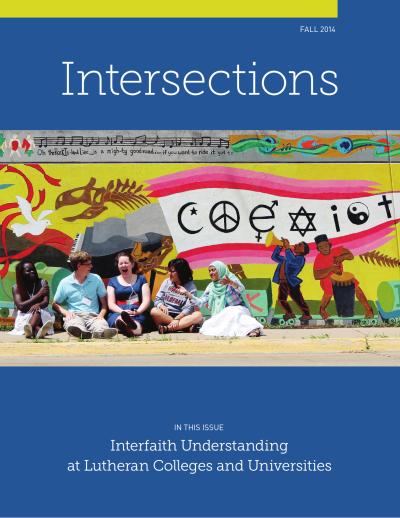
Glass Perez and Priggie introduce the issue by recounting the campus conversations and the June 2014 Interfaith Understanding Conference at Augustana College that gave rise to it, framing the central question, “What does it mean to be Interfaith at a Lutheran College?,” as a living example of the praxis of being a Lutheran college in the twenty-first century.
-
 Book Review
Unconventional Wisdom and Talking about God: A Review of Beckstrom’s Leading Lutheran Higher Education in a Secular Age
Ann Rosendale
No. 53 · Spring 2021
Rosendale reviews Brian Beckstrom’s Leading Lutheran Higher Education in a Secular Age, recommending its diagnosis of the gap between espoused and perceived Lutheran identity at ELCA schools and its prescription—Trinitarian Missiological Ecclesiology and a campus-wide willingness to talk explicitly about God.
-
 Editorial
From the Publisher
Mark Wilhelm
No. 33 · Spring 2011
Wilhelm notes that while the ELCA’s vocation in higher education remains vibrant, the landscape of churchwide leadership has shifted dramatically with the dissolution of the Vocation and Education unit, and expresses appreciation for the faculty and staff at ELCA colleges and universities who have stepped up to sustain the network during this time of transition.