As someone who grew up on an Iowan farm, I find the idea of travel by subway rather intimidating. Will I get on the right train? Will I be able to navigate the chaos of Grand Central Station? Will I find my way back home?
In reality, subways provide opportunities to (quite literally) bump into people of diverse cultures and beliefs. Travel stretches us out of our comfort zones and connects us with new communities.
Rebecca Diamond, a 2015 graduate of Muhlenberg College and a member of our Interfaith Leadership Council, designed this subway map as an image for interfaith engagement here. To a blank map of the Montreal subway system, she added the various religious and spiritual communities of our student body. The map is a powerful image for interfaith engagement. Students often begin at one point, perhaps identifying strongly as Roman Catholic or atheist. Other students start at one of the unnamed stations, which we could label “questioning” or “exploring.”
While many students feel most at home at one point on the map, diverse college environments invite students to “jump on a train” and learn about another point. Lutherans attend Shabbat dinner with their Jewish friends. Muslims celebrate Holi with Hindu classmates. An atheist talks with a Catholic about social justice. Many travel back to their home base communities, of course, to be nurtured in their religious (or non-religious) practices and beliefs. But once given the opportunity to learn about a peer’s tradition, one’s worldviews has been stretched.
Interfaith encounters enable students to articulate—often for the first time—what they believe and don’t believe. Conversations with new neighbors often lead to a discovery of common ground. But lingering for more than a few minutes at a new subway stop inevitably leads to points of theological disagreement as well. Interfaith dialogue should not only be kumbaya circles of commonality. It should provide sanctuaries for civil discourse and, at times, respectful disagreement.
Consider the major intersections in the subway map. Where are these intersections on your campus? Muhlenberg students are especially eager to explore the intersections of religion and science, spirituality and the environment, faith and mental health. These topics invite students of any or no religious belief to participate in deep conversation. These intersections also invite collaboration between academic departments and co-curricular partners to co-sponsor speakers, panel conversations, film screenings, and art exhibits.
I invite you and your students to draw an interfaith engagement map for your campus. Where do students call “home” on the map? What intersections and partnerships would you like to explore? The train is about to leave the station. Will you get on board?
-
 Editorial
From the Publisher and Editor
Jason A. Mahn, Mark Wilhelm
Writing weeks after the 2016 presidential election, Wilhelm and Mahn frame interfaith engagement as the urgent and ongoing work of ELCA colleges and universities, recap NECU’s growing commitments to inter-religious leadership, and introduce essays first delivered at the summer 2016 Vocation of a Lutheran College Conference under the theme “Preparing Global Leaders for a Religiously Diverse Society.”
-
Article
Laboratories for Living in a Diverse World
Elizabeth Eaton
Presiding Bishop Elizabeth Eaton argues that ELCA colleges and universities are called to be laboratories for living in a religiously diverse world. Reflecting on the decline of Christian privilege, the ELCA’s ecumenical and inter-religious work, and her own experience addressing the Islamic Society of North America, she offers three questions about partnerships, formation, and institutions as platforms for new collaborations.
-
Article
Why Interfaith Work is Not a Luxury: Lutherans as Neighboring Neighbors
Martha E. Stortz
Stortz argues that interfaith work is not a luxury but a constitutive commitment of Lutheran higher education — institutions she describes as both “faith-based and interfaith-dependent.” Reading the parable of the Good Samaritan as both an intra-faith and inter-faith encounter, she offers a four-fold matrix of theological reflection, spiritual engagement, social action, and everyday experience as portals into the work of being neighbor.
-
Article
The Promise and Peril of the Interfaith Classroom
Matthew Maruggi
Maruggi draws on his years teaching in the Augsburg religion department to identify three pairs of seeming opposites — dialogue and debate, safety and risk, commonality and particularity — that, held in creative tension, nurture a vibrant interfaith classroom where pluralism is actively engaged rather than merely present.
-
Article
Religious Diversity and the Vocation of a Lutheran College
Darrell Jodock
Jodock argues that a college which takes its Lutheran values seriously is well positioned to foster inter-religious relations along a “third path” that is both religiously rooted and inclusive. He traces the relational and communal character of Lutheran theology, develops a Lutheran understanding of deeper freedom, the theology of limits, and human complexity, and shows how a down-to-earth image of God offers theological resources for overcoming the anxiety and fear that block interfaith engagement.
-
Article
Risky Speech–Gifted Friendships
Sonja Hagander
Augsburg College Pastor Sonja Hagander reflects on pastoral care across faith traditions — from a campus chapel service after the 2008 murder of Muslim student Achmednur Ali, to her decade-long friendship with Jewish colleague Barbara Lehmann — and reads the Gospel of John as a roadmap for interfaith friendships marked by love, free speech, public space, and a willingness to risk being changed.
-
Article
Negotiating Legitimate and Conflicting Values
Eboo Patel, Katie Bringman Baxter, Mark S. Hanson
In a closing-day conversation at the 2016 Vocation of a Lutheran College Conference, Mark Hanson and Eboo Patel — moderated by Katie Bringman Baxter of Interfaith Youth Core — share case studies in which legitimate religious values come into tension with one another, and make the case that Lutheran colleges should teach interfaith leadership through the hard cases rather than the easy ones.
-
Institutional Focus
Interfaith Campus Organizing at California Lutheran University
Allison Bermann, Mehak Sachdev
California Lutheran University students Allison Bermann and Mehak Sachdev describe how interfaith participation at CLU grew from a grassroots movement into a sustained, integrated part of campus identity — with an intern program, Interfaith Allies, co-curricular events from Diwali dinners to Hunger Banquets, and a classroom practice of storytelling that opens the required Introduction to Christianity course to students of every faith and none.
-
 Article
On Recruiting Diverse Students, Rooted in Mission
Eric Rowell, Jason A. Mahn
No. 59 · Spring 2024
Jason Mahn interviews Eric Rowell, Assistant Director of Admissions and Diversity Outreach at Augustana College, about how recruiting students from a wide variety of backgrounds — rooted in Augustana’s Lutheran commitment to vocation and educating across difference — remains essentially unchanged in the wake of the Supreme Court’s 2023 decisions on affirmative action.
-
 Editorial
From the Publisher
Lamont Anthony Wells
No. 61 · Spring 2025
5 min audio
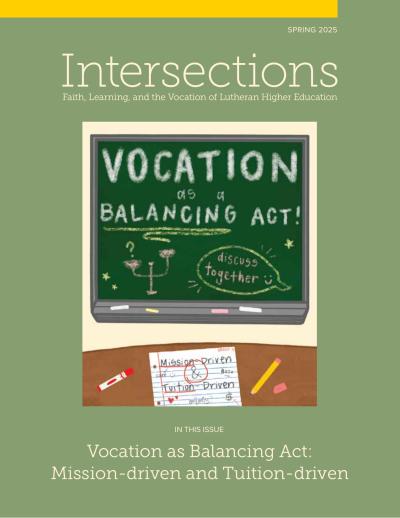
Wells introduces So That All May Belong: Lutheran Roots for Diversity, Equity, Inclusion, and Justice as a theological and institutional articulation of NECU’s commitments, and previews four accompanying essays that frame vocation as a societal responsibility rooted in justice and not solely an individual pursuit.
-
 Article
The Diversity Dilemma: Dealing With Difference
Kathy Fritz
No. 8 · Winter 2000
Fritz reports from Newberry College—83% Caucasian, 16% African-American, 22% Lutheran, the smallest college in NCAA football—on a 1998–1999 year of crisis in which the Board of Trustees Executive Committee asked the president to resign over financial issues, the president fired three vice presidents, four trustees including the chair and treasurer resigned, and the controversial “veterinary technology” major became a flashpoint between the president’s recruitment-driven vision and the faculty’s commitment to “preparation for LIFE.” Turning to ethnic diversity, she frames three sociological approaches—“feed them all” to reduce conflict, the “3 A’s” (academics, athletics, arts) to create common identity, and Aguirre and Turner’s case for “weak ethnic identification” against the post-Yugoslavia failures of strong pluralism—and grounds the search for institutional unity in St. Paul’s body-of-Christ imagery from 1 Corinthians 12 and Ernest Simmons’s claim that diversity yields “creative adaptations that assist mutual survival.”
-
 Reflection
David Kamins
David Kamins
No. 40 · Fall 2014
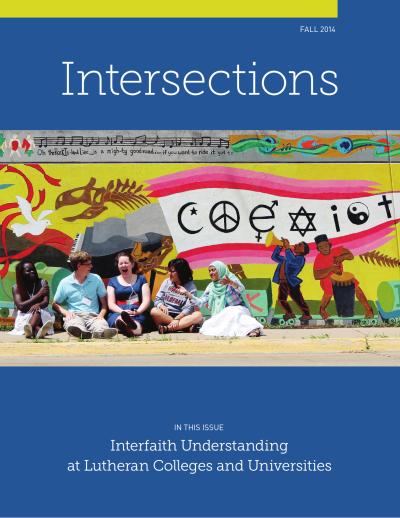
Kamins, a Jewish student at Muhlenberg College, reads Rabbi Joseph Soloveitchik’s The Lonely Man of Faith alongside his own journey at the Interfaith Understanding conference on the eve of Shavuot, finding in the dual figures of Adam I and Adam II a way to remain firmly grounded in his faith community while going out to learn from those around him.
-
 Institutional Focus
Building a Developmental Framework for Vocational Reflection at Thiel College
Brian Riddle, Greg Q. Butcher, Liza Anne Schaef
No. 55 · Spring 2022
Riddle, Schaef, and Butcher describe how a NetVUE Program Development Grant enabled Thiel College to build “the Tomcat Way” — a four-year developmental framework with personal, social, academic, and professional domains and four phases (Explore, Envision, Belong and Lead, Launch) — that now guides every aspect of the student experience.
-
 Editorial
From the Editor
Robert D. Haak
No. 33 · Spring 2011
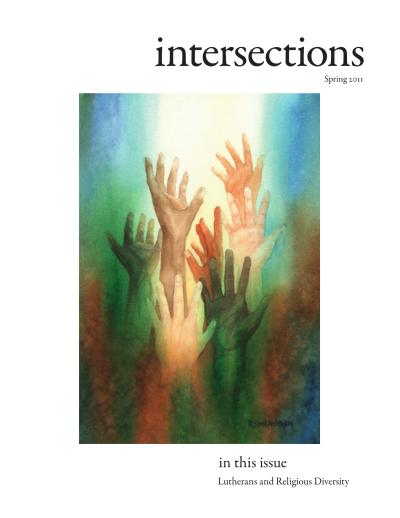
Haak frames the issue by asking how Lutheran colleges and universities understand the changing landscape of religious identification on their campuses, and argues that Lutheran theological commitments — including the work of the Spirit and the Incarnation — call institutions to create places where the voice of “the other” is heard and valued.