The Lilly Endowment has in recent years invested significantly in church-related colleges and universities in order to strengthen vocational discernment and church ministry throughout the country. Nine colleges affiliated with the Lutheran church received Lilly grants. Luther College, Decorah, IA, Augsburg College, Minneapolis, MN, and Augustana College, Rock Island, IL were three colleges of the Evangelical Lutheran Church in America (ELCA) of the more than 80 colleges across the country who received Lilly Endowment support. Each college has developed its own distinctive programs and structures to help students discern and commit themselves to their vocational callings.
In June 2004, key leaders of all the ELCA colleges that received Lilly grants gathered at Luther Seminary, St. Paul to discuss the strategic significance of these grants for Lutheran higher education and to explore their wider relationships to the church. This meeting also focused on the feasibility of conducting a demonstration project to rigorously study the effectiveness of vocation programs in collaboration with Luther Seminary’s Centered Life project and Wilder Research, St. Paul, MN. The Centered Life initiative is a multi-year project located at Luther Seminary’s Center for Lifelong Learning that seeks to strengthen the capacity of churches to inspire, equip, and send church members into their work, family, and community life in a way that is centered in their faith and their values.
This 2004 meeting concluded with the decision to propose a three college project to the Lilly Endowment in which the assessment and skill-building tools developed as part of the Centered Life project would be adapted and expanded for used on college campuses to assess vocation program effectiveness. Luther College was selected to serve as the lead institution and project administrator. Wilder Research was selected as the collaborating partner for research design and implementation.
Specifically, the Called for Life project undertook a rigorous examination of the tools, resources, programs, and structures at each of the three partnering colleges (Luther, Augsburg, Augustana) to answer the following questions:
- Have campuses increased students’ exposure to and knowledge of calling and vocation?
- Has exposure to campus programs increased students’ understanding of call and vocation?
- Are students who have been exposed to these programs more likely to report that they have identified vocations, callings, or plans for incorporating their faith and their values into their post college lives?
- What program elements appear to have the most promise of making a difference in students’ discernment of callings and preparation for vocations?
In September 2005 the Lilly Endowment awarded a 3-year grant of $278,437 for an impact assessment of vocational exploration programs and thus the Called for Life initiative was begun. Our collaboration on the Called for Life project has solidified our commitment to continuing vocational discernment on our campuses, strengthened our inter-institutional connections, and affirmed that cooperation and trust can be fostered in ways we never thought possible. We have also demonstrated the efficacy of using survey methods to evaluate and strengthen programs, but most importantly we have affirmed the value of the investment made by the Lilly Endowment to engage college students in the consideration of how their talents and gifts can be applied to respond to the needs of the world for the common good. The results of the Called for Life project are highlighted in the following pages.
-
 Editorial
From the Publisher
Mark Wilhelm
Wilhelm traces his decades-long enthusiasm for the Lutheran doctrine of vocation from his St. Olaf days reading Luther’s Open Letter to the German Nobility, notes Parker Palmer’s lecture-circuit ministry and Mark C. Taylor’s reflections on calling, and argues that ELCA colleges should claim vocation as the defining mark of Lutheran higher education—yet warns that vocation risks becoming “the program du jour” rather than a permanent hallmark.
-
Article
Called for Life
Brian Pittman, Ellen Shelton, Greg Owen
Owen, Shelton, and Pittman of Wilder Research present the key findings of the Called for Life study, comparing the class of 2007 “Lilly graduates” from Luther, Augsburg, and Augustana to a pre-Lilly cohort from the class of 2001. They report that Lilly graduates were more than twice as likely to associate vocation with “calling” rather than “just a job,” and they identify four common ingredients of effective programming: relationships with caring adults, experiential learning outside the classroom, vocation-infused courses, and peer relationships within a pervasive campus culture of vocational exploration.
-
Article
A College with a Calling: Vocation at Augsburg
Mark D. Tranvik
Tranvik narrates Augsburg’s decade of deep engagement with vocation—from President William Frame’s 1997 visioning process and the 2002 two-million-dollar Lilly grant for Exploring Our Gifts, through five Lutheran theological principles (vocation includes the whole life, lives for the sake of others, ranks all callings equal, cannot be reduced to ethics, and engages public life), to the Wilder Foundation’s Called for Life assessment and the 2008 founding of the Augsburg Center for Faith and Learning under Dr. Tom Morgan and the Bernhard Christensen Chair held by Dr. David Tiede.
-
Article
Sense of Vocation
Ruth R. Kath
Kath describes Luther College’s Sense of Vocation program, organized into three components: General Program Initiatives (Vocation Visitors such as Parker Palmer, the Faith and Learning Workshop, self-directed reading grants, publications, and travel funds), the Church Ministry Program (Vocation Fellowships, the DIAKONOS discernment group, seminary visits, alumni discernment retreats, church leader workshops, clergy renewal, and the WIYLDE youth initiative), and the All-Student Vocation Program (Paideia I orientation, Peer Mentors, Capstone curriculum development grants, the Vocation Advising Workshop, and a Vocation Advising Handbook).
-
Article
Called to Serve
Robert D. Haak
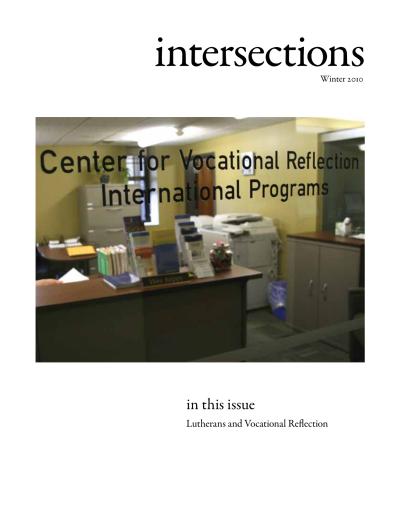
Haak describes Augustana’s Center for Vocational Reflection (CVR) and its threefold framework of skills/gifts/talents, passions/values, and needs of the community. He surveys the CVR’s Working with Faith group, seminary visits, spiritual companioning, Servant Leader Internships, international travel reflection, and the major Senior Inquiry curriculum revision—then reports the lessons learned at Augustana: that multiple exposures matter more than any single program, that the language of vocation works even for non-religious students, that student-initiated ideas (like Erin Blecha’s Athletes Giving Back) often succeed most, and that the CVR will soon merge into a new Community Engagement Center.
-
 Editorial
From the Publisher: Navigating Affirmative Action, DEI Policies, and Lutheran Vocational Identity
Lamont Anthony Wells
No. 59 · Spring 2024
Wells surveys the converging pressures on NECU institutions — the unsettled landscape of affirmative action, political and academic scrutiny of DEI work, and the preservation of distinctively Lutheran vocational identity — and previews how the issue draws on affirmative practices, sociological viewpoints, and theological responses to navigate a path forward.
-
 Institutional Focus
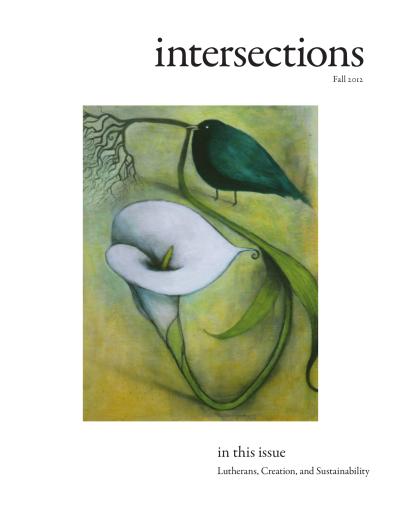
Facing Tornados and Climate Change: An Interview with Jim Dontje about Environmental Innovation at Gustavus
Jim Dontje
No. 36 · Fall 2012
Dontje, director of the Johnson Center for Environmental Innovation at Gustavus Adolphus College, describes the Center’s work with solar thermal and photovoltaic systems, LEED certification of Beck Hall, recycling and conservation initiatives, the Linnaeus Arboretum, and the difficult work of building consensus around climate response—reflecting on how Gustavus’s 1998 tornado recovery shaped a community capable of collective action, and on how the “Lutheran identity” both restrains and energizes the college’s environmental ethos.
-
 Reflection
Some Personal Reflections on the ELCA Vocation of a Lutheran College Conference, 1998
Jennifer Sacher Wiley
No. 7 · Summer 1999
Sacher Wiley, a Unitarian Universalist with one Jewish parent and a first-year music faculty member at Susquehanna, reflects on common-ness and other-ness at the 1998 conference—Tom Christenson’s weaver’s warp and Charles Ives’s essay on American music—and proposes four markers of group identity. Against the fear of secularization expressed by some attendees, she suggests that “Christian” might be defined less by belief in Christ as Savior than by living a vocation as Jesus lived, with Cheryl Ney offered as an example of a “working prophet,” or “little Christ,” regardless of specific belief in the Trinity.
-
 Article
Lutheran Higher Education in the Land of Anxiety
Jon Micheels Leiseth
No. 47 · Spring 2018
Leiseth, returning to Concordia from work with the ELCA’s Young Adults in Global Mission in Southern Africa, draws on Bessel van der Kolk and Babette Rothschild to argue that pervasive student anxiety functions as low-grade trauma that hijacks the storytelling at the heart of vocational discernment — and explores embodied, breath-based practices that might help students reclaim their stories.
-
 Editorial
From the Editor
Tom Christenson
No. 17 · Summer 2003
Christenson introduces the four essays by participants in the first Lutheran Academy of Scholars as fruit of the “genuine conversation” that emerges when specialists set aside their lecturers’ podiums to speak as human beings, and welcomes the issue’s additional “Intersections first”—a response to a response to a review—continuing the conversation between Baird Tipson and Robert Benne about the paradigm of Lutheran higher education.
-
Article
Called to Compassion over the Course of a Life: A Buddhist Perspective
Florence D. Amamoto
No. 47 · Spring 2018
Amamoto, an associate professor at Gustavus Adolphus shaped by Jodo Shin Shu Buddhism, argues that although Buddhism has no “caller” God, it has a strong sense of calling — we are called by the world to respond to the suffering around us with mindfulness, egolessness, and compassion — and that this lifelong journey is enriched by encounter with the Lutheran vocational tradition.