Pivoting to Imaginative Programming in the Midst of the Pandemic at Bethany College
Intersections No. 55 · Spring 2022
Thanks to generous funding from the Council of Independent Colleges and the Lilly Foundation, Bethany College was fortunate enough to receive a two-year, $50,000 NetVUE Program Development Grant in the Spring of 2019. Despite some radical changes due to the COVID-19 pandemic, the grant programming at Bethany College was a success. Indeed, the pandemic encouraged us to be more imaginative and global in envisioning the work of the grant and the vocational goals of our students. The initial grant proposal involved leading four service learning and social responsibility trips each year, for a total of eight over two years. These trips were designed to extend learning from the classroom out to local sites and organizations. Our pilot trip, for example, involved taking several students from a Women’s and Gender Studies course to a local homeless shelter where they hosted a Christmas party for the families there. It exposed our students to the realities of the intersectionality of poverty, displaying how the brunt of poverty often falls on women and children. As was the plan, this experience led to several student-led projects, such as one student’s development of a garden whose produce was then donated to a local food bank.
The first year of the grant was quite generative, with frequent meetings, development of curricular resources, and the great success of several initial trips and projects. Yet, it was cut short in March 2020, right before three additional trips were scheduled to take place. Like many, we were bewildered at the forced changes and the speed with which they gripped our lives and the lives of our students and community. It sometimes felt like we returned to the virtual drawing board in the Fall of 2020, and with limited personal resources. Yet, conferring with NetVUE leaders and other grant recipients in the Summer of 2020 gave us hope and additional ideas. We moved our team meetings to the grant director’s backyard, and we transitioned from a format of trips out to visit local organizations to one of speakers coming from all over the nation and globe to join our classes virtually.
Several trips were reformatted and executed in new and exciting ways. For example, students from Interdisciplinary Communication classes were originally scheduled to observe the Kansas House of Representatives in Topeka, Kansas and provide them with (invited) feedback regarding their use of civil discourse, ultimately offering strategies for public deliberation based on their classroom learning. Instead, a local political candidate running for the U.S. House, representing the Kansas First Congressional District, spoke about her own vocational journey as she transitioned from grade school teaching to politics. The change in timing (from March to October) meant that the class and other community members were able to gain important insights about political campaigns and the importance of voting and engagement with local politics.
As another example, Developmental Psychology students were originally scheduled to visit a Heartland (Headstart) preschool class in Salina to practice social and emotional learning strategies through the use of self-regulation tool kits and toys. Instead of using the kits with the students, a teacher from the program spoke with Bethany students about using these types of sensory bottles to help kids self-regulate their emotions. The Bethany students then made sensory bottles, observed their own play with them, and then donated them to the school. Knowing the value of the sensory bottles and conscious discipline practices made the students more eager to work with children in emotionally healthy ways. They were excited to know that the sensory bottles—something they made—would be donated and used by children in the Heartland program.
In several instances, when we sought out guest speakers for our classes, we learned that our community and extended networks offer a deep pool of stories that can significantly shape how students envision what is possible. For example, in a playwriting class, a college alum who is now a critically acclaimed playwright in New York City was able to Zoom in to talk with students about how her own experiences with race, religion, and power dynamics in small town Kansas shape the plays she writes. In another instance, a student who had participated in our earlier pilot trip to the homeless shelter returned to a peer ministry course to speak about his experiences as an AmeriCorps VISTA volunteer with a local organization that fights poverty through building mentor relationships. Students responded well to the close connections of these speakers. Suddenly, what seemed impersonal or impossible regarding their own vocations seemed within reach. While a student might learn about poverty and think generally about the value of volunteering when interacting with an expert, it is wholly different to hear from a current student or recent alum who actively works with a local poverty reduction organization and explains volunteer opportunities that might fit a student schedule based on firsthand experience. Our community learned an excellent lesson regarding how rich, varied, and global we are already, even in central Kansas. The structure of the grant encouraged students to take the opportunity to follow up with guest speakers or their suggestions. Following the speaker’s visit, several students arranged job shadowing experiences or began volunteering at similar organizations.
“Suddenly, what seemed impersonal or impossible regarding their own vocations seemed within reach.”
Trips out to local organizations are excellent opportunities, of course, but they can also require a lot of time and money to plan and to execute. Students’ lives are increasingly busy as they juggle classes, clubs, sports, and jobs. Trips like these are also impossible during lockdown periods. But bringing in guest speakers can be a relatively easy alternative that can still open new worlds to students. With our original plan, we had a goal of including around 100 students in these trips. The shift to guest speakers meant that three times as many students were able to participate, potentially hearing the call of the needs of the world in ways that inspire their own vocational reflection. I would encourage fellow instructors to think about incorporating guest speakers into their classes, and particularly those that come from your own communities. Consider the types of stories you might want to hear about the various topics the class addresses. Then, look to your own networks and think creatively about the people who are in your larger networks and the talents and pools of knowledge they possess. You might imagine what types of students at your institution might particularly benefit from hearing their story. If our experience is an indicator, you will be surprised at the ways students respond when they glimpse new vocational possibilities and are encouraged to follow up on their interests.
-
 Editorial
From the Publisher
Mark Wilhelm
Wilhelm announces his planned retirement on January 31, 2023, after serving as the founding executive director of the Network of ELCA Colleges and Universities, and gives thanks for the privilege of helping NECU articulate a shared vision for Lutheran higher education in twenty-first-century North America.
-
Editorial
From the Outgoing Editor
Jason A. Mahn
Mahn closes out a decade of editing Intersections, passes the duties to Colleen Windham-Hughes, gives thanks to Mark Wilhelm and Augustana College, and introduces an issue largely drawn from comments by Lutheran faculty, staff, and administrators at the 2022 NetVUE national gathering.
-
Editorial
From the Incoming Editor
Colleen Windham-Hughes
Windham-Hughes introduces herself as incoming editor by reclaiming the root of assess — “to sit by” — and committing to the question “What does this mean?” as she sits with readers in the worth of our work and the universality of vocation.
-
Institutional Focus
Building a Developmental Framework for Vocational Reflection at Thiel College
Brian Riddle, Greg Q. Butcher, Liza Anne Schaef
Riddle, Schaef, and Butcher describe how a NetVUE Program Development Grant enabled Thiel College to build “the Tomcat Way” — a four-year developmental framework with personal, social, academic, and professional domains and four phases (Explore, Envision, Belong and Lead, Launch) — that now guides every aspect of the student experience.
-
Article
Assessing Self-Assessment Instruments at Finlandia University
René Johnson
Johnson surveys three self-assessment instruments presented at the NetVUE conference — PathwayU at Colorado State, the Intercultural Development Inventory at Friends University, and Mark Savickas’s Career Construction Counseling Manual at Union College — and describes Finlandia’s use of the CliftonStrengths© assessment to link students’ personhood to “behaviors that benefit the community.”
-
Institutional Focus
Serving and Building Community at Concordia College
Larry Papenfuss
Papenfuss, director of the Dovre Center for Faith and Learning, frames eight ways Concordia College serves the world by building community — from quality teaching and liberating liberal learning to interfaith cooperation and modeling “diversity with particularity” as a Lutheran “third path” institution.
-
Institutional Focus
Sharing the Gift of Vocation at (and beyond) Augsburg University
Paul C. Pribbenow
Pribbenow, drawing on a 2022 NetVUE panel with Dorothy Bass and Jodi Porter, considers how the gift of vocation forged with undergraduates can be extended — beyond undergraduate campuses to graduate students, faculty, and staff; across the vocational lifespan from high schoolers to alumni navigating the “gig economy”; and into accompaniment of faith communities through Augsburg’s Riverside Innovation Hub.
-
Book Review
Assessing the Value of Liberal Arts: A Review of The Evidence Liberal Arts Needs, by Richard A. Detweiler
Robert D. Haak
Haak reviews Richard A. Detweiler’s The Evidence Liberal Arts Needs, in which the former president of the Great Lakes Colleges Association analyzes 240 college mission statements and interviews more than 1,000 graduates to argue that liberal arts educational experiences have a measurable impact on adult lives of consequence, inquiry, and accomplishment — and invites NECU institutions into a further conversation about how Detweiler’s methodology applies to Lutheran higher education.
-
 Editorial
From the Publisher
Arne Selbyg
No. 10 · Fall 2000
Selbyg explains that, while Intersections usually publishes papers from the annual Vocation of a Lutheran College conferences, this issue gathers presentations from a St. Olaf 125th-anniversary conference—a companion to the volume Called to Serve edited by Pamela Schwandt—because the theology and educational perspectives behind them apply to any Lutheran college and clarify what makes ELCA church-related colleges excellent institutions for students of any faith.
-
 Article
Semper Reformanda: Lutheran Higher Education in the Anthropocene
Ernest L. Simmons
No. 43 · Spring 2016
Simmons enumerates the ELCA initiatives over the past twenty years that have helped Lutheran higher education retrieve a Christian understanding of vocation, then argues that the looming reality of human-caused climate change — the geological epoch of the Anthropocene — now requires Lutheran liberal arts education to prepare students for “planetary citizenship” as sustainability leaders, drawing on the classical Trivium, Luther’s panentheism, and a quantum-physics-inflected theology of divine entanglement and hope.
-
 Article
Activism, Justice, and the Danger of Silence
Dezi Gillon
No. 52 · Fall 2020
In conversation with Jason Mahn, Augustana College alumnux Dezi Gillon traces the call to action they felt as a Black student organizing for Black Lives Matter on a predominately white campus — through seminary, art, spirituality, and restorative justice work — and warns white professors that staying silent “actually speaks volumes.”
-
 Article
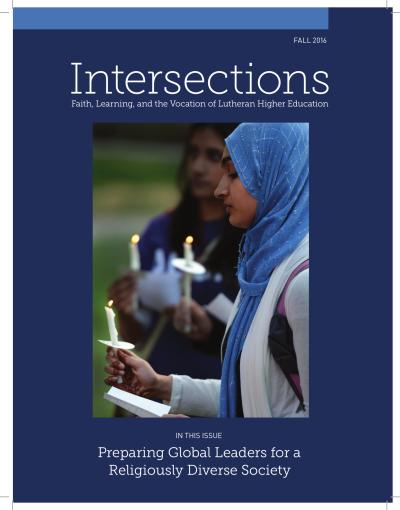
The Promise and Peril of the Interfaith Classroom
Matthew Maruggi
No. 44 · Fall 2016
Maruggi draws on his years teaching in the Augsburg religion department to identify three pairs of seeming opposites — dialogue and debate, safety and risk, commonality and particularity — that, held in creative tension, nurture a vibrant interfaith classroom where pluralism is actively engaged rather than merely present.
-
 Editorial
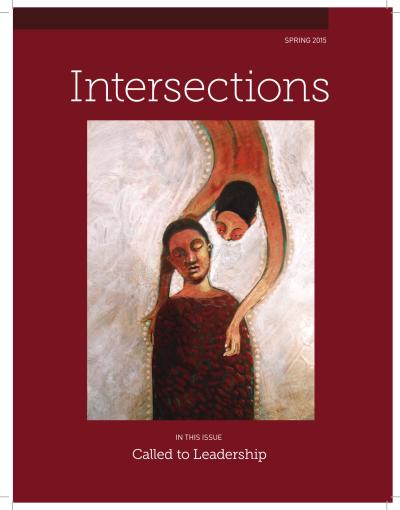
From the Publisher
Mark Wilhelm
No. 41 · Spring 2015
Wilhelm celebrates the leadership of ELCA colleges and universities within American higher education — from presidential service in major higher-education agencies to recognized leadership in global education and interfaith understanding — and lifts up the health of the ELCA network of schools as a church-related community that maintains shared identity while living as good citizens of the larger academy.
-
 Institutional Focus
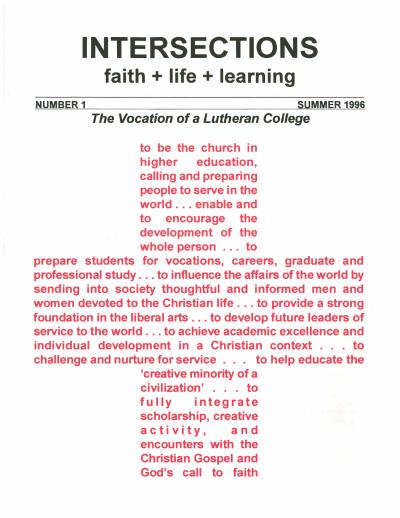
Continuing the Dialogue: Augustana College
Sandra C. Looney
No. 1 · Summer 1996
Looney describes Augustana College, Sioux Falls, debating and renaming its values—Christian, Liberal Arts, Community, Excellence, Service—under the leadership of religion professor Dr. Arthur Olsen and the T’N’T (“Through Thick and Thin”) committee, in the wake of ELCA Region III’s “What Does It Mean to be a College of the Church?” conversations. She describes Augustana’s 56% Lutheran student body, daily 10 a.m. chapel, dual Christmas Vespers in Our Savior’s Lutheran Church and St. Joseph’s Cathedral, the Capstone classes on moral and aesthetic issues, and the ongoing work of enlarging Augustana’s conversation to include Native American, Jewish, and Islamic voices.